At the end of the week, there are plenty of options for unwinding. Being on a bus for seven hours is probably not one of them. But if the bus is headed for La Union during the surf break season, well, that changes things. Any surfer will tell you that the trip is more than worth it. After trying surfing for the first time, even I would have to agree. Despite being very far from athletic (when I say I tried surfing, I mean I got to ride a wave for all of five seconds - after drinking around a liter of saltwater, turning black and blue all over, and becoming an expert at tumbling off the board) I can see how easy it is to fall in love with surfing. Based on an outsider's idea of surfing, it seems obviously appealing. After all, it looks so smooth and laid-back, and let's face it, when you say "surfer," you can't help but think "cool." Of course, this is based on the flawless photos we see of surfers gliding on unbelievably large waves, or carrying their boards, arms raised to expose their perfectly-toned bodies. And don't forget the distant gaze, squinting at the sun, and the tanned skin.

This is what it looks like when you know what you're doing.
But like any other sport, what looks effortless is the result of plenty of practice - and before getting to the point where anyone would care to photograph you while surfing, you go through the painful beginnings of Surf 101. But don't worry. All you need are your board shorts, rash guard, sunblock, and a patient instructor. Oh, and you need to be ready to go with the flow. Cliche as it may sound, there just isn't anything else you can do. The thing about water sports is, you can only do so much. A big part of it is just surrendering to nature, and in this case it means rolling with the punches and accepting the fact that the sound of waves crashing on the shore is only soothing when you aren't in the water. Especially during the surfing season, when it feels like the waves are really out to get you.
Don't look at the wave TALKING 'STACHE Musician and surfer Donavon Frankenreiter shares some thoughts about his iconic mustache.

Does the 'stache have a name? "My kids call it the Magic Mustache because when they are hurt or have a booboo, I kiss it and I tell them that the Magic Mustache will make the pain go away. One time I shaved it and they cried. They freaked out and were like "what happened to the Magic Mustache? You're not magic anymore." So Magic Mustache is one name for it. Who gives you grief over the 'stache? Everyone does. I get grief all the time about the way I look or the way I smell. There's all different kinds of people... they say a bunch of different stuff. But it's fun and I like it. It's... whatever. What would it take to get you to shave the 'stache? Everyone does. I get grief all the time about the way I look or the way I smell. There's all different kinds of people... they say a bunch of different stuff. But it's fun and I like it. It's... whatever. Really, really? No. I think I will though. I don't know I think I look a lot younger without the mustache and I'm thinking of hitting a younger market with my new album. What advice do you have for aspiring 'stache growers? Just let it grow. It's gotta be thick. Mine just grows really fast. Text and photo by Karla Gozun Saturday night on the beach was deceptively calm. People walked around barefoot, enjoying the warm sand as Donavon Frankenreiter performed on a small stage. "We could drift all night untill the new sun rise... Pass me a drink or maybe two... One for me and one for you," goes his hit song "Free," and it made perfect sense for everyone to sing along. The set ended when the 37-year-old musician announced they would be calling it a night. "I hear there are some really great waves here," he told the audience, who kept him around for a while longer to sign some autographs. While some people hung around, drinking beer, and eating street food from the beach stalls, a good number disappeared to get some much-needed rest. The surfer-musician was in town to open the surfing season at Sanuk Opening Act, a two-day music and surfing event held at the San Juan Surf Resort last weekend. On Sunday morning, the sky was clear and eager surfers headed out with the sunrise. I watched nervously from afar, wincing in anticipation of all the falling I was going to do in a few hours. Before I knew it, I found myself standing by a gigantic surfboard (for beginners, the bigger, the better) listening to the instructor as he demonstrated how to lie on the board. Sure, I could do that, I thought as he lay prone on the board. And then he showed us how to stand, and how to bend our knees to balance on the board. "Madali lang, basta tumingin ka lang sa harap. Huwag mong titingnan yung wave, derecho lang dapat. Para ka lang tumatawid sa alambre!" he told us. So it's as easy as walking on a tightrope. Great. Except I've never tried that, either, I thought.
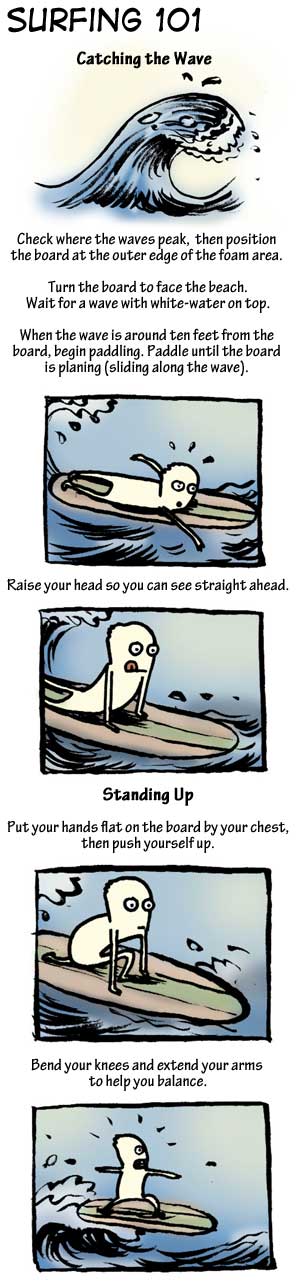
Illustration by Manix Abrera
But it was too late. It was time to practice. Lie down. Paddle. Paddle. Get up. Again. After what seemed like way too short a time, I found myself following my instructor as he pulled the board into the water. "Basta kapag sinabi ko, ready, ready. Tapos paddle, paddle. Tapos kapag sinabi kong tayo, tayo agad, okay?" he said, and I nodded. In my mind, I was saying no way, but I knew it was now or never. For quite some time, it seemed like it would be never. Over and over we waited for a wave. The instructor would shout, "Ready!" And I would squint at the shore, hoping that no one was documenting this exercise in embarrassment. Then he would tell me to paddle, which I could do just fine. And then he would shout at me to stand, and for some reason, it wouldn't happen. Sometimes my legs just wouldn't move, and sometimes they would get tangled in the leash that kept me tied to the board. "Ano'ng nangyari," my instructor would ask me repeatedly, and I would try to come up with an answer while wondering if it was okay to swallow so much saltwater. At some point in between failing to ride the waves, I realized that this was probably more frustrating for the instructor than it was for me. In between falling and laughing, I learned that his name was Ron and he had been surfing regularly since he learned the sport ten years ago. He didn't have any formal lessons, but being related to San Juan Surf Resort's Luke Landrigan, it isn't surprising he eventually became an instructor. Before the hour was up, I finally got to stand on the board. I managed to stay on for about five seconds - but it felt like much longer.
Riding the waves Surfing (even semi-surfing for five seconds) is beyond description. The only previous experience I can compare it with is sliding on the floor with your socks on, which is pretty awesome, but obviously it's very different. Surfing is like flying on water. Or floating on water. No, that isn't right either. I could try to explain it, but I'll have to cop out and say there's no substitute for the actual experience. "You can do it through photos, or you can do it through videos. But the best way is if someone experiences going to the beach and having someone teach them how to surf. It's the most amazing thing," says Donavon when I ask him to tell me what it's like. "Even just the adventure of just driving down to the beach, I think if you go down to the beach just once and you fall in love with surfing then it sort of sticks with you forever. Then you can go out on the beach a couple of times a year, even if you live in Manila all year long but if you get a couple of times to go down and catch some waves, it's a beautiful thing," he adds. "People will find when they get out and interact with nature, whether it's just surfing or getting out on a trail and hiking, they come back energized and feel good, and surfing can really do that for you," adds Sanuk founder Jeff Kelley, who has been surfing for 40 years.

It was a good day for surfing.
Apart from the travel time, there isn't really much to keep you from trying to surf. Lessons are 400 pesos an hour, including the board rental. And one hour is enough, both to get the hang of balancing, and to leave you with an aching body and bruises for souvenirs. Although there is no formal training in the Philippines for instructors, those at the resort have gone through training with the Philippine National Red Cross. "We're the very first surfing school here, and most of the instructors are really surfers," Landrigan assures me, noting that Filipinos are spoiled in the sense that instructors teach one on one, unlike in other places like Australia, where he worked in a surf school for two weeks. "There they have one instructor for eight students. The instructor never goes in the water, he just has a whistle," he explains. "It's so easy," he adds. "Even if you're not standing up it's still fun. You should just try it. Just come. Try it so you can experience it," he says, adding that surfing is for everyone. "Yung iba akala nila it's a macho thing, that you have to be strong, you have to be malaki, di ba. Pero, if you're bigger, you just need a bigger board, if you're smaller you just need a smaller board," he says.

If you really can't surf, you can just pretend with this wave backdrop.
Landrigan observed that after the movie Blue Crush came out, there was a boom in the local surfing scene. "People realized that chicks can surf," he laughs. "So chicks started surfing. Syempre kung saan yung girls susunod yung boys," he says. Sure enough, there were all sorts of people on the beach that weekend, both professionals and first-timers like myself. But there was no pressure at all, and whether they were riding the waves or rolling under, it was undeniably fun. It's the kind of fun that's difficult to resist, and even those who had no plans of learning to surf eventually decided to give it a try. On the bus back home, bodies sore, sand between our toes and our skin still smelling of salt, we began making plans to go back soon. They were right. Surfing is incredible, and you fall in love with it. -
YA, GMA News 

 GMA Brandtalk
 Tracking
 Archives


