We use cookies to ensure you get the best browsing experience. By continued use, you agree to our privacy policy and accept our use of such cookies. For further information, click FIND OUT MORE.
Make this your preferred source to get more updates from this publisher on Google.
The author's shot of Brooklyn's Gowanus Canal.
I was at a stylish party in Williamsburg, Brooklyn a few years ago during my early twenties. It was one of those parties in an apartment I’d never be able to afford, filled with designers, performers, start-up entrepreneurs: young American prodigies, all. It was a gathering that saw me shifting from foot to foot, my used, heavy winter coat in one arm, feeling self-conscious with my cheap, salon-school haircut. I wondered whose conversation to join. I spotted a dark-haired dude around my age. Aha! I thought. A fellow Fil-Am! I was suddenly excited. I had exactly zero Fil-Am friends in New York City at the time, and I didn’t know how much I wanted to make a Fil-Am friend until I saw this boy, at this party. “Excuse me,” I said. “Hello. Are you Filipino? I’m Filipina American.” The dude had a good haircut with just the right sweep to his bangs. He was strongly slender, with skinny jeans, and he chose to keep his handsome black peacoat on indoors. He looked like he belonged in this scene. There was one obvious difference between him and everyone else at the party, though; his complexion was deeply brown. Behind his glasses with thick black rims, the boy hesitated before answering me. “Yeah,” he said. His “Yeah” was not a happy affirmation. It was more a chilly introduction to what he was about to say next: “I was hoping to avoid that conversation.” It was the kind of socially awkward moment for which I had no instructions, no experience. Do I apologize for asking? Do I reprimand him? Do I walk away pointedly? Do I wait silently and increase the social awkwardness of the moment? I decided to do that. The dude didn’t say anything more. After another chilly pause, he moved into a different room. We didn’t cross paths at the party, or ever, again. Sitting in Quezon City now, five years later, feeling alternately at home and displaced in the Philippines, I wonder about the questions beneath my original question to the stylish guy at that stylish Brooklyn party: “Are you Filipino?” This is what I would have asked, had he let me: Can we laugh together about growing up here with an immigrant family? Do you ever feel lost for seemingly no reason? Will I start to feel at home with you? Do you like canned meats with ketchup and eggs and rice? Do you want to eat with me? Maybe the dude sensed the weight of my expectation and hope. Or maybe he was tired of dealing with the question—“Are you Filipino?” Maybe he felt that answering in the affirmative would have thrown his belonging at the Brooklyn party into question, would have disturbed the perfect, raceless sweep of his bangs.
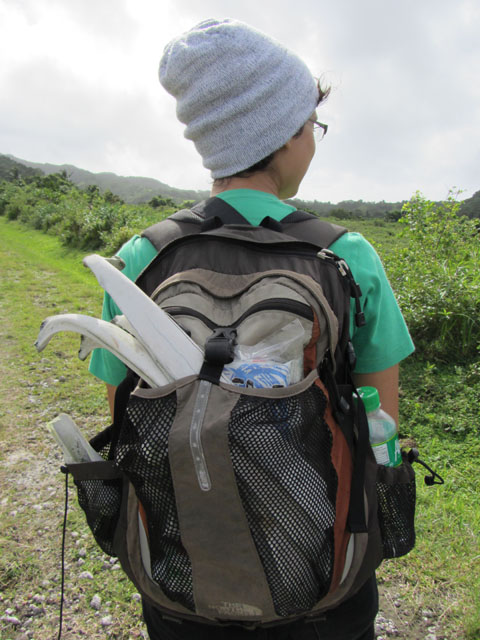
The author carries a backpack in Batanes, containing too many things.
In the intervening years since this moment, I have felt strangely guilty for asking what I thought was a happy question, for asking if he was Filipino before I asked his name. The moment, small as it was, haunts me a little. Non-Filipinos have rarely ever asked me if I’m Filipino. Usually non-Filipinos will say, “Are you . . . ?” The ellipses counting for courtesy, or confusion, or some cocktail of both. Filipinos who ask me—“Are you a Filipina?”—do so with open curiosity. I’ve never sensed any malice in the question. Before they ask, they have assumed, thanks to the post-colonial assumption that less pigment means more wealthy, that I’m rich (I’m not, though with thrifty parents and American scholarships I’ve been luckier than some). Or Filipinos assume I’m a Spaniard (no). Or Italian (yes, on my father’s side). Or a foreign missionary (hindi naman). Sometimes I reply, simply, “Fil-Am ako,” or “Mestiza!” (which always seems to make Filipinos laugh). Sometimes I reply, simply, “Pinay ang nanay ko.” When I’m asked, “Are you a Filipina?” I never answer, simply, “Opo.” I never say, “Pinay ako.” My birth in Southern California, my ethnically ambiguous, pale face, and my disappointingly intermittent commitment to Tagalog tutoring sessions always seem to require an apologetic qualifier. “I’m Fil-Am,” or “I’m mixed,” or “My mom is Filipina.” These, so far, are rotating explanations that feel acceptable to me; asserting my Filipina status more strongly makes me feel like an impostor. I have spent much of my life tangling with what makes someone Filipino. I have wondered if the complicated code to becoming Filipino can be untangled, if by untangling it I can become enough of something, somehow. I have determined so far that I will always be a little tangled, because I exist in a complicated in-between space. Having made an uneasy but ultimately loving relationship with Manila, I will always feel a little dislocated in the States, caught by some longing and belonging to somewhere else that will always be hard to explain at parties. And I will always feel a little dislocated here, still unable to negotiate with cab drivers at night without a native speaker’s help, still fielding questions constantly if I am what my wild dark hair hints that I am. It is strange to me that, should I ever choose to deny the motherland, I could potentially say “No, I’m not Filipina,” and strangers would believe me. I can’t imagine denying the motherland’s role in my formation so entirely; I can’t imagine avoiding the conversation, as the dude in Brooklyn did. I suppose it would be easy for me to scorn his unwillingness to engage with his Filipino heritage in any way, in the bosom of Brooklyn. But I don’t know what the boy at that party endured, when less sympathetic people in his past noticed that he was Filipino. I don’t know if the dude’s denial in Brooklyn was not so much a personal spurning of me as it was a form of self-protection. As much as I ask myself, “How do I become Filipina?” I’m aware of Fil-Ams who, wanting to commit entirely to an American existence, experience the inversion of this desire: “How do I unbecome Filipino?” I remember what the writer Gina Apostol—herself the mother of an Italiapina daughter—said to me once in another borough of New York one evening, at a quieter gathering. “There’s an inevitable richness to being Filipino because you contain too many things. In a sense, we pre-date Michael Jackson; we are the world.” Perhaps the Fil-Am dude didn’t want to contain too many things; perhaps too many things were too heavy for him. Perhaps he didn’t want to be the world. Perhaps he wanted to be one thing; someone who belonged at that party in Brooklyn. Or maybe the dude was always comfortable with what he was. Maybe he had never tangled with the question of his heritage, what he owed to it, or where he belonged. Maybe he didn’t care to start tangling now. Maybe he felt completely free and at home at the party in Brooklyn, in a way I never would. It’s impossible to know now. We spent the rest of the night, and the rest of our lives so far, in completely different rooms. - GMA News


 GMA Brandtalk
 Tracking
 Archives