

 GMA Brandtalk
 Tracking
 Archives

ADVERTISEMENT
Filtered By: Scitech
SciTech
From scourge to savior: Remote-control roaches coming soon
+
Make this your preferred source to get more updates from this publisher on Google.
Cockroaches may soon have a change of image from pesky pest to remote-controlled rescuers, after researchers found a way to remotely steer them.
A team from North Carolina State University used an electronic interface to "control" the roaches, which can then be used to infiltrate and scout around tight spaces.
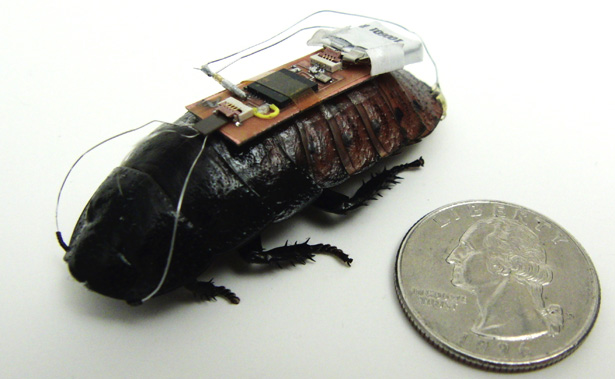
"Ultimately, we think this will allow us to create a mobile web of smart sensors that uses cockroaches to collect and transmit information, such as finding survivors in a building that’s been destroyed by an earthquake," Alper Bozkurt, an assistant professor of electrical engineering at NCSU and co-author of a paper on the work, in an NCSU news release.
Bozkurt previously developed similar interfaces to steer moths, using implanted electronic backpacks.
In this case, he said their aim had been to determine if they could create a wireless biological interface with cockroaches, which have shown an ability to infiltrate small spaces.
He added this would be more practical than building small-scale robots to perform in "uncertain, dynamic conditions."
Also, he said cockroaches are "experts at performing in such a hostile environment.”
The team's paper, “Line Following Terrestrial Insect Biobots,” was presented Aug. 28 at the 34th Annual International Conference of the IEEE Engineering in Medicine & Biology Society in San Diego, California.
Its author was Tahmid Latif, a Ph.D. student at NC State. Bozkurt was a co-author of the study.
Chip on a roach
For its project, the team embedded a cheap and light commercially-available chip with a wireless receiver and transmitter on Madagascar hissing cockroaches.
The backpack, weighing only 0.7 gram, also has circuitry to prevent potential neural damage.
A microcontroller is wired to the roach’s antennae and cerci, sensory organs on the roach’s abdomen.
"(T)he researchers use the wires attached to the cerci to spur the roach into motion. The roach thinks something is sneaking up behind it and moves forward," the NSCU said.
On the other hand, the wires attached to the antennae serve as electronic reins, injecting small charges that trick the roach into thinking that the antennae are in contact with a physical barrier. — TJD, GMA News

