

 GMA Brandtalk
 Tracking
 Archives

ADVERTISEMENT
Filtered By: Lifestyle
Lifestyle
‘Película 2012’ showcases Spanish, Latin American films
+
Make this your preferred source to get more updates from this publisher on Google.

Argentina's “Un Cuento Chino” (A Chinese Tall Tale) is part of the Película 2012 official line-up. Photos courtesy of the Instituto Cervantes de Manila
A wealth of award-winning Spanish-language films will be showcased at “Película 2012,” billed as the biggest and grandest celebration of Spanish and Latin American cinema in the Asia-Pacific region.
The films will be screened from Oct. 4 to 14 in Ayala Greenbelt 3 theaters in Makati City. Basque and Catalan representation
This year, Película 2012 introduces a new and significant ethnic flavor to its lineup, with the inclusion of nine short films in Basque as well as one full-length Basque film, “80 Egunean” (En 80 Dias/In Eighty Days) and one full-length Catalan film, “Pa Negre” (Black Bread).
Spanish Ambassador to the Philippines, Jorge Domecq, said the Basque country government has “an interest” in showing Filipinos films about the Basque Country. “The Philippines is a very good place to show these Basque films,” he said.
“The main community and the majority of the Spaniards and Filipinos with Spanish lineage [now in the Philippines] came from the Basque region. Many of the Spanish names that you have in the Philippines are Basque,” Domecq told reporters.
The inclusion of the films is also part of the Instituto Cervantes de Manila's mandate to promote the four co-official languages of Spain, which includes Basque and Catalan along with Castilian and Galician.
Spanish director Alberto Rodriquez will be present when his film, “Grupo 7,” is premiered on Oct. 8. He is also scheduled to discuss it with the audience after the screening.
The annual “Película,” one of the major highlights of the month-long Spanish Festival for the Culture and the Arts, is organized by the Instituto Cervantes de Manila together with the Spanish Embassy.
Instituto Cervantes de Manila senior cultural officer Jose Maria Fons also said that short film-making by young Spanish directors is “in its peak,” and that the festival “gives much attention to the creativity of these younger film professionals.” 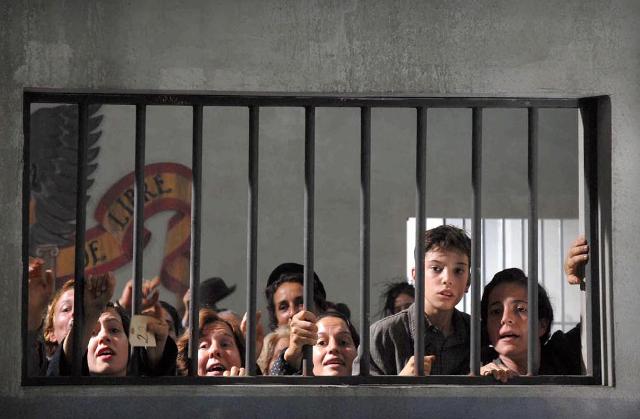
Spain's “Pa Negre” (Black Bread) is in Catalan.
“This is one of the ways to show the cultural diversity of Spain. The Basque region has been very active in producing cinema in the last couple of years,” Fons added.
“Spanish narratives and sensibilities are close to us, Filipinos, as our cultural ties run deep. This connection is no more apparent than in our respective national cinemas. The depth of human experience and the unbridled passion of diverse characters are shared traits of our films," said Film Development Council of the Philippines chairman Briccio Santos at the same press conference.
Cultural exchange
Santos, who is leaving for Spain in November, also said that 23 Filipino films have been sub-titled in Spanish to be shown in Madrid, Barcelona, and three other Spanish cities before going on to be shown in South America as part of the “Philippine cultural diplomacy through films.”
The films comprise the first batch and single biggest bloc of Filipino films to be given foreign language subtitles, Santos said. “We want these films to be a part of our cultural diplomacy. We want our films to tell our stories or to promote our cultural diplomacy,” he added.
The films ill include "Ang Sayaw ng Dalawang Kaliwang Paa," "Ang Damgo ni Eleuteria," "Halaw," "Sigwa," "Imburnal," "Batad," "Itim," "Maynila sa mga Kuko ng Liwanag," "Sister Stella L," "Kisapmata,” "Kakababa Ka Ba," "Emir," "The Red Shoes," "Donsol," "Nono," "Urduja," "Kinatay," "Serafin Geronimo: Ang Kriminal ng Baryo Concepcion," and "Zamboanga." The move is perhaps in response to a statement made by Domecq last year: “We hope that soon the Philippines will take its movies to our country, whose audience is wishing to see the works of Filipino filmmakers."
At the recent press conference, Domecq said Spanish and Filipino officials are already working on the Film Cultural Exchange Program as well as “a possible Filipino Film Series to be shown in Spain in 2013.” Art thrives in times of crises
Asked if the roster of films for Película 2012 reflects the socio-political and economic difficulties in Europe, Fons said the films selected “are a bit darker generally ... and the animation is not for kids.”
One of them is “Arrugas” (“Wrinkles”), about how old people in a home cope with Alzheimer’s and how they support each other to avoid becoming terminal cases.
Santos said at least 25 percent of the animation for “Arrugas” was executed by Filipino animation experts.
Domecq added, “Normally in Spanish history and also in European history, the best artistic works and productions had been done in the period of crises.”
“People think harder in times of crises, thereby you have better productions. People ask questions and when you question things, you are in reflective mode. There might be a relation between the period and the dark films,” he said.
Película 2012 official line-up
- “Donde el Olor del Mar no Llega” (Far From the Smell of the Sea) by Lilián Rosado
- “Un Cuento Chino” (A Chinese Tall Tale) by Sebastián Borensztein (Argentina, 2011)
- “Dos Hermanos” by Daniel Burman (Argentina, 2012)
- “Arugas” (Wrinkles) by Ignacio Ferreras (Animation, Spain, 2011)
- “No habrá Paz para Los Malvados (No Rest for the Wicked) by Enrique Urbizu (Spain, 2011)
- “Grupo 7” (Unit 7) by Alberto Rodríguez (Spain, 2011)
- “After” by Alberto Rodríguez (Spain, 2009)
- “Mientras Duermes” (Sleep Tight) by Jaume Balagueró (Spain, 2011)
- “Katmandú, Un Espejo en El Cielo” (Kathmandu, A Mirror in the Sky) by Icíar Bollaín (Spain, 2011)
- “Lo Mejor de Eva” (Dark Impulse) by Mariano Barroso (Spain, 2012)
- “Madrid, 1987” by David Trueba (Spain, 2011)
- “Pa Negre” (Black Bread) by Agustí Villaronga (Spain, 2010)
- “La Chispa de la Vida” (The Spark of Life) by Álex de la Iglesia (Spain, 2012)
- “5 Metros Cuadrados” (5 Square Meters) by Max Lemcke (Spain, 2011)
- “18 Comidas” (18 Meals) by Jorge Coira (Spain-Argentina, 2010)
- “80 Egunean” (En 80 Dias/In 80 Days) by Jon Garaño and Jose Mari Goenaga (Spain, 2010). - Nine Basque short films (Cortos Vascos): “Amar,” “Artalde” (Rebaño/Flock), “La Cortadora de Margaritas” (The Daisy Cutter), “Exhibition 19,” “La Gran Carrera” (The Great Race), “Korosho” (Todo Bien/Everything’s Alright), “Un Novio de Mierda” (A Crappy Boyfriend), “Ondar Ahoak” (Bocas de Arena/Mouths of Sand), and “El Premio” (The Award).
For more information, visit the Instituto Cervantes or the Spanish Film Festival websites. — BM, GMA News

