

 GMA Brandtalk
 Tracking
 Archives

ADVERTISEMENT
Filtered By: Lifestyle
Lifestyle
So you want to write a horror story?
+
Make this your preferred source to get more updates from this publisher on Google.
(Updated 7:12 a.m., Oct. 8) - Filipinos love horror stories—from flicks that usually involve a cursed ba gua mirror, videotape, doll or any other household item to barkada night-outs where everyone shares a horrific tale passed down from his/her lola (while the actual spirits of the grandmothers eavesdrop).
Without the sound and visual effects, it is a wonder how horror prose writers can concoct scary tales that would engage readers.
But there are certain techniques in writing horror fiction, and no, there is no need to consult your friendly neighborhood manghuhula to find out about these. Last Sept. 8, horror novelist G.M. Coronel (“Tragic Theatre” and “Tomb Keeper”) and award-winning speculative fiction writer Eliza Victoria (“A Bottle of Storm Clouds”) shared their techniques in writing horror stories during Visprint's “Writers in Talks: 2nd Annual Readers Day” held in Makati City.
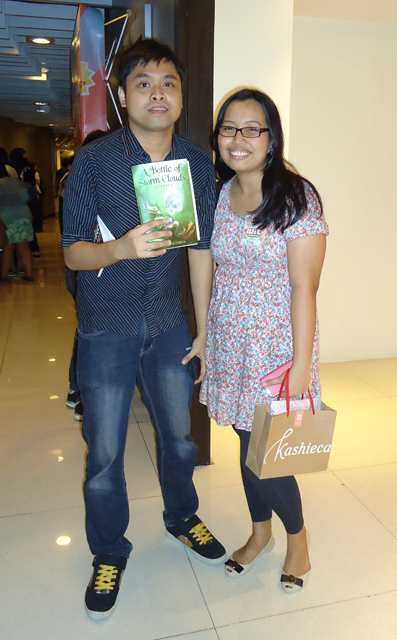
Author and Eliza Victoria
In choosing themes for horror stories, writers should leave out their favorite love struck vampires and werewolves. “Why would I write stories with American characters? There are American writers for that,” Victoria said.
She said that the fiction genre—including science fiction and fantasy—will have a very different flavor compared with the more dominant stories from the West. “For example, our sci-fi won't have American frontier mentality because we are the colonized,” she said. “We can't write traditional steampunk.”
In her collection of short stories, “A Bottle of Storm Clouds,” Victoria introduced a rural demon that she called “Salot.”
“I wrote 'Salot' as a test if makakasulat ako ng horror story,” she recalled. “When I wrote the first paragraphs, I scared myself.”
For Coronel, he wrote the novel “Tragic Theatre” based on the Manila Film Center tragedy in 1981, when an untold number of construction workers fell from quick-drying cement while sprinting construction for the first Manila Film Festival.
“'Yung semento, basang-basa pa, pinatungan na,” Coronel said. “Nalibing ng buhay 'yung mga na-trap 'dun.”
But integrating our urban legends, myths and beliefs in stories does not guarantee a good horror story. “I don't care if your story has a 'manananggal.' Gawin mo siyang kapani-paniwala,” Victoria said.
A way to make horror stories believable is through conflicts. “In any plot, there should be conflict. In any conflict, there should be suspense. Boring kung wala,” Coronel said.
How to build suspense
For writing horror novels, Coronel uses five techniques in building suspense.
1. Short-term deadline
“Make the characters race against time,” he said. “Kapos sa oras ang bida.”
In this technique, he said the writer should create natural uncontrollable events—looming darkness, approaching storm, rising flood water. “’Pag gabi, kailangan ng umuwi,” he said.
A writer can also create tension through “manmade deadlines” such as ultimatum, trial date, train schedule or a clock ticking. “Hints of approaching crisis. Footsteps, creaking of an opening door, police siren—all build a sense of urgency into a scene,” Coronel said.
2. Foreshadowing
Use hints of what is to come, he said. “The casual appearance of a weapon—gun in the drawer, knife in the sink—in an earlier chapter leaves readers worrying when it will be used,” Coronel said.
Other examples he suggested to aspiring readers were setbacks and failures early in the story that portend of even great disasters to come; and an ominous event that keeps recurring.
3. Omission
This calls for leaving it to your reader to imagine the worst. “Incomplete info and unanswered questions create tension that keeps the audience turning the pages,” Coronel said.
“Never explain everything at once. What you leave out is as important as what you include,” he added.
Under this technique, Coronel gave the following tips:
- Describe how some pages are torn from a missing person's diary.
- Let your suspicious character answer questions with a joke to hide what he's really thinking.
- When your character answers the phone, describe his facial expression to show some grim news.
- Don't identify the shadowy figure moving outside the window.
- Don't interpret the muffled voices behind the closed doors.
4. Cliffhanger
Coronel said that the cliffhanger is best used for chapter endings. He advised would-be-writers to end the scene before it's resolved then shift to another scene, leaving readers worrying and wondering.
“Make sure suspension pays off. Hindi dapat false alarm na parang ma-feel ng readers na naloko siya,” Coronel stressed.
5. Pace and Tempo
He said writers can also build tension by slowing time in the story.
Getting your stories out
Once your horror novel is written and polished, it is time to send a one- or two-paragraph query letter to publishers.
“'Dun pa lang sa query letter, lagyan mo na rin ng suspense. Para 'pag nabasa ng editor, sabihin niya, 'Mukhang interesting 'to,’” Coronel said.
Aside from dealing with Visprint which published her novel “A Bottle of Storm Clouds”, Victoria also found an ebook publisher, Flipside (email: publisher@flipside.ph), for her novels “Lower Myths” and “The Viewless Dark.”
For short stories, Victoria shared a number of local publications that are looking for speculative fiction. Price range per story is P500-P1000:
Philippine Speculative Fiction
nikkaalfar@gmail.com
Philippines Free Press
Published works will serve as entries to the Philippines Free Press Literary Awards
ramblingsoul@yahoo.com
Philippine Graphic
Published works will serve as entries to the Nick Joaquin Literary Awards
litgraphic@gmail.com
Philippine Genre Stories
Currently closed to submissions
pdofsf@yahoo.com
Victoria also prefers sending short stories to online publications because they reply quicker than their print counterparts and can pay professional rates, ranging from 5 to 10 US cents per word.
Some of these sites are:
“For one story, they (Daily Science Fiction) paid me $500. Pambili na rin ng bag at shoes,” Victoria said.
Just make sure the bag you'd be buying is not haunted, okay? –KG, GMA News

