When the UAAP Finals between the University of Santo Tomas Growling Tigers and the Ateneo de Manila University Blue Eagles tip-off on Saturday, the two lower-seeded teams that fell in the Final Four round will undoubtedly be wondering what they could have done differently to, at the very least, force their opponents to burn their twice-to-beat advantage, and in the best case scenario, come up with a big upset and take their place. What could the National University Bulldogs and the De La Salle University Green Archers have done differently? The answers, below:
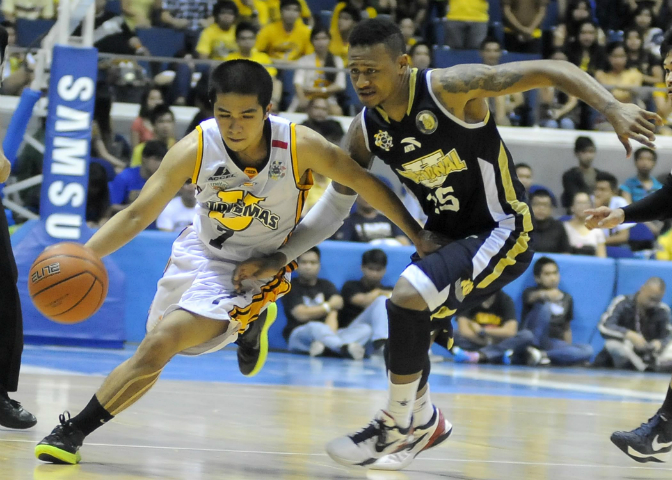
Bobby Ray Parks (right) couldn't lift his team to an upset win over UST. KC Cruz
For the NU Bulldogs - •
Bobby Ray Parks needed to be more aggressive Ratings (RTG) – There are offensive ratings and defensive ratings. They are sometimes referred as Efficiency and are usually used in per-100 possessions for equal valuation. RTG = 100* (Points scored/produced/allowed)/Possession Free Throw Rate (FTR) - is an estimate of a team/player’s ability to get to the FT line. FTR = Free Throws Made/Field Goals Attempted
For someone who took 9.5 free throw attempts a game entering the Final Four, getting to the FT line only six times against UST indicates some level of passiveness. It’s also worth noting that at this point in his career, Parks should know that his three-point shooting is not yet a strength for him (29.2 percent on 4.6 three-point attempts entering the game). It’s not just the fact that he’s missing them a lot, it’s that he’s still taking a lot of shots even when his triples are only inconsistent at best. In the most important game of the Bulldogs' season, the presumptive MVP decided to hoist up jump shots instead of taking it all the way to the rim. UST definitely wanted to annoy him by bumping, body tagging, and generally making him uncomfortable. That’s simply what you get for being one of the best players in the league. However, Parks didn’t deal with it well, thanks to the efforts of Kevin Ferrer and Jeric Teng, who dogged him (no pun intended) throughout his 38-minute stint. Overall, Bobby Ray Parks used too few possessions (23.11% USG), and was inefficient with the ones he had. BRP also turned the ball over four times, and ended up with an ORTG of 81.4, which is 21 points/100-possessions lower than his season average. •
Emmanuel Mbe needed to be more aggressive NU has two clear stars on their team: Bobby Ray Parks and Emmanuel Mbe. Shutting this duo down almost always assures you of a victory against the Bulldogs. That is why in my preview of their matchup, they were huge keys to winning. Mbe, like Parks, simply disappeared, especially on the offensive end. In stark contrast to his superb game against FEU, there were no strong dives to the rim, nor were there strong picks to free up Parks or Gelo Alolino. The effort was there, no doubt. But effort can only get you so far. His five huge offensive rebounds, most of which were rebounds that he worked for, not those that just fell on his lap, were mitigated by the fact that he turned the ball over four times. Mbe was the Robin to Parks’ Batman, and sometimes, Batman can’t do it alone. Sadly, Robin didn’t show up in this game either. •
NU lost the free throw battle NU didn’t even dominate the one stat I thought they would: drawing and making free throws. Based on the elimination round, NU usually won the free throw battle by a margin of around 8.7%, while UST lost by a margin of around 4.9%. So it was not unworldly to think that NU would dominate these factors of the game. Instead, they didn’t own it. They allowed UST to get a FTR of 22%, which is 5% higher than their regular season average.
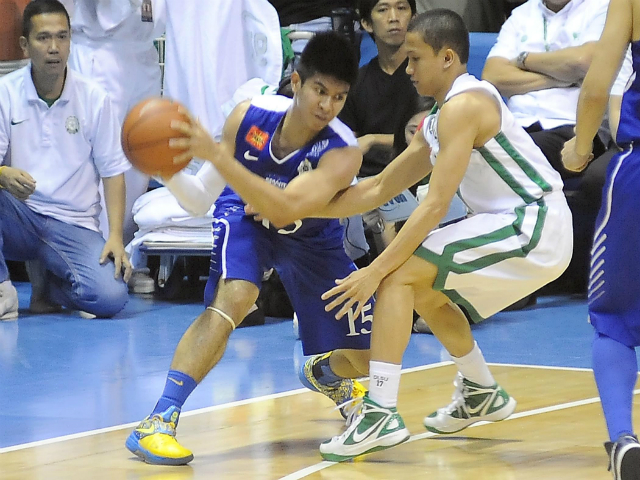
Kiefer Ravena (left) was unstoppable late versus DLSU. KC Cruz
For the DLSU Green Archers - •
They picked their poison, and they chose the wrong one Rebounding Percentage (Offensive/Defensive/Total) - it is defined as the percentage of rebounds the team/player gets from the total rebounding opportunities. Offensive Rebounding Percentages = Team OREB/ (Team OREB + Opp DREB) Defensive Rebounding Percentages = Team DREB/ (Team DREB + Opp OREB) Total Rebounding Percentages = Team Total Rebs / (Team Total Rebs + Opp Total Rebs) For player rebounding percentages, the denominator is adjusted for the time the player is on the court. This means that the denominator is multiplied by (Player Minutes Played)/ (Team Minutes Played/5)
It’s been said over and over again that playing against great players is a lose-lose situation – you have to pick your poison and learn to live with it. Versus Ateneo, La Salle decided to pick the Kiefer Ravena poison, which turned out to be the wrong move. Question: Would you rather have a great player beat you or let other players beat you? Personally, I’d rather have someone else beat me. And after watching the game two more times, La Salle clearly decided not to do something about Ravena until it was too late. There were some flashes of a fullcourt press on Ravena, but they didn’t make him give up the ball, which is the most important thing you need to do. Finally, when the La Salle defense began to target Ravena exclusively, it was too late, he began finding his teammates, highlighted by key assists to Juami Tiongson and Ryan Buenafe. If you want to see how dominant Kiefer was in the fourth quarter then this might seal the deal for you: his stats in the fourth quarter were equal to or better than the stats in the fourth quarter than all of La Salle, combined. Yes, you can sort of say that Ravena single-handedly defeated La Salle. •
Jeron Teng got frustrated Jeron Teng was clearly frustrated with the refs. The younger Teng got bodied up in the same way that Ravena, Parks and Romeo get bodied up on every single play. That comes with the territory of being a great scorer. Teams will try to annoy you by bumping you, bodying you up and making you uncomfortable even before you catch the pass. It was up to Teng to channel his inner peace and work through the physicality, except that he didn’t. The former Xavier School star shot just 5-of-18 from the field. By my count, he took six shots that he shouldn’t have taken and was always complaining to the refs after the contact instead of just running back down the court. He also got caught up in a little trash talking with Ryan Buenafe. In the end, when La Salle needed its King Archer to display the type of season he had in the elimination round (with an ORTG of 93.3 while using 28.8% of his team’s possessions), the King Archer succumbed to the pressures of a Final Four game. Teng registered an ORTG of just 63.95 while using 29.82% of his team’s total possessions. If you’re not going to be efficient, you might as well not use possessions. Teng's game was almost 0.3 points worse per possession (or 30 points worse/100-possessions). That may not seem like a lot, but for someone who uses a lot of possessions, and in a game that was close thanks to the efforts of Vosotros and Yutien Andrada, those 0.3 points matter. •
They lost their edge There are two reasons why DLSU was one of the hottest teams entering the Final Four. They improved by leaps and bounds from round one to round two in their free throw drawing ability and their ability to pull down defensive rebounds. To be more specific, the Green Archers allowed their opponents to rebound 6% less in the second round, while maintaining their already good offensive rebounding. They were also able to win the FTR battle by an average margin of 7.05% in the second round as compared to losing by -1.81% in the first round. The FTR battle was probably going to be a close one because both DLSU and ADMU are great FT drawing and making teams. Sadly, DLSU lost this one by more than 5%. In fact, Ateneo drew 6 more charities, which resulted in three more FTs made for them. How many points did Ateneo win by again? The rebounding battle was supposed to be lopsided in the favor of La Salle with four good-to-great rebounders on their squad, namely Norbert Torres, Arnold Van Opstal, Jovet Mendoza, and Yutien Andrada. Ateneo on the other hand, was hamstrung by the absence of their reserve center JP Erram. But the guy who stepped up for the Eagles was the same guy who torched the Archers shooting-wise: Kiefer Ravena. The former Rookie of the Year was splendid from the shooting guard position. He also had a TRB% of 18.8%, 10% higher than his season average of 7.79%. In fact, based on sheer numbers alone, Ravena was the best rebounder of the game, hauling down 12 caroms. The difference that separates a win from a loss is so minuscule that sometimes, people tend to overlook it. In playoff games, every possession is more important because the game usually slows down. Fewer possessions mean fewer chances to score. Fewer chances to score means the value of a score/stop becomes more important. Because of this, the playoffs become a human chess match for the coaches and the players where every move is countered by the opponent. Their decisions and/or indecisions throughout the game probably caused their respective teams a shot at the Finals. If Parks and Mbe were only a little bit more aggressive attacking the paint, if only the Bulldogs played smarter, if only Teng was a little bit more composed, if only they took the ball out of the hands of Ravena, if only this, if only that. It was the little things that cost them the victory, and it’s these little things that pushed UST and Ateneo into the Finals and NU and DLSU out of contention.
- AMD, GMA News Nico Baguio holds a Masters Degree in Mathematics from the Ateneo de Manila University. He's currently a writer for SBNation's At The Hive and runs a website that focuses on using advanced statistics on the local hoops scene, Humble Bola. You can email him at contact@humblebola.com. You can also follow him on Twitter. 

 GMA Brandtalk
 Tracking
 Archives


