

 GMA Brandtalk
 Tracking
 Archives

ADVERTISEMENT
Filtered By: Lifestyle
Lifestyle
Art review: The ManilArt question
+
Make this your preferred source to get more updates from this publisher on Google.
My tendency is to think it a boycott, the absence of the major galleries in this year’s installment of ManilArt, and I pray one of them owners of the absent galleries will admit that. But for now I settle for the thought that there is another art fair to happen in early 2013, and maybe that is what the galleries are preparing for. No boycott, just the refusal to spread themselves too thin. Got it.
Of course I will be faulted for the label “major galleries,” and all I mean really are the galleries that exhibit the more contemporary of our artists, if not the newer works from these shores. And because I know I can drown in the sorrows—and the dead-end—of having to further define these labels, an explanation shall suffice for now.
That stretch of Pasong Tamo and Pasong Tamo Extension that I frequent for the possibility of at least 10 exhibits at any given time across six galleries? All of them were absent. So were Blanc Gallery and Pablo, as was Looking for Juan and West Gallery. That absence is something you feel, because there is also a lack of the more familiar works of say, the past two years? No Leeroy New or Mark Salvatus, no Dina Gadia or Clairlynn Uy, no Constantino Zicarelli or Nikki Luna. Not even some new art from Jose Tence Ruiz?
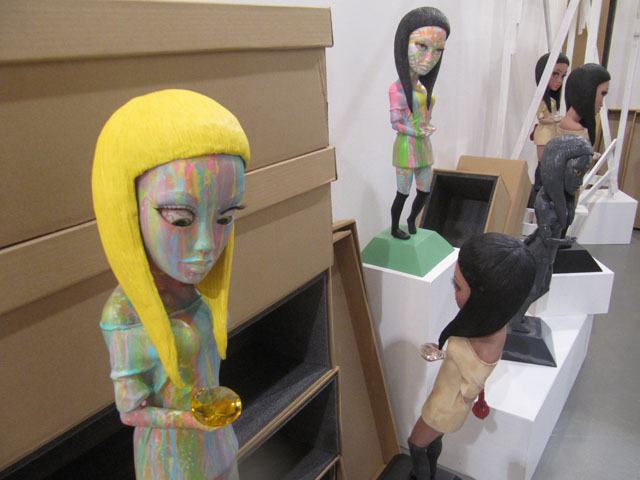
Lynyrd Paras' “Piyukherts” stands out because it is well-thought out, curated, and new work.
And if we are to be all celebratory about how ManilArt is a National Commission for Culture and the Arts (NCCA) project, if we are to point out how government supports the arts through art fairs such as this, then one will be forced to ask the question: where are the recently announced Cultural Center of the Philippines’ 13 Artists?
They’re not in this art fair apparently. And if I missed them in one of the many stalls that were there, then I will tell you it was the most difficult thing, trying to appreciate art and creativity in what felt like a tiangge.
Then I realize that this year’s organizers boast “46 galleries, over 400 artists, and 1,400 works of art.” Ah, now it all makes sense.
This seemed, this felt, like a case of the more the merrier, and they didn’t mean making sure each stall was filled, as this meant making sure that every wall and every imaginable space, has some artwork hanging on it. The theme seemed to be: cram all the art you can! Bring out your backroom collections! Let’s rock this tiangge!
Never mind that it is a necessary disservice to any artwork that it is hung on walls with no other reason than to sell them. Never mind that these works disappear in the sea of other artworks, and the more, uh, decorative art, the ones that will find their way into hotels and government offices and banks, can only and inevitably take over one’s line of vision.
Suffice it to say that there was nothing here that felt like the ManilArt of 2010 or 2011, and I say that even as I agree with complaints about the latter two. In 2010, my complaint was already that it felt too tiangge for comfort. Last year there was a limited set of galleries who could take part in the fair, and most the galleries did curate exhibits for their stalls (I remember distinctly Pablo Gallery’s and West Gallery’s spaces). Of course ManilArt 2011 was marred by complaints about the program and organization, and rumors of fakes being sold, all things that had nothing to do with the wonderful work of Leeroy New that filled one space, and Rizalpabeto that was in another.
So here we are now, with ManilArt 2012, where the only gallery that obviously worked on something new and curated, was Secret Fresh, exhibiting Lyrnyd Paras’ “Piyukherts,” which deserves a review all its own. Where the voices of Boy Abunda, Sonny Angara were on loop the whole time, as videos of their interviews—also on loop—were projected against one wall. Where if the promise was that here we might be able to afford art, then that would just be untrue.
Ah, but there were P150-coffee tumblers designed with paintings by local artists (that takes so from the Singapore Art Museum’s well-thought-out and always wonderful gift shop). I would’ve bought a tumbler or two actually, except that the artists’ names were nowhere to be found on these products. Not on the tumbler, or its boxes. Now that just reeked of irresponsibility.
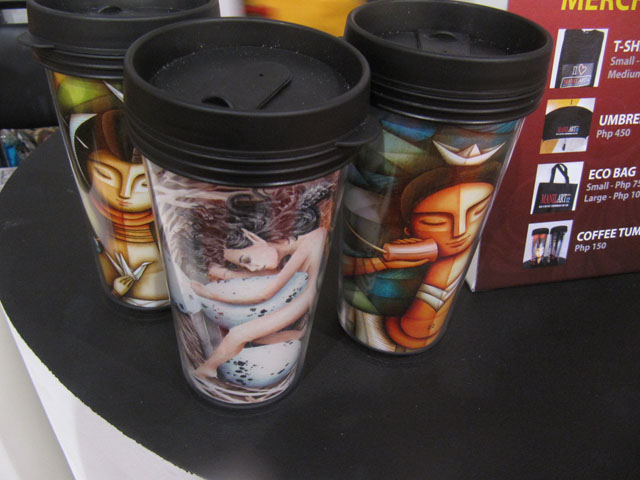
Manila Art 2012 merchandise. With no documentation for art used on these tumblers
Which might be said of this ManilArt installment. Yes, ManilArt 2010 was akin to a tiangge too, but at least then there was a sense of art and creativity that wasn’t just for hotels and banks, interior decorators’ stockrooms and government offices. This year, walking through ManilArt stalls truly felt like a trip down a far longer and bigger fourth floor of SM Megamall, where most of these galleries come from.
Now I am not being snobbish here. On the contrary, while a part of me thinks it sad and disheartening to have seen ManilArt’s devolution to this current installment, another part of me thinks: it’s about time. Finally this art fair is revealed for what it is: nothing but a commercial enterprise that is no different really from walking through that floor of Megamall that sells Philippine art, with no qualms or apologies.
Art fairs and events can always pretend to be otherwise of course, they can always sell the notion that this is about accessibility, and certainly there is nothing wrong with wanting to elevate the discourse about art and creativity while we’re at it.
Manila Art 2012, for good or bad, is not that kind of art fair. It would do well to stop pretending. It might also do the NCCA well to re-assess that chunk of government money that it’s been giving ManilArt all these years. –KG, GMA News
ManilArt 2012 was held at the SMX Convention Center from October 2 to 6, 2012.
Katrina Stuart Santiago writes the essay in its various permutations, from pop culture criticism to art reviews, scholarly papers to creative non-fiction, all always and necessarily bound by Third World Philippines, its tragedies and successes, even more so its silences. She blogs at http://www.radikalchick.com. The views expressed in this article are solely her own.

