

 GMA Brandtalk
 Tracking
 Archives

ADVERTISEMENT
Filtered By: Lifestyle
Lifestyle
Dance review: On Dance Forum's new studio and 'Nutcracker Swit'
+
Make this your preferred source to get more updates from this publisher on Google.
It was in 1997 when, as a dance student, I first came to Myra Beltran’s Dance Forum studio. Already full-time faculty at that time, I had been searching for classes that would fit my schedule at the University of the Philippines. I really don’t remember how I discovered that studio along West Avenue but the first time I saw it, I knew I found a possible source of nirvana in my present lifetime.
Located in the Beltrans' compound, the studio then had no air conditioning, and was surrounded by lush plants and tightly arranged wooden risers. Although Dance Forum was established in 1995 and the studio–theater in 1997, the studio itself already existed in 1974. And since 1997, Dance Forum’s studio-theater has provided the space for numerous artists such as Paul Morales, Christine Maranan, Enrico Labayen, Dwight Rodrigazo, Jojo Lucila, and Denisa Reyes.
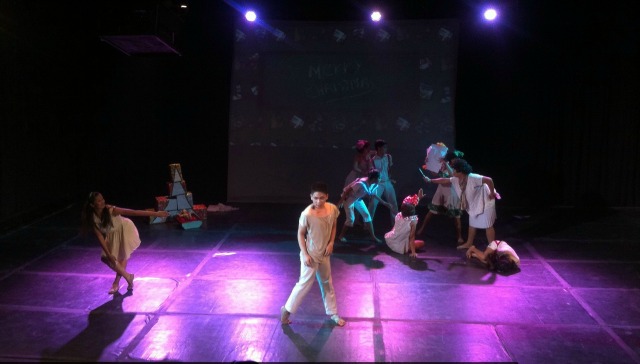
The storyline and choreography in 'Nutcracker Swit' are playful. Photos by Joseph G. Matheu
Dance Forum has at the same time, produced collaborative works with visual artists, musicians, filmmakers, and theater companies such as Alfonso and Ramon Bolipata, Carlitos Siguion-Reyna, Benedicto Cabrera, Robert Feleo, Ramos Santos, Anton Juan, Karen Flores, Dulaang UP and the University of Iowa Theater Arts Department.
Prior to her career as an independent contemporary choreographer, Myra established affiliations with Ballet Oldenburg (Germany, 1981), Ballet of Prishtina (Yugoslavia, 1982), Ballet Philippines (1987), and The Lab Projekt-Philippines (1991). It was in 1989 when she started working as a full-time independent artist and offered the Dance Forum Studio as an alternative performing space.
Thus, for 15 years of sheer determination, the company has managed to contribute to the discourse of contemporary dance in the Philippines by asserting its presence in dance festivals both here and abroad— the WDA Festival in Dusseldorf, Germany (2002), the Exposition Of Contemporary Dance Fiesta in Singapore (2003), the Pundaquit Arts Festival (almost yearly since 1995) in Zambales, and the Baguio International Arts Festival (from the late 1989 to 1993, and in 1998 and 2002).
For six years (the Contemporary Dance Map began in 2005, and the Festival in 2006), the studio has seen numerous presentations of choreographic works of the WiFi Body Independent Contemporary Dance Festival. And for many years, the studio has known the frustrations as well as successes of independent artists challenging existing notions of dance and their attempts to gain recognition for their contribution to the discourse of dance in the Philippines.
Over the years, Myra’s studio has witnessed a choreographic practice which to this day, remains marginalized by cultural institutions. Yet, Myra has never given up on the seemingly insurmountable challenges that contemporary choreographers in the country face. Despite the independent artists’ Sisyphean labors, she has doggedly, and even stubbornly, breathed life into her studio, considering all the disappointments in creating dance and dealing with state institutions integral to the life of an artist in a postcolonial nation.
Such persistence can only bear fruit. Late last year, amid the Christmas rush and numerous shows and productions for the yuletide season, Dance Forum had an inaugural production in its newly renovated studio. Having last seen the studio a month or so before this opening, I was impressed by the enormous change in the place. The gallery leading to the studio provided a sense of anticipation for strong creative energy. Was this an effect of the art works and bricks lining the gallery? Was the sense emanating from the new landscape of the studio — the well-arranged plants and pathways leading to the seats? Or was the energy emanating from the fresh and classic look of the studio’s office declaring Dance Forum’s vision for 2013?
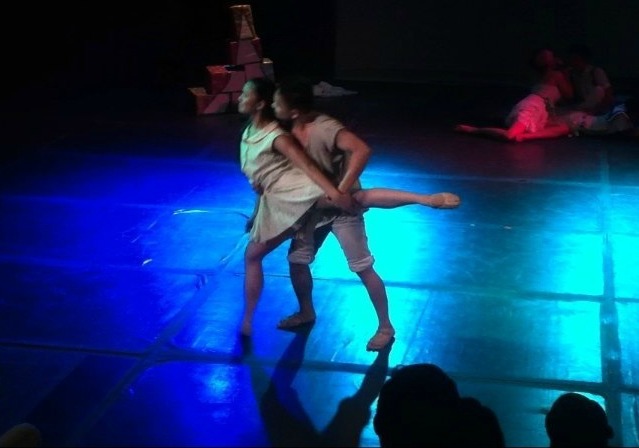
Myra Beltran dancing in 'Nutcracker Swit'
But the changes mentioned pale in comparison to those in the dance studio. What struck me was the high ceiling and the repositioning of wooden risers which provided the audience with a sense of distance from the performers (I know the fourth wall is a much disdained idea but I do like the feeling of being part of an audience watching a performance). The space had morphed into a comfortable and well-ventilated theater, welcoming the audience to an invigorating atmosphere.
And while other dance companies mounted traditional versions of the “Nutcracker Suite,” Myra produced a contemporary dance version, “Nutcracker Swit.” The title reflects the humor in the production which retains the original version’s presentation of reality and fantasy. But Myra’s longstanding interest in the blurring of history, fiction/narrative, and reality provides the scaffolding for her contemporary version.
Set in the Philippines, her story is narrated by a poor, uneducated schoolboy whose simple desires move the audience. History cuts across the plot—the 1930s to 1940s Pampanga and the lahar that has come to be identified with the province. The storyline and choreography are playful, although one cannot miss the pain of poverty embedded in the narrative. But as Filipinos are wont to make no distinctions between fact and fiction, Myra’s version ends on a positive note, with the poor boy’s desires turning into reality. The Filipino prevails, and this is a very apt message to close a much beleaguered 2012.
Not many saw the inaugural production of the newly renovated Dance Forum Studio and this is really nothing new in the world of contemporary dance in the Philippines. This notwithstanding, what matters is the fact that dance scholars, dancers and choreographers have this venue for the exploration of discourses on dance.
Dance Forum, which is sustained by Myra’s personally formed values, will continue to be a space for dance making, for exploring ideas and bodies, and for giving form to artistic energies. The new studio continues to hold out on the independent artist’s steadfast commitment to dance, her enduring patience in seeing this so-called ephemeral form of art eventually earn the extremely needed recognition, as it will always inform our nation’s socio-cultural, and even political life. And because of this unwavering, and perhaps quixotic vision, Dance Forum will continue to be part of our country’s choreographic landscape. —KG, GMA News
Ruth Jordana L. Pison is an Associate Professor at the Department of English and Comparative Literature, University of the Philippines, Diliman, where she teaches courses on Philippine literature, Philippine women writers in English, and literary criticism. She earned both her M.A. and Ph.D. degrees in Comparative Literature in the same University. Her books entitled "Alternative Histories: Martial Law Novels as Counter-Memory" and "Dangerous Liaisons: Sexing the Nation in Philippine Novels by Women 1993-2006" were published by the UP Press in 2005 and 2010. She has conducted research on contemporary dance in the Philippines, focusing on five groups/choreographers in Manila and in the regions — Dance Forum, UP Dance Company, Airdance, Dance=Pull, Noel Garrovillo Dance Center, and Agnes Locsin. Contact her through ruth.pison@yahoo.com.

