

 GMA Brandtalk
 Tracking
 Archives

ADVERTISEMENT
Filtered By: Topstories
News
Consult your lawyer before you click
+
Make this your preferred source to get more updates from this publisher on Google.
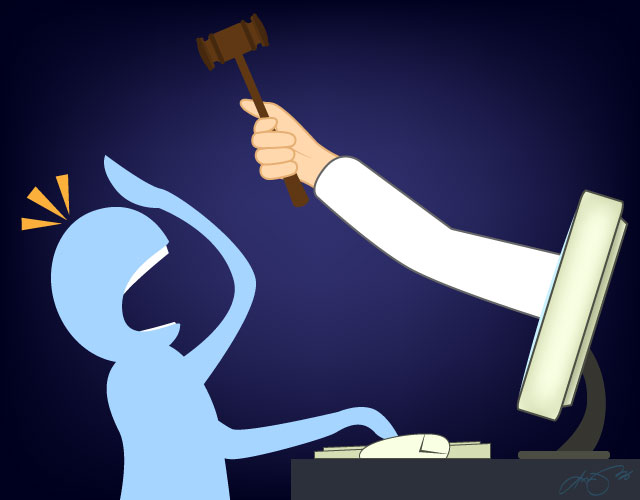 One of the less-sung recurring characters on The Simpsons is Judge Roy Snyder, who despite having modelled from real life right-wing Judge Robert Bork, has slouched towards Gomorrah in matters of juvenile crime. “Boys will be boys”, he has pronounced from the bench, justifying why Bart Simpson need not be condemned to jail or a state-run reformatory. Judge Snyder though was not a member of the Special Ninth Division of the Philippine Court of Appeals, which last December, interjected the majesty of Philippine law into a juvenile dispute that played out on Multiply’s blog platform. “Meet MY backstabber FRIEND;p”, the title of blog entry enticed. “FRIEND”, according to the author and her friends who commented on the blog post, was “the frikin next assuming queen”, a “looser”, a “mother freakin dead kid mehn”, “mukhang bakla”, “B-I-T-C-H”, “LOSER NA NGA, BITCH PA, AT BACKSTABBER PA!!!”.
The posters were charged with criminal libel – the ordinary sort, not the cyber-libel now awaiting affirmation from the Supreme Court. At least one of the prosecuted was 16 years old when she uploaded the offending comment. The Court of Appeals ruled that there was enough basis for the case to proceed to trial, the implicit premise being that there was nothing inherently unconstitutional or illegal with penalizing online-based criminal libel perpetrated by and against kids.
The concepts of backstabbing, losing and bitchery have existed and been inveighed against friends and foes for centuries. Had these playground taunts of minors been litigated in our judicial system as recently as 15 years ago, these would have been laughed out of the courts. What changes the equation is the Internet’s promise of perpetuity. The lifetime of a blog post depends on the will of the author. Unless the default settings are toggled, a blog entry is visible to the whole world. In theory, what had once been written about you online remains available through Google decades later. This was among the reasons why the Supreme Court, in 2006, decided to stop publishing the names of victims of sexual abuse in its decisions. A distraught mother had realized that because of a court decision posted online, anybody was able to find out how her daughter had once been victimized by a sexual predator.
The complainant in the case that reached the Court of Appeals was not actually identified in the offending posts. The blog author had taken pains to rename her target as the pseudonymous “Jopay”, and the defense was raised that “’Jopay’ makes no clear reference to the complainant as the object of the blog.’” The Court of Appeals though did not dispute the finding that complainant was sufficiently identifiable in the postings, based on the affidavits of 3 witnesses of the complainant. Translated into just slightly more adult circumstances, this would mean that blind items in entertainment or business gossip columns may be cause for libel, even if the unnamed subject is known only to that social circle in the know.
Had the complaint not been filed, it would have been unlikely that people outside of the parties’ common set of friends would have become aware of that the complainant was the subject of a libelous post. Multiply itself, having fallen into hard times, has already announced it would take down its formerly popular blog platform. However, with the complainant’s case having been registered with the court systems, her name and the details of this unfortunate event in her life are now publicly available online, through the Court of Appeals decision now posted on its website, possibly available for the great-great grandchildren to see.
Juvenile slights inflicted by juvenile minds. Should they find relief in the august confines of our judicial system? One blanches at the thought of the majesty of the law being used to enable the revenge fantasies of the immature. Yet there is that stolid legal doctrine – that for every wrong, there must be a remedy under the law. A blog post entitled “Meet MY backstabber FRIEND;p” can only come from a mean place. And it could not be denied that the spirit of nastiness has long been the subject of society’s restraint and control. Intuitively, you should be able to punish for bad behavior, for bad speech.
There is, nonetheless, the Bill of Rights – a set of counterintuitive guidelines that curb the popular instinct to oppress the minority. The Bill of Rights not only guarantees free speech of any single person on a single incident, it cultivates a society where people are not afraid to speak. This is the danger of a culture where it is easy for libel cases to be filed and to prosper. Knockout gas to silence toxic speech when a muzzle would do. The case filed by “backstabber FRIEND” must be decided prudently and decisively by the courts, in a way that relieves the victim without encouraging just anybody who has been maligned online to file their own cases.
The balance is tricky, yet the free speech paradigm has been altered by cyberspace. People converse with each other just as they used to, but in a medium wherein anybody can be an eavesdropper, where a dedicated researcher can retrieve past utterances that the speaker may have easily forgotten having said. The opportunities for communication and information-sharing allowed by the Internet are available only because people are open with what they say. If the time comes when people are unable to freely communicate online as they would in ordinary conversations, when they are compelled to think of the possible lawsuit before they click, then the utility of the Internet would truly be, mostly for porn.

