

 GMA Brandtalk
 Tracking
 Archives

Should women fear menopause?
WOMEN TALK
Perhaps it's because I've been in active OB-GYN practice for so long (more than 25 years) that the demographics of my patients is now skewing towards the “older” generation. Last week alone I had several patients who were in their early 40s, and their queries mostly centered on the changes that will occur when they reach menopause. Most of them were worried about how they will deteriorate in the looks department – dry and wrinkled skin, lack of pep, getting old, and mainly, loss of attractiveness.
I explained that even at 35 years old, their ovaries – the two structures attached at the sides of the uterus – will produce less and less of the necessary female hormones, called estrogen. There is this transition period, a very gradual change until the mid-40s, and then the menses stop at around 48 years old, the mean age for Filipino women. This stop may be abrupt, with the menses suddenly disappearing in the succeeding months, or it may be gradual, the menses coming in irregularly until eventually the monthly periods stop.
When the woman has not had her period for 12 months or more, we can say that she is already in menopause.
During the gradual decline of ovarian hormones, the brain will detect the low levels of estrogen and produce more releasing hormones, in an effort to spur the body to produce more estrogen. This is why menopausal women get hot flashes, which are sudden feelings of heat on the face or the body caused by sudden dilatation of the capillary vessels. The pores open, and sweating occurs in an attempt by the system to cool the body.
The decrease in female hormones too, will make the skin lose a lot of its elasticity, making it dry and wrinkled. Mood swings may occur, making many women weepy, melancholic, or in extreme cases, suicidal.
Once we understand, however, that this is a natural process and all women will go through it, there seems to be no need for alarm or worry as the ovaries go through their life span, gradually but inexorably, ending their reproductive function because these are no longer needed.
The side effects of HRT
If the loss of estrogen is causing these changes, why not supplement this lack with intake of estrogen?
Forty years ago, this was indeed the popular thinking, and Hormone Replacement Therapy (HRT) became de riguer for women: taking estrogen pills to replace nature’s loss. The favorite slogan then was, “Forever Young!”
Years later however, in a backlash, studies found that taking oral estrogen was a two-edged sword. True, the hot flashes and sweating diminished, the skin (including the vagina mucosa) became less dry, and mood swings were lessened. However, the incidence of breast cancers increased, and it was explained that the breasts, having estrogen receptors, were sensitive to these medications. Some doctors also reported an increase in blood pressure, blood serum cholesterol, and triglycerides with oral estrogen.
After this scare, the pendulum swung back to the “no medical replacement at all” phase. Nowadays, estrogen replacement therapy is given in very short courses (e.g. three months) only to women with severe vasomotor disturbances that might cause insomnia, or extreme depression. Tablet preparations of black cohosh (cimicifuga racemosa rhizome) has also been introduced for these symptoms.
Carry a fan
So what can Pinays do to ease the transition to menopause?
One very practical advice for women in the tropics is to carry around a large “abanico,” or a fan. This usually elicits laughter from my patients, and indeed it is not a facetious advice. What better way to combat the sweating than an ever-ready fan, and a sweet-scented handkerchief?
For those complaining of dryness in the vaginal mucosa, making sexual activity painful, there are lubricants and topical hormonal creams that may be used. Many patients refuse to have any sex after suffering from painful intercourse (and its concomitant painful urination – because of the irritation as well of the urethra, the opening from which urine flows, as it is very close to the vaginal opening), and these creams and lubricants can offer the much-desired relief.
For mood swings, unless these affect day-to-day activities, the best way to confront such occurences is to be aware that indeed, they come and go. So far, none of my patients have had depressive states that were excessive and frequent, or else a consultation with a psychiatrist could be advised.
Lifestyle changes and late pregnancy
It is during these times too, that lifestyle changes can be helpful.
For those who are overweight, a shift to a healthier diet and allowing more time for exercise would be helpful. Cessation of cigarette smoking would be a good start for those entering menopause. A regular Pap’s smear too, would be beneficial.
At around this time women in their forties already know what they want, and are leading full, productive lives. Their children would probably be setting out on their own. It is the best time to read up on menopause, and arm oneself to prepare for life’s surprises.
One frequent question from my patients is, can I get pregnant if I am in my mid-40s, even if my periods are already irregular?
The answer is “yes.” The ovarian functions may be failing, but it is not impossible for ovulation to occur. For most women, pregnancy is no longer desired because by this time, they have already completed their families. Oral hormone contraceptives are not prescribed for menopausal women so they are best advised to use other forms of protection, even if sexual activity is infrequent, as pregnancy can still occur. – YA, GMA News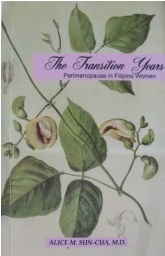
Alice M. Sun-Cua is a practicing obstetrician-gynecologist at San Juan de Dios Hospital, Pasay City. She has published “The Transition Years: Perimenopause in Filipino Women” (Libro Agustino, 2009), a book based on her local study of the critical years leading to actual menopause and the subtle physical and emotional changes that occur during this phase. The book is available at Solidaridad Bookstore (Padre Faura St. in Manila) or from the author.

