

 GMA Brandtalk
 Tracking
 Archives

ADVERTISEMENT
Filtered By: Scitech
SciTech
Where have all the pangolins gone?
+
Make this your preferred source to get more updates from this publisher on Google.
If a pine cone were turned into an animal, it would become a pangolin or scaly anteater, a mammal covered in scales made of keratin. It has no teeth, and curls up into a ball when threatened—a gentle and harmless creature, other than to the ants and termites it consumes with its long, sticky tongue.
But the pangolin is hunted for its meat and scales, which are believed to have medicinal properties. In China, pangolin scales are used to treat skin ailments, while its meat is consumed as an aphrodisiac.
On Monday, at least 400 boxes of frozen pangolin were found inside the Chinese fishing vessel that ran aground in Tubbataha Reef last week.
"Evidence suggests that since at least 1995, the principal market for pangolins and their scales, China, has largely depended on imports of pangolins, primarily from Indochina but subsequently from Southeast Asia more widely, with harvesting having generally shifted southward in the region," Dan Challender, co-chair of the IUCN (International Union for Conservation of Nature) Pangolin Specialist Group wrote in March. In the Philippines, the pangolin is only found in Palawan, where it is known as balintong. According to Dr. Mundita Lim, director of the Protected Areas and Wildlife Bureau (PAWB), the pangolin species is vulnerable, because there is a chance that it will eventually become endangered.
"At this point, we don't have enough information tungkol sa kanyang population. But we can safely say na ito ay vulnerable, dahil limited 'yung range at mayroon talagang, may actual threat," Lim said in a report on GMA News TV's News to Go on April 17. There is a large demand for pangolin in China, where the pangolin is believed to have medicinal value, although Lim noted that this is unsubstantiated.
In Binondo, some Chinese drug stores carry skin products containing pangolin, which are sold as treatment for eczema, acne, and allergies, GMA News' Lei Alviz said in the report on News to Go.
The vendors claim these products are imported from China. Pangolin meat is also consumed in China, because it is believed this is good for mothers who breastfeed, the report also said.
Pangolin meat is considered a delicacy, despite the lack of information regarding its safety.
"Some say that may aphrodisiac properties siya, ganun. Pero again, unsubstantiated ito. Siyempre kapag hindi dumadaam sa meat inspection, may mga safety standards din tayo eh so hindi mo alam kung anong posibleng sakit 'yung puwede nilang i-carry," Lim said.
Lim explained that the decreasing pangolin population may cause an imbalance in the ecosystem.
"Nagkakaroon ng imbalance, tataas 'yung termite population. Wala ka nang natural control," she said.
PAWB may use DNA samples from the pangolins found on the Chinese vessel that ran aground Tubbataha reef to find out if they are Palawan pangolins.
The Palawan or Philippine pangolin (Manis culionensis) is one of eight pangolin species, as listed by Save Pangolins on their website. 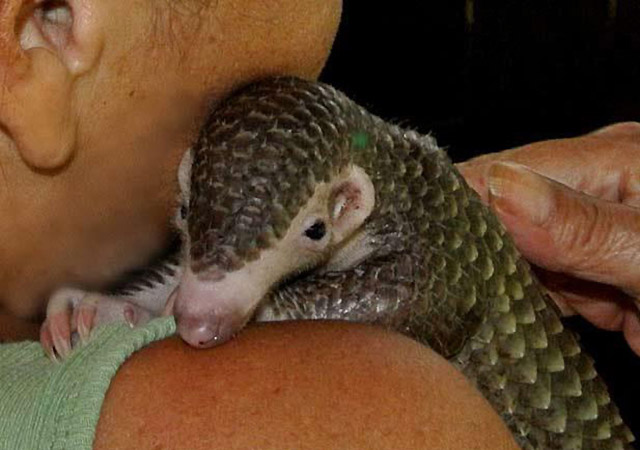 The IUCN Red List of Threatened Species lists the Chinese and Malayan pangolins as endangered, while the Indian and Palawan pangolins are near threatened. Meanwhile, African pangolins include Cape or Temminck's ground pangolin, long-tailed or black-bellied pangolin, as well as the tree or African white-bellied pangolin and giant ground pangolin, both of which are listed as near threatened.
The Palawan pangolin, or scaly anteater, is cuddly and friendly toward humans. It is very difficult to nurture baby pangolins, as they must cling to their mothers for up to four months for body warmth. They only eat termites and ants. An estimated 2,000 dressed pangolins (locally known as Balintong) were discovered in the hold of the Chinese fishing vessel that ran aground in Tubbataha Reef on April 8. Diana Limjoco
Pangolins are listed under Appendix II of CITES, the Convention on International Trade in Endangered Species of Wild Fauna and Flora. CITES passed a zero export quota in 2002, banning commercial trade of the species.
Despite this, a large unrecorded and illegal international trade continues in Asia, Challender noted.
It is estimated that in the last decade, there have been tens of thousands of pangolins illicitly traded annually in Cambodia, China, Hong Kong, India, Indonesia, Lao PDR, Malaysia, Myanmar, Nepal, Pakistan, Philippines, Singapore, Sri Lanka, Taiwan, Thailand and Vietnam.
In 2012, a Filipino was caught in Malaysia smuggling almost 4,988 kilos of pangolin meat, worth more than P9.819 million. Malaysian news site The Star said it was the biggest seizure of pangolin meat in the international market. Although the lack of knowledge and research on pangolins makes it difficult to determine whether the illicit trade is sustainable, Challender wrote that the "dynamics of the trade certainly suggest it could be unsustainable." — RSJ/BM, GMA News

