

 GMA Brandtalk
 Tracking
 Archives

Art review: Controlled whimsy in 'Into The Rabbit Hole'
The magic is in the telling. But for tales already told, reconfigured by Disney animation, one can only see diluted stories, where the grimmer these tales are, the less they are so with Disney. It is difficult not to be critical of this Disney-fication; even more difficult to refuse being sucked into it, soundtrack and visuals and all. Those happy endings are love.
It might be said that Amihan Lim’s “Into the Rabbit Hole” is proof positive of how our sense of tales, fairy and Grimm and everything in between, has become all about Disney. And while this is at the core of the works here, there is also a sense of how these works go beyond Disney, as they insist on a kind of creativity that we rarely see, or acknowledge, as “art.”
After all, when we speak of the art community, we mean Manila, and when we say Pinoy art, we mean a set of forms and types of art that are acceptable. And when we say abstract art, we mean a particular hand; when we say pop art, we mean digital prints and street art. The hope of course is that we can argue about these labels, too.
Away and apart
“Into the Rabbit Hole” doesn’t quite fall into any of these categories. The exhibit was held in Puerto Princesa, Palawan. It is 12 works in watercolor, on 24 x 32 centimeter paper. It is small by all standards, except that the detailed work, the control that is here, is far larger than we usually see in local art. Even more so when we consider how it traverses print and illustration, as well as abstraction, and one is forced to take stock.
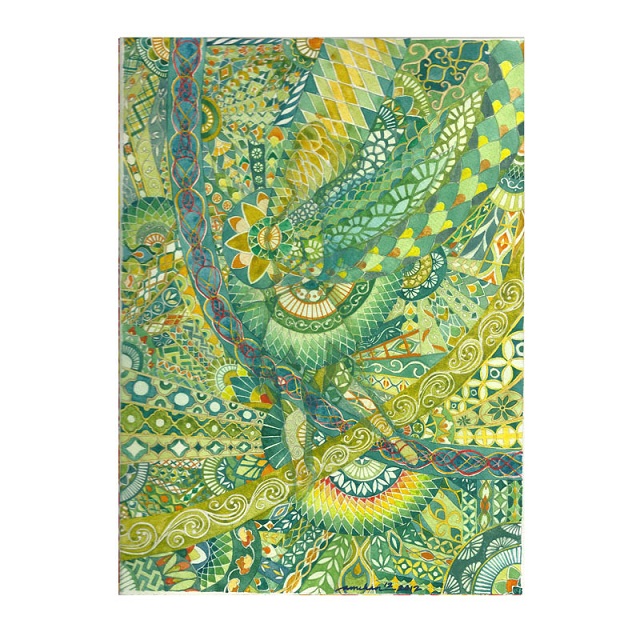
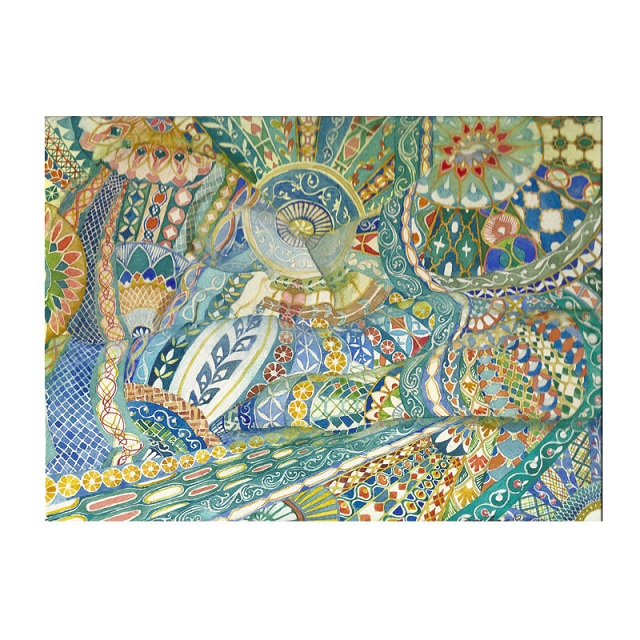
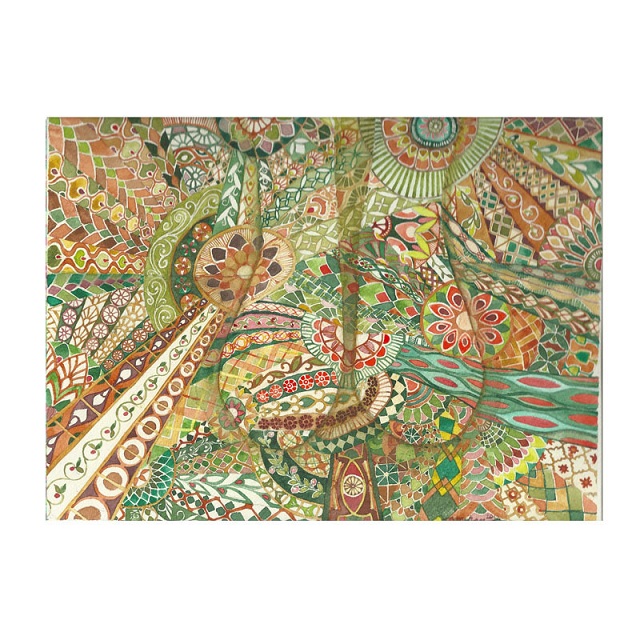
From afar the works in “Into the Rabbit Hole” look like colorful prints, the kind you’d see on fabric maybe, or a huge mural on a wall. Up close those colors reveal a variety of patterns, floral and geometrical, soft curved lines and shapes that appear to be layered one on top of the other. Up close, there is nary a repetition of a pattern in each of these works, even as there is a sense of their sameness, of how color and shape and form intertwine within each image to create the whole.
The manner in which these patterns are put together expectedly creates texture, but also it creates a sense of movement, with lines that give a sense of depth and distance. The colors in each work is dictated by the tale it is based on, and the whimsy in these patterns/shapes/forms allows for the lightness and childlike wonder that each of these tales might still stand for, Disney or no Disney.
Tales as symbols
But also what these works in “Into the Rabbit Hole” have is the magic of surprise and the unexpected. While the patterns tightly fill the space in each work, there is a central symbol within each one, embedded into the image, if not seemingly embossed over it. It might be said that these symbols, hidden in varying degrees within these patterns, actually mark the individual success of each of the works here.
As is the symbol in “And straight on till morning,” referring to how Peter Pan describes the way to Neverland. The colors of the patterns here are in Peter Pan greens and yellows, with some burnt oranges, that remind of Neverland, too. The central image though is that of Tinker Bell, embossed onto the pattern, seemingly in mid-dance, her head looking up to the sky. The lightness of her feet, the fancy skirt, remind of Tink’s litheness, the colors and patterns working with the fact of her swiftness as the tiny fairy that would teach Peter Pan to fly.
“Part of your world” meanwhile is in hues of aqua and pink, with some heavier greens, and patterns that allow for a sense of flight – strong lines that seem to cut from one end of the space to the next, unlike the other works here. These lines work seamlessly with the hidden shape of mermaid fins that also cut from the upper right to the lower left corners, allowing for the imagination of water, of fins swimming, in the colors and shapes of this world on paper.
The title image is “Into the rabbit hole,” that carries the image of two feet as symbolic for Alice and her adventure. The lines of the patterns here all lead somehow to a central point on the paper in the area where the feet are embossed, creating a sense of depth, but also of direction. The shades of green interspersed with hues of orange and red, along with the patterns that are here, allow for this work to seem heavier than the others, more concretely about the Wonderland adventures of Alice.
Control over whimsy
Which is to say that while the tendency is to think that this kind of work lives off a seeming randomness, the creativity that is here is also clearly about a great amount of control. Given the patterns and shapes, colors and forms, it is also clear how the task of whimsy could’ve taken over, where the task of creativity could’ve meant taking one pattern or color, and running with it.
Only to find that there is more here than the promise of color and pattern, because there is also the decision at a symbol for each of these tales, symbols that aren’t necessarily what we would all think central to each of these tales. Say, the fins instead of the red hair of Ariel, or the feet instead of Alice’s clothes. But too when it does work with the expected symbol, say the lamp in “Three wishes” for Aladdin, or the apple in “Skin white a snow, lips red as blood” for Snow White, the decision for patterns and color allow for the richness and magic of Aladdin’s narrative, and the darkness and haunting in Snow White’s story.
Ultimately too, there is this: given that this happens in watercolor, given the discipline that this medium demands, and given the freedom with which these particular works were created, “Into the Rabbit Hole” also reminds of the impossibility at repetition, and the fleetingness of art such as this.
As the stories are told, they fall but victim to memory. Tales are only as unique as the way in which we tell them, and in this case, art and creativity make precisely for a retelling that resonates. At least until the next time the tales are (re-)told. — BM, GMA News
“Into The Rabbit Hole” by Amihan Lim ran from April 12 2013 at Ka Lui’s in Puerto Princesa, Palawan.
Katrina Stuart Santiago writes the essay in its various permutations, from pop culture criticism to art reviews, scholarly papers to creative non-fiction, all always and necessarily bound by Third World Philippines, its tragedies and successes, even more so its silences. She blogs at http://www.radikalchick.com. The views expressed in this article are solely her own.

