

Bam Alegre visits South Korea's 'Solar Income Village' for his first 'I-Witness' docu as a guest host
Around GMA
Around GMA
DENR checks Davao City landfill for safety before reopening Private prosecutors in Sara Duterte impeachment: We don't take cues from Malacañang Independence Day celebrations and dealsArticle Inside Page
Showbiz News
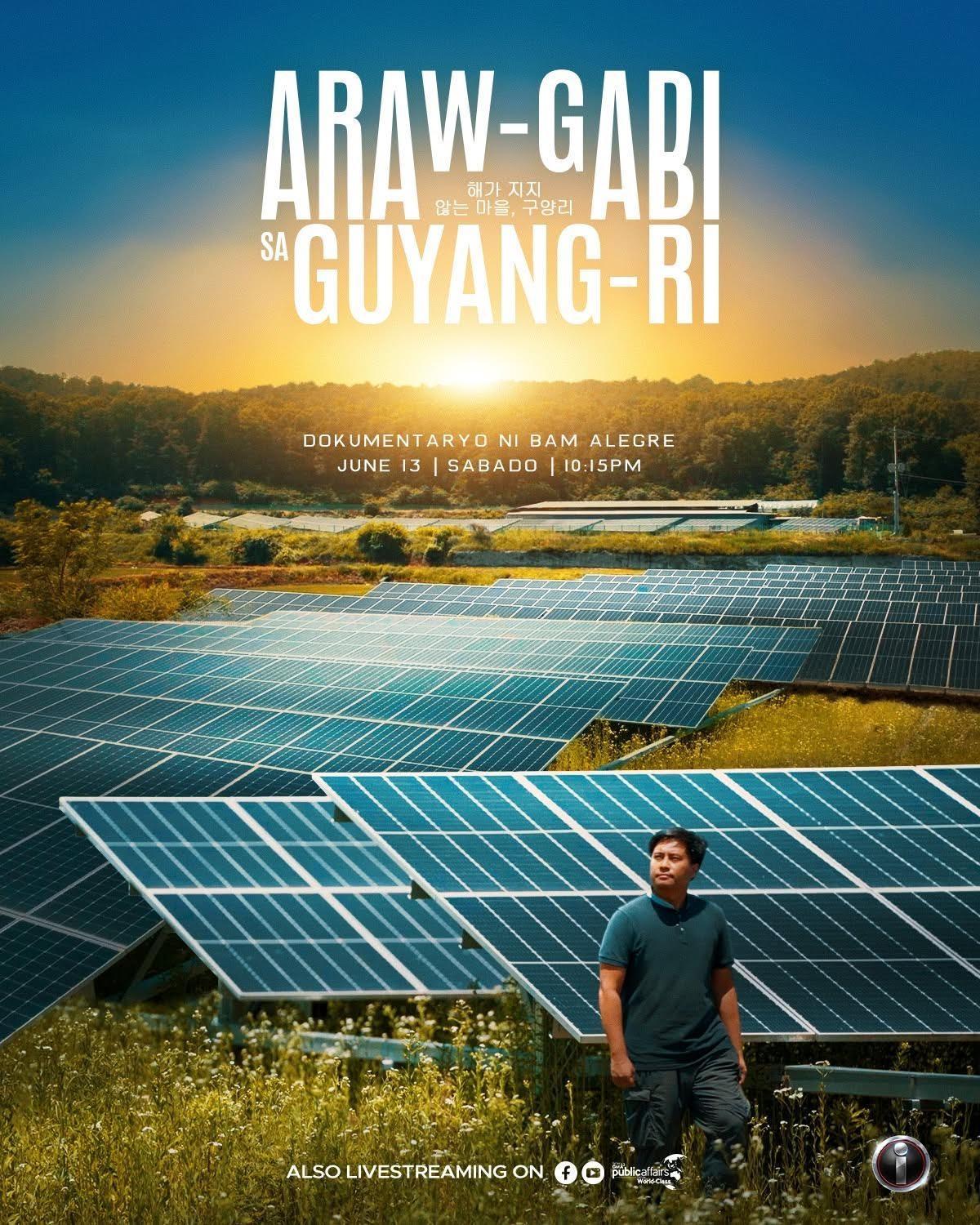
GMA News reporter Bam Alegre marks his I-Witness documentary debut as a guest host this Saturday (June 13), where he sets foot on Guyang-ri, South Korea and meets the people whose smiles are brighter than the sun.
In South Korea, there is a village where the sun seems to never set—its energy is harvested and used effectively day and night.
This is Guyang-ri, where people rely on solar energy. It is officially named “Solar Income Village” due to its goal to generate a stable and community-owned income.
With the support from the national government, the village is able to set up “solar farms” or rows of solar panels installed on vacant lots. The electricity generated from the solar panels is sold directly to the Korea Electric Power Corporation (KEPCO).
The earnings are then allocated to the community fund, where the money is used to subsidize most of the community's activities—from agriculture to sports, to simple meals and free transportation; the villagers enjoy the perks of the sun's power to generate electricity.
As part of its clean energy transition and rural revitalization efforts, the South Korean government labeled Guyang-ri as the national blueprint and prototype for the Solar Income Village Program. Almost two hours away from Seoul, Guyang-ri is gaining popularity due to the success of the program.
But residents prefer it to be known as the "Sunlight Income Village." The sun gives light, and light brings hope.
This is exactly what Guyang-ri needs right now, as most of its residents are elderly. At a time when the youth are blinded by the glitter of the city and its promises of a better life, the community advocates their return to a sustainable home.
How were they able to pull off this kind of project, and is it possible for this to happen in the Philippines?
Join Bam Alegre in his first I-Witness documentary as a guest host.
Watch “Araw-Gabi sa Guyang-ri” on I-Witness this Saturday (June 13), 10:15 p.m. on GMA.
For more news and updates, visit www.GMANetwork.com. Follow Kapuso PR on Facebook, Instagram, TikTok, X, and YouTube.
