
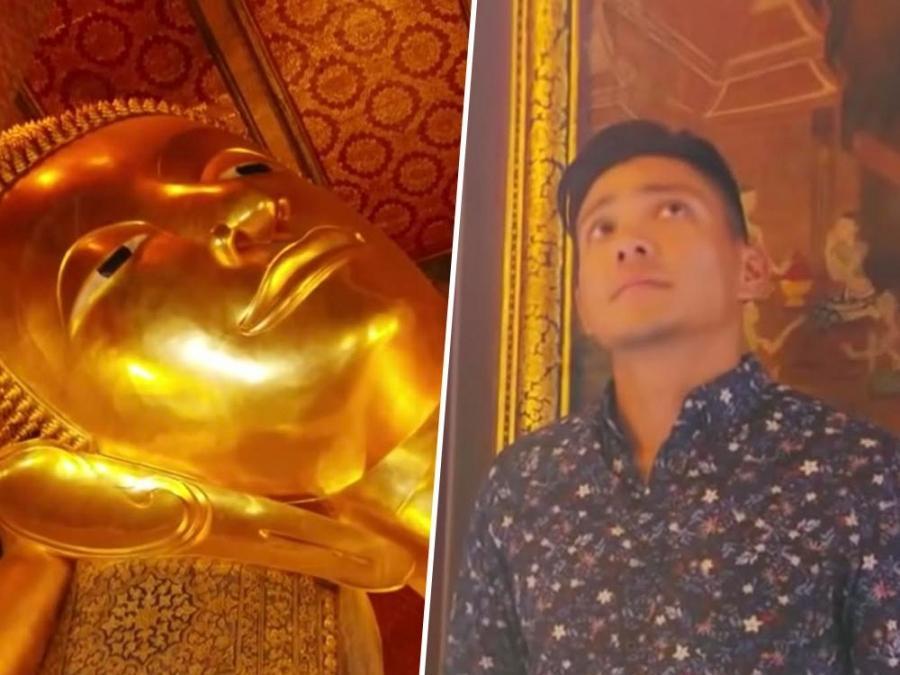
'Biyahe Ni Drew' uncovers the story of Bangkok's Reclining Buddha
Around GMA
Around GMA
Foreign exchange rate, March 13, 2026 | One Western Visayas 40-anyos na babae, patay sa pananaksak ng mister sa loob ng paaralan sa Sarangani Izzy Johnson wins Manila qualifiers of freestyle dance competitionArticle Inside Page
Showbiz News
Have you ever wondered what is the meaning behind the Reclining Buddha? 'Biyahe Ni Drew' finds out.
In the city of Bangkok, Thailand lies the Buddhist temple complex of Wat Phra Cetuphon Wimon Mangkhalaram Rajwaramahawihan, more commonly known as Wat Pho.
Wat Pho is the first temple in Thailand to be classed as the highest grade of the first-class royal temples and one of Bangkok's oldest.
Its founder remains unknown but it was rebuilt by King Rama I around the 16th century and was named after the monastery of the Bodhi tree in India where Buddha is believed to have attained enlightenment.
The overall land area of Wat Pho is 80,000 square meters and is home to more than a thousand Buddha images, four Viharns (sermon halls), and many stupas (Buddhist architecture). But the highlight of every tourist visiting Wat Pho is the Reclining Buddha.
With its impressive 15-meter height and 46-meter width, the gold plated statue feels like it's being squeezed into a building that was built by King Rama III in 1831 and took about 16 years to be completed.
According to tourist guides, the image of the Reclining Buddha represents the entry of the god into Nirvana and the end of all reincarnations.
Similarly, it signifies that just like humans, Buddha needs a little bit of rest, too.
The posture of Buddha is referred to by Thais as “sihasaiyas,” or the posture of a sleeping or reclining lion and is often seen in most Buddhist art, not just in Thailand.
The soles of the Buddha's feet are about 3 meters high and 5 meters long and are inlaid with mother-of-pearl.
Each foot is divided into 108 arranged panels and at the center of each foot is a circle representing a “chakra” or energy point.
Contrary to popular belief, the Reclining Buddha in Bangkok is not a pilgrimage point, although it remains an object of popular piety.
Across the Reclining Buddha are 108 bronze bowls that represent the 108 auspicious characters or “sins” of Buddha.
Locals and tourists may drop coins in these bowls as it is believed to bring good fortune and help monks to maintain the temple.
The breathtaking architecture of Wat Pho, as well as the Reclining Buddha, are enough reasons to visit the complex. With its historic significance, temples, and relics inside, make sure to add this on your travel list.
For now, explore Bangkok, Thailand with the help of Drew Arellano in Biyahe ni Drew:
'Biyahe Ni Drew' tips: Four budget-friendly countries to visit
'Biyahe Ni Drew:' Culinary adventure on the streets of Osaka
