
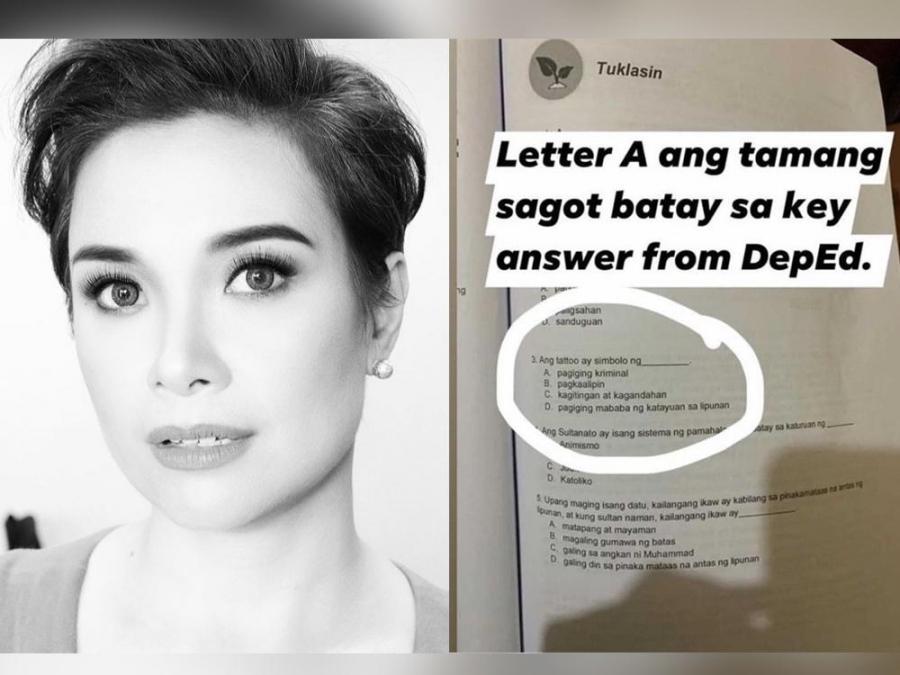
Lea Salonga apologizes to DepEd over 'tattoo' module
Around GMA
Around GMA
Ilang empleyado, naranasang maging Christmas party performer noong bagong hire sila Visually impaired soldier promoted from captain to major Farm to Table: (December 14, 2025) LIVEArticle Inside Page
Showbiz News
Lea Salonga tells the module saboteur: “There's a special place in hell for the likes of you.”
International Broadway singer Lea Salonga has apologized on Saturday, November 21, after questioning the Department of Education (DepEd) about a module linking tattoos to the likes of criminals.
It can be recalled that on Monday, November 16, Lea shared on her personal Facebook account a page from a self-learning module asking students to identify what tattoos symbolize.
The choices provided were the following: being a criminal, being a slave, courage and beauty, or having low standing in society.
Based on the photo, the right answer allegedly indicated by DepEd was “being a criminal.”
“I am this close to getting a tattoo if only to prove a point,” Lea noted on the social media site.
Nevertheless, she also asked fans and friends to send her an original photo to receive a full context of the statement in question, as the other details on the module in question could not be seen in the photo.
In a follow-up post, Lea shared that someone could send her an unaltered photo and apologized for her reaction.
She explained, “Thanks to a direct message (you have my sincerest thanks… you know who you are) sent to me, turns out that the context of that page was such: the discussion was on Philippine History and the significance of tattoos in our culture.”
Lea noted that the correct answer was “a symbol of beauty and courage” and not “that tats are a sign of being a criminal.”
She continued, “So, in my amateur opinion, someone out there wants to make someone else look incompetent. Covering up a big part of the page and making it look like the answer key was marking the wrong letter as correct.
“For my part in this, allow me to apologize. I just want for our kids to get as good an education as they can get.”
“As for the saboteur, there's a special place in hell for the likes of you,” Lea concluded.
Based on history, tattoos are a prominent feature among pre-colonial tribes in the Philippines because a tattoo served as a corporal roadmap to where a person stands within an ethnic group.
It also acts as a protective charm or medal for warriors and symbolizes beauty and fertility for women.
The first documentation of the Philippine tattoo art can be found in the Boxer Codex, also known as the Manila Manuscript, written in the 1590s by the Spaniards, which contains illustrations of the different ethnic tribes within the archipelago.
