Save lives even after you're gone through organ donation
Around GMA
Around GMA
QC fire leaves 4,000 families homeless; 1 dies due to heart attack Cebu makes a special appearance in K-drama 'Boyfriend on Demand' Witness IDs suspect in killing of brgy chief in IloiloArticle Inside Page
Showbiz News
Because you don't need to have superpowers to save a life and be a superhero.
Organ donation is the process of surgically removing an organ or tissue from a donor and placing it to the recipient.
We know it sounds scary at first, but organ transplantation is one of the great advances in modern medicine.
Why? Because a person can donate in as much as 50 organs and tissues to several patients who are eagerly waiting in line to be treated from catastrophic illnesses.
Unfortunately, the need for organ donors is much greater than the number of people who are willing to donate.
The World Health Organization (WHO) shows that deaths caused by various end-stage organ diseases involved up to 230,000 Filipinos in 2017 alone. These deaths may have been prevented by organ transplantation and the number of donors remains dismally low in the Philippines.
Dr. Francisco Sarmiento III of the Department of Health is encouraging Filipinos to see the benefits of organ sharing as a means to help extend life.
To name a few, the human transplantable organs include the kidneys, liver, lungs, heart, intestines, and pancreas, in addition to human tissues, bones, skin, and blood vessels.
He tells The Healthy Juan, “Normal lang naman na 'yung reaksyon ng tao ay matakot pero maaring mabago yung mindset na yan.
“Paano ba? Dapat ma-realize ng tao na being an organ donor could be a meaningful part of life. It's an end-of-life decision kasi dahil sa kanyang desisyon pwede na ito makapagdugtong buhay sa mga nangangailangan.
“Nandyan din 'yung challenge na tuloy ang pakikipagugnayan natin sa ibang ahensya ng pamahalaan kahit sa pribadong sektor para maging aware yung mga kababayan natin sa maidudulot ng organ donation.”
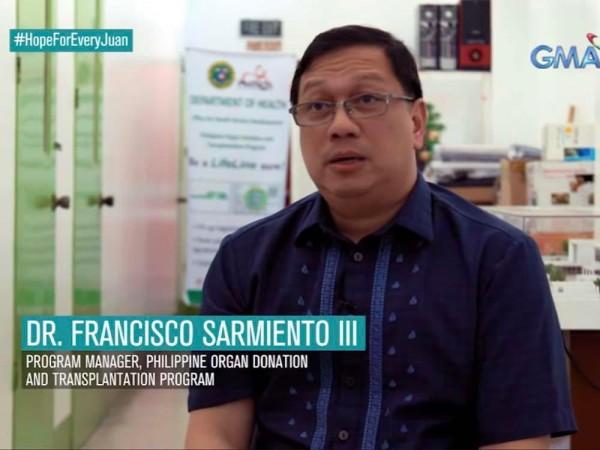
Dr. Francisco Sarmiento III, Program Manager, Philippine Organ Donation and Transplantation Program / Source: GMA Public Affairs (YouTube)
With this, DOH implemented the Philippine Organ Donation and Transplantation Program and the Philippine Network for Organ Sharing to continue to sustain the advocacy and educational campaign on deceased organ donation.
Individuals who wish to be organ donors should complete the following steps:
Join a donor registry at the Department of Health. It is a way to legally give consent for the anatomical gift of organs tissue, and eyes.
Sign and carry an organ donor card which will be issued upon your registration; lastly
Let your family members and loved ones know your desire to be a donor.
Dr. Sarmiento added, “Importante ang konsento o pahintulot sa legal next of kin. Kaya napakaimportante na 'pag nag-sign up ka, ipapaalam mo ito sa mga miyembro ng pamilya mo para alam nila na may meaningful intent ka na makatulong sa iba kahit natapos na yung buhay mo.
“The individual has to maintain a healthy lifestyle para pagdating na ng end-of-life decision, malaki ang chances na lahat ng sinign mo for donation ay pwede natin maibahagi yan.
“Magiging kabahagi ka na ng community.”
Beneath it all, donating your organs highlight the Filipino spirit of bayanihan --- extending help without expecting anything in return.
For more info on organ donation, you may visit www.doh.gov.ph.
