We use cookies to ensure you get the best browsing experience. By continued use, you agree to our privacy policy and accept our use of such cookies. For further information, click FIND OUT MORE.
Make this your preferred source to get more updates from this publisher on Google.
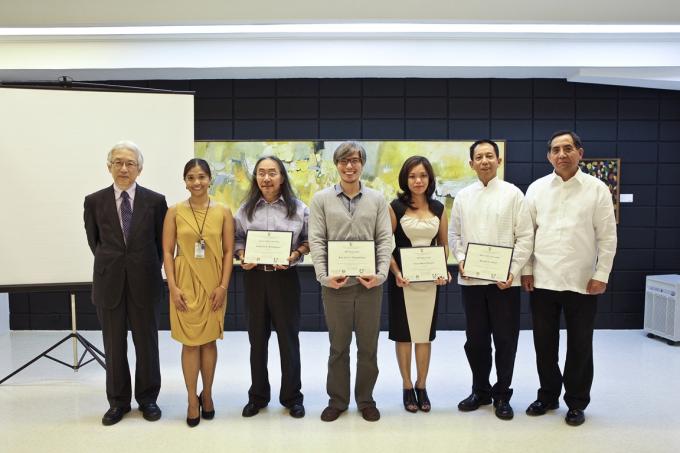
In simple ceremonies held March 8 at the Ateneo Art Gallery, two faculty members of the Loyola Schools – Dr. Ricardo Abad of the Department of Sociology and Fine Arts Program and Dr. Karl Ian U. Cheng Chua of the Department of History and the Japanese Studies Program – were among the four Filipinos who were awarded Asian Public Intellectual (API) Fellowships for 2013-2014.
Dr. Ricardo Abad of the Department of Sociology and Fine Arts Program and Dr. Karl Ian U. Cheng Chua of the Department of History and the Japanese Studies Program were among the four Filipinos who were awarded Asian Public Intellectual (API) Fellowships for 2013-2014.
Dr. Abad, named Senior Fellow, will visit Malaysia for four months starting in March 2014 to examine the process of intercultural theater production in selected theater communities, while Dr. Cheng Chua , named Junior Fellow, will stay in Japan starting this July 2013 for an eleven-month study of disaster education among children in disaster-stricken communities. The other two fellows are in the arts: Senior Fellow Federico S. Dominguez, a visual artist, will create, curate and exhibit a series of murals depicting origin tales and folklore in Indonesia and Malaysia and Junior Fellow Tessa Maria Guazon, art critic and associate professor at the Department of Art Studies, University of the Philippines in Diliman, will travel to Indonesia and Thailand to investigate public art in major urban centers. On hand to award the new fellows were Mr. Tatsuya Tanami, Executive Director of the Nippon Foundation that hosts the Asian Public Intellectuals program and Fr. Jose M. Cruz, S.J., Vice President for University and Global Relations, and Program Director of API Philippines. The Ateneo School of Social Sciences manages the API program in the country. Clarissa Cecile Mijares is the new Program Coordinator. Seeking a link between theater and nation, Abad focuses on the possibility of convivial theater, specifically the sociological process in which two cultural communities, an urban and indigenous group, forge their respective performance traditions in an atmosphere of open and negotiated discourse. Having undergone a similar process in the Philippines with a production of the much-acclaimed Sintang Dalisay, Abad will seek comparative processes operating in contemporary Malaysian theater. From these case studies of intercultural performance, Abad hopes to shed light on how nations can bring together diverse groups to collaborate on a common project. The nation, he argues, is not only imagined but constructed as well. Cheng Chua, in turn, looks at the ways Japanese children learn to confront earthquakes, tsunamis and other disasters – not with fear and panic but with a coolness that comes from preparedness. His focus is on the wide range of media materials that have influenced social response to disasters -- specifically those materials that appeal to children, among them manga and picture books, some of which, he notes, were written by the children themselves. His long-term goal is to introduce similar materials in the Philippine communities and give Filipino children a fighting chance in coping with our own disasters. Dr. Cheng Chua’s choice of project drew inspiration from a visit he made in disaster-stricken areas in Japan last year. The day after the award ceremonies, the four new fellows attended the API Country Workshop where they were formally introduced to the Philippine community of API Fellows. The API program began in 2000, then and now, with five partner countries: Japan, Indonesia, Malaysia, Thailand and the Philippines. To date, thirteen years later, over 300 fellows from these countries have been named public intellectuals who, according to the API Mission Statement, are “academics, researchers, media professionals, artist, creative writers, NGO workers, public servants and others who are committed to working for the betterment of society by applying their professional knowledge, wisdom and experience.” Press release and photo from Ateneo de Manila University


 GMA Brandtalk
 Tracking
 Archives