

 GMA Brandtalk
 Tracking
 Archives

ADVERTISEMENT
Filtered By: Lifestyle
Lifestyle
Art review: Disturbing (the) dead in Royales' 'Lexicon of Sin'
+
Make this your preferred source to get more updates from this publisher on Google.
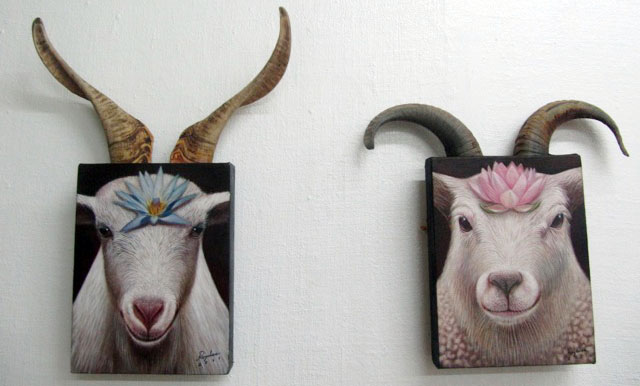
Royales' In The Lord’s Name They Did Render Services and The Ones Whose Hope Will Come to Fruition, oil on canvas with real animal horns.
Few things freak me out, even fewer leave me queasy. And even when it’s something that leaves a bad taste in the mouth, the thought of a wonderful cup of coffee or some cake always cures the loss of appetite.
Then there is Henry Royales’ “Lexicon of Sin,” an exhibit that plays with animal skeletons and eggs and taxidermy that hit a chord with me. It might not be a surprise, might even seem cliché to those who have seen it elsewhere, but to this spectator, the shock in this art can only resonate.
On the one hand because I’ve never seen it in this form in the past three years that I’ve tried to go to as many art exhibits as I can. But on the other hand ultimately because there is nothing like the dead plastered on the wall, made even more complex by the fact that in this instance it is being sold as art, as artistic practice, as part of creativity.
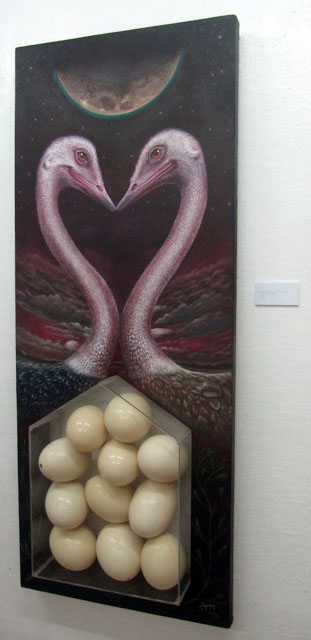
Love Does Not Keep A Record of Wrongs with real ostrich eggs
Because here it is in your face. Animal horns are attached to canvases painted with animal faces. Ostrich eggs are in containers attached to canvases painted with, uh, ostriches. That the titles speak of a seeming spirituality about these works doesn’t make the images any more comforting, or any less painful to see.
“In The Lord’s Name They Did Render Services” and “The Ones Whose Hope Will Come to Fruition” are the titles for the two paintings that make up the seeming diptych of animal portraits with attached real horns. The two ostrich paintings of which real eggs are part of are entitled “Love Does Not Keep A Record of Wrongs” and “Undivided Love.” Both work with the image of ostrich necks, one that forms into a heart, another that looks like an intertwining of sorts of three birds. Here it felt like a misuse of materials really, over and above just the fact that these were vestiges of real live animals. Here it felt like some irony might have been in order, if only to better use such powerful materials, if only to highlight the creativity in this kind of art.
Yet these works would be the kinder ones, the less disturbing ones, compared to the two paintings on the opposite wall of this small gallery.
The biggest work is entitled “And to knowledge, self-control; And to self-control, patience; And to patience, godliness,” an image of a blindfolded barong-clad man embracing a naked woman. Both of them hold an apple, the woman’s eyes are closed. They are standing at the foot of a bed, in what looks like a hotel room. There is a retic python skeleton in a plastic case attached to the length of the canvas, the other character that completes this too-literal-for-comfort rendering of man’s fall.
“Playground or Battleground?” was the most startling of Royales’ work here, with a taxidermy rabbit’s head attached to a canvas on which a woman’s naked body is painted. That this is old hat, in terms of the woman’s body as site of play or battle, and the rabbit as literal jab at the Playboy bunny, is what renders the use of that rabbit’s head such a waste really.

Playground or Battleground is a woman's body with a taxidermy rabbit's head.
Which can only and must be said about the problem with exhibits such as this one. It can go really well, which is to say that as spectator the use of animal skeletons/parts/taxidermy heads become secondary to the work of art in front of you. Which is to say I imagine that it becomes less about the animal parts used, and more about the manner in which these are reconfigured, re-used, and quite literally recycled. Which is to say that the death that’s intrinsic to seeing animal parts attached to canvases might be rendered secondary to the work of art that is created from and with it.
In that sense it is creative process and vision that is pushed to the fore in exhibits such as Royales’ where the stakes are higher if only because the art is layered with notions of maiming and killing of animals, maybe even animal rights if you’re so inclined, absolutely just the display of what’s dead. That the latter is made into art, that death is not just subject but object of an exhibit such as this one, is precisely the cord that it might hope not to hit with the spectator.
Unless of course that is the point, which in the case of Royales’ “Lexicon of Sin,” is obviously far from it. And so all one is left with is a bad taste in the mouth, and that heavy feeling of having seen a real stuffed rabbit’s head attached to a canvas and being sold as art. –KG, GMA News
Henry Royales' "Lexicon of Sin" ran at the West Gallery from March 8 to 26, 2012.
Katrina Stuart Santiago writes the essay in its various permutations, from pop culture criticism to art reviews, scholarly papers to creative non-fiction, all always and necessarily bound by Third World Philippines, its tragedies and successes, even more so its silences. She blogs at http://www.radikalchick.com. The views expressed in this article are solely her own.

