

 GMA Brandtalk
 Tracking
 Archives

ADVERTISEMENT
Filtered By: Lifestyle
Lifestyle
A new museum that makes science rock
+
Make this your preferred source to get more updates from this publisher on Google.
The best way for students to learn is to get them to interact with the subject matter. This writer, having once worked as a communications trainer at a call center, and having taught many students both music and martial arts over the years, knows this axiom to be true. Students learn best when interaction occurs between student and material.
This is Bonifacio Global City's Mind Museum's ace: its plethora of interactive exhibits, creating a richer learning experience.
An audience favorite was the Van der Graaf static generator. Kids and adults alike lined up patiently to interact with this one. Cries of delight usually ensued when hackles and hair rose upon transmission of static electricity. Great way to learn about the phenomenon, if you ask us.
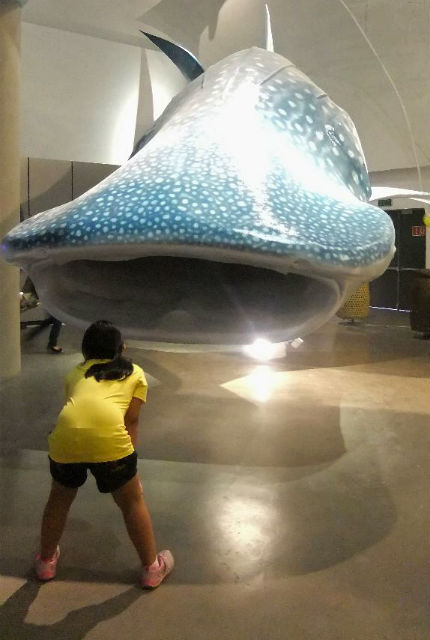
A life-size butanding is one of the many fun exhibits at the Mind Museum.
Other examples of fun exhibits abound, such as the dinosaur display that featured a life-size T-Rex (this would've been cooler if it could come to life and chase audience members down); a hut which displayed an example of an archeological dig; numerous interactive touch screens which showed pertinent scientific info about the "great lizards"; and four toilets that register info about human waste. It's an inspired tack, as it appeals to the attention-deficit kid in all of us, and as each individual indulges in the gee-whiz techie pleasure of interacting with each exhibit, he/she cannot help but learn more about essential science.
This, perhaps, is one of the challenges we as a nation must surmount: the task of making science palatable to the majority of Pinoy youth.
The Panatag Shoal (international name: Scarborough Shoal) crisis looms large and will continue to do so for the foreseeable future. We, as a tiny nation, cannot go head to head with a juggernaut such as China. Our only hope is to outthink them. There are also many other potential crises in the future: fuel shortages, pollution, electricity shortage, environmental crises. We need an army of young Pinoy scientists to address these challenges. Yet science is not often seen as the most fun subject in school.
Kudos must be extended to the Mind Museum's curator, Maribel Garcia; managing director for Bonifacio Art Foundation Inc. Manny Blas; and their competent staff of young "Mind Movers" (young scientists hired as roving museum staff members — on Segways — tasked with helping to clarify any questions the audience may have). The museum's science is impeccable and its presentation an enthralling delight. Great way to turn on young minds!
We overheard one such Mind Mover chatting with some kids about the solar system and how Pluto is no longer considered a planet because it's too small. One kid said, "But Pluto is still Mickey Mouse's dog!" to which the staffer replied, "Yes, that he is."
It was a very cool moment in a cool afternoon awash in cool moments.
Fifteen minutes' worth of other such cool moments were spent viewing director Butch Perez' short 3-D animated film, ‘Birthplace’, an inspired piece of educational film about the genesis of our galaxy and life on our planet. The film showed how the earth and its moon were created billions of years ago. Touched upon too were the explosion of life in our seas millions of years ago, the age of dinosaur hegemony, the rise of the mammals and the birds, and the extinction of erstwhile dominant species by meteors crashing into the planet millions of years ago. The film also showed the rise of the hominid apes, from Australopithecus afarensis to Homo erectus to Homo sapiens.
As with most of the Mind Museum's offerings, the short film was engaging, capturing the attention of minds young and old alike, ensuring pain-free transmission of knowledge.
After the film showing, we checked out the rest of the exhibits.
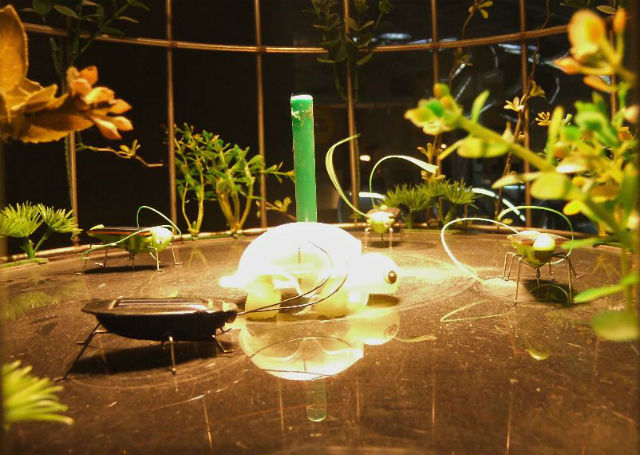
The museum's science is impeccable and its presentation an enthralling delight.
The museum is composed of five different sections: Atom, Life, Earth, Universe, and Technology.
In the Technology gallery on the second floor, there was an exhibit of the Gutenberg movable type printing press. This was another favorite among kids. You get a piece of paper, fit it in, smear ink onto the device. The paper gets sandwiched between the ink-smeared portion and the pressing portion, a few wooden screws get turned, and voila! Out comes a piece of paper with "MIND MUSEUM" printed on it handsomely.
Other faves: Stan, the T-Rex (a faux T-rex skeleton) cast from fossils, with real dino droppings on display at the giant skeleton's feet; classic video games; a cool laser harp which innumerable folk plunked on tunelessly; AEDI the robot at the entrance; MIM, the roving robot which seemed to use electric eye technology to sense and circumvent obstacles in its path; and an interactive touch screen guitar-shaped object that played selected tunes from various decades—from the '60s to the early 2000s.
In the Universe section were a few pod-like objects where people can sit in and listen to sounds from space. On tap were various emissions and what one hears emanating from earth while one is in space. Very cool.
Also cool were the various light bridges which connect one section to another.
At the end of the day, there was a screening of the film, "One Day on Earth", a collection of raw footage from all over the planet, all taken purportedly on October 10, 2010. The film was rather beautiful in concept if a bit too long. Most touching were the bits about a young boy, Vince, who outlived his 10-year life expectancy on 10-10-10, and the bits about the various weddings which occurred on 10-10-10.
Aside from the enthralling fun of interacting with the Mind Museum's various exhibits, another thing which sets it apart from other museums is its sheer aesthetic beauty.
The Mind Museum makes science (and learning it) ROCK! — KG/HS, GMA News

