

 GMA Brandtalk
 Tracking
 Archives

ADVERTISEMENT
Filtered By: Lifestyle
Lifestyle
A dialogue of in-betweens in 'UnBound'
+
Make this your preferred source to get more updates from this publisher on Google.
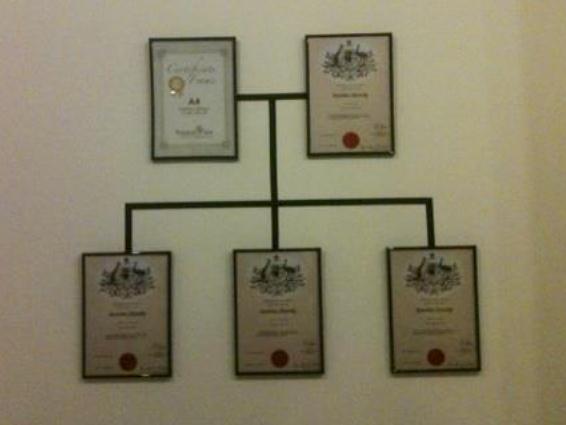
Citizenship certificates turn into art in Juni Salvador's "They who wait..."
Filipinos are masters at transition and migration, flying off to the most remote parts of the world to find a better life, or at the very least a better salary, for themselves and their families. Many Pinoys are all-too familiar with the struggle of adapting to a new culture while preserving their own.
But beautiful things often come out of that struggle—many poems, stories, films, and songs have been built on the neither-here-nor-there crisis that most Filipinos abroad experience.
In “UnBound,” the struggle takes on the form of visual art crafted not only by Filipino artists living in Australia, but by Australian artists living in the Philippines.
The result is an exhibit that truly crosses cultures and transcends boundaries, an exchange not only of Filipino and Australian identities, but also of the identities that exist between the two spaces.
“How culture is transported, repackaged by these artists, and then interpreted by local audiences, sits at the core of this exhibition. It is both an expression and a questioning of our times,” curator Gina Fairley said.
For the exhibit, Fairley selected six artists who divide their time between Australia and Manila.
Among them are Tony Twigg, who has been shuffling between Sydney and Manila for 20 years; Diokno Pasilan, who lives between Melbourne and Palawan; Juni Salvador, who relocated to Sydney in 2007 but maintains a Manila studio; David Griggs, born in Australia and living in Quezon City since 2009; Maria Cruz, who lives in Berlin, but was born in Manila and studied in Australia; and the team of Alfredo and Isabel Aquilizan, who came from Cagayan Valley and Manila respectively, but are now based in Brisbane.
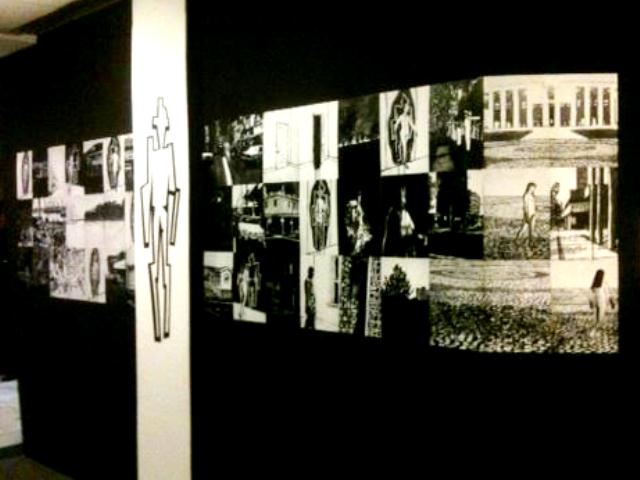
Tony Twigg's digital print, "we seem to arrive in places twice, first in space when we name the destination, second in time when our destination names us"
“The artists in this exhibition have been particularly committed in their desire to live and work across our two countries—one that has been driven by passion,” Fairley explained.
“As a curator, it is fabulous to work with material that connects with audiences of different locations in unique and local ways. Clearly it is this passion that is felt,” she added.
Twigg’s kilometrically-titled work, “We seem to arrive at places twice, first in space when we name the destination, second in time when our destination names us,” heralded viewers as they entered the exhibit, setting the tone for the rest of the show. The black and white piece was a play on space and dimension, only emphasized by its absence of color.
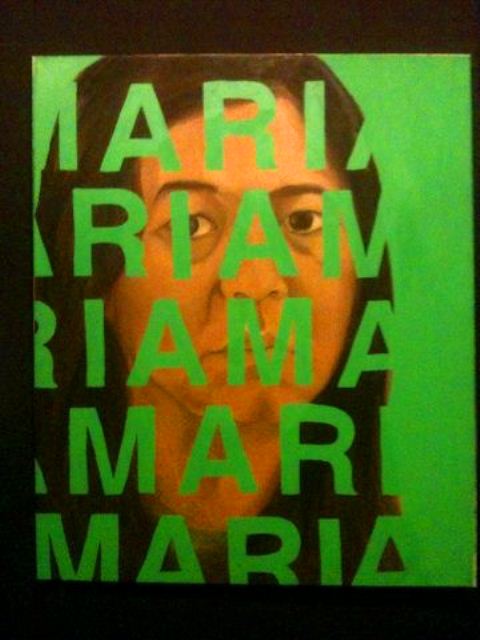
A self-portrait by Berlin-based Maria Cruz
The rest of the pieces were just as unconventional, and many of them were not simply paintings, but art installations that made use of various media and material. There were videos, digital prints, sculptures made out of found objects.
Even the works that could be classified as paintings were not simply displayed on the wall, but were arranged in meaningful collages, or used as material for an art installation such as in the Aquilizans’ “Shift: Another Country,” which consisted of 300 tourist paintings lined up in a panel.
The unusual quality of the art only reinforced the theme of transition, and magnified the motif of an in-between space if only because the pieces were harder to classify or label—unbound indeed.
All the mundane things that make up a migration were also used in a lot of the artworks, juxtaposing the ideas of home and away through the familiarity of the material and the unusual way in which they were used and presented.
For instance, “Passage” by the Aquilizans was a patchwork of balikbayan boxes and packing tape, while Salvador’s piece “They Who Wait” featured a family tree of framed Australian citizenship certificates. The same artist’s work, “Boomerang…neither here nor there” was a video clip of a boomerang in various everyday settings like the kitchen, and the laundry room.
Some of the other works tackled the question of identity: Cruz’s “Maria” was a portrait of a woman hiding behind the letters of her name; Grigg’s “Cowboy Paintings” was a series of portraits of nameless people of ambiguous origin; Pasilan’s “Senior Citizen series” featured photographs of aged men and women staring out from the canvas as their memories were written out in coffee behind them.
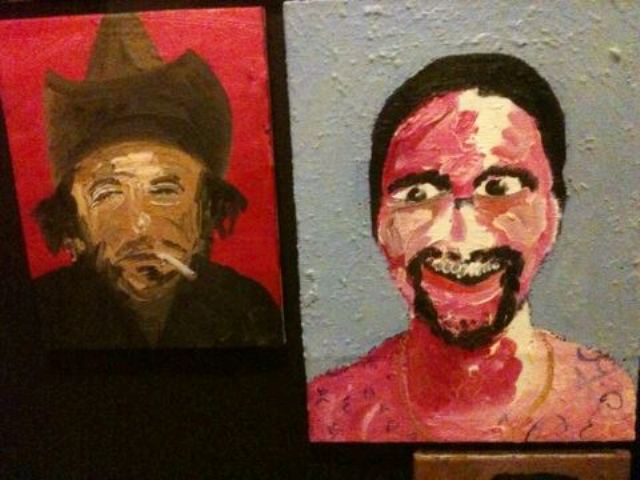
Two of David Grigg's series of portraits, "Cowboy Paintings"
In her exhibition notes, Fairley wrote, "UnBound explores how culture can move beyond physical boundaries and the cartographic disposition of nation-based exhibitions and prepackaged notions of exchange."
"Our world is shrinking and our capacity to bounce between locations has become unbounded," she added. "It promotes a hyphenated identity that throws up fresh thoughts on how we define concepts such as assimilation, belonging, memory, and movement in our times." —KG, GMA News
UnBound will run until today, Feb. 20, at the Yuchengco Museum at the RCBC Plaza, Makati.

