

 GMA Brandtalk
 Tracking
 Archives

ADVERTISEMENT
Filtered By: Scitech
SciTech
New car side mirror removes blind spot
+
Make this your preferred source to get more updates from this publisher on Google.
A mathematics professor has received a United States patent for designing a vehicle side mirror that removes the so-called dangerous blind spot.
Dr. R. Andrew Hicks of Drexel University created a mirror shows a wider field of view of about 45 degrees, compared to 15 to 17 degrees of view in a flat mirror:
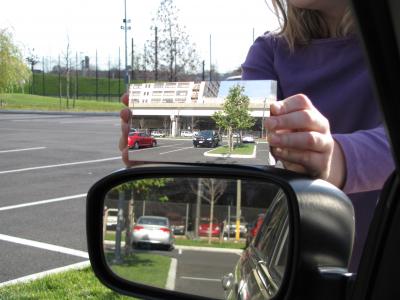
Photo credit: R. Andrew Hicks, Drexel University
The subtly curved mirror “dramatically increases the field of view with minimal distortion,” according to an article posted on Phys.org.
Phys.org said the professor received a US patent for the mirror last May.
“Hicks’s driver’s side mirror has a field of view of about 45 degrees, compared to 15 to 17 degrees of view in a flat driver’s side mirror. Unlike in simple curved mirrors that can squash the perceived shape of objects and make straight lines appear curved, in Hicks’s mirror the visual distortions of shapes and straight lines are barely detectable,” Phys.org said.
While traditional flat mirrors on the driver’s side of a vehicle give drivers an accurate sense of the distance of cars behind them, they have a very narrow field of view.
Because of this, there is a space behind the car - the proverbial blind spot - that drivers cannot see via either the side or rear-view mirror.
A curved mirror can give the driver a wider field of view, but it may cause some visual distortion and make objects appear smaller and farther away.
‘Disco ball’ effect
Hicks, a professor in Drexel’s College of Arts and Sciences, designed his mirror using a mathematical algorithm that controls the angle of light bouncing off of the curving mirror.
“Imagine that the mirror’s surface is made of many smaller mirrors turned to different angles, like a disco ball. The algorithm is a set of calculations to manipulate the direction of each face of the metaphorical disco ball so that each ray of light bouncing off the mirror shows the driver a wide, but not-too-distorted, picture of the scene behind him,” Hicks said.
But he said that in reality, the mirror does not look like a disco ball up close. He said there are tens of thousands of such calculations to produce a mirror that has a smooth, non-uniform curve.
Not in US cars any time soon
Despite the potentials of Hicks’ mirror, Phys.org said the gadget may not be equipment on cars in the US because regulations there dictate that cars coming off of the assembly line must have a flat mirror on the driver’s side.
Curved mirrors are allowed for cars’ passenger-side mirrors only if they include the phrase “Objects in mirror are closer than they appear.”
“The mirror may be manufactured and sold as an aftermarket product that drivers and mechanics can install on cars after purchase,” it said.
However, it said some countries in Europe and Asia allow slightly curved mirrors on new cars, and Hicks has received interest from investors and manufacturers who may pursue opportunities to license and produce the mirror. — TJD, GMA News

