The Ateneo de Manila University Blue Eagles' quest for five straight championships came to a close with a title-clinching win last Thursday against the University of Santo Tomas Growling Tigers, as ADMU swept the Finals series against their foes. It was only fitting that the team that fueled Ateneo's hunger to win a championship was the team they needed to dispatch in order to win their fifth crown. Back in 2006, Ateneo dominated the UAAP, only to find themselves coming up short in the Finals, as UST head coach Pido Jarencio and his charges overcame a last-minute miracle shot by Doug Kramer in game one. They would move on to win the next two games, enough to secure the Season 69 crown. This year though, ADMU head coach Norman Black was able to close the book on his highly successful UAAP career by beating UST, the team that denied him his first collegiate title, en route to a fifth straight championship. It was a hard battle, and a long and grueling journey that is now at its end. That said, the question remains - how exactly did Ateneo do it? And with that in mind, what could have UST done differently? MIA - Karim Abdul As previously mentioned, each team has their own strengths and weaknesses, and the easiest path to victory would be for each team to concentrate on the aspects of the game that they could dominate. For all the talk of UST's depth, they actually lacked the manpower up front to defend the biggest guy in the league, 7'0" Greg Slaughter. Once you get past starting center Karim Abdul, the Growling Tigers were forced to field in undersized Paolo Pe (6'4'), as they were reluctant to field in the tall, but raw, Robert Hainga, and it was evident that Ateneo wanted to take full advantage of this situation. Compared to his lackluster Finals game one, Slaughter was aggressive all throughout game two. He used almost 34.1 percent of his team's possessions while he was on the court, indicating both ADMU's clear goal of involving him on offense, and a renewed aggressiveness from the big guy. Had it not been for five turnovers, the graduating center would have had an excellent game. On the other side of the fence, Abdul was clearly bothered throughout the Finals by Ateneo's defense. Outside of isolation situations versus Slaughter and the occasional mid-range jumper, Abdul was completely shut down. In two games, Abdul shot just 28 percent from the field on 25 attempts, and made just 3-of-11 free throws, far cries from his regular season numbers.
| | Regular Season | Finals |
| Minutes per game | 34.6 | 35.5 |
| Offensive rating | 100.99 | 62.55 |
| Usage | 24.95% | 21.48% |
| True shooting percentage | 51.5% | 28.29% |
| Effective field goal percentage | 47.1% | 28% |
| Assist percentage | 11.5% | 7.66% |
| Turnover rate | 16.00% | 11.75% |
Outside of turnover rate, all of Abdul's regular season numbers went down. During the entire Finals, I remember Abdul taking only around five easy layups, so credit must go to ADMU's coaching staff and their bigs for not allowing him to dominate the way he did in the regular season.
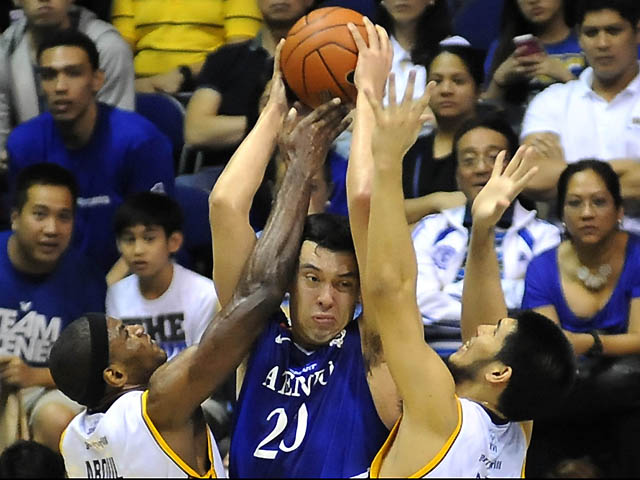
Greg Slaughter (center) was able to out-perform Karim Abdul (left) and Paolo Pe (right). KC Cruz
Ateneo turned out to be the hungrier team “This series is about experience vs hunger.” That was a quote that went around the internet and newspapers which was supposed to define this Finals series – Ateneo’s experience (being in the Finals for a fifth consecutive time) versus UST’s hunger (their first trip to the Finals since 2006). It was a quote that seemed to undermine ADMU’s “hunger.” The idea of “hunger” is usually actualized in the rebounding category. Getting an offensive rebound requires a lot of effort because you are usually out of position. A defender usually places himself between the ring and the basket. As such, when a shot goes up, a player who wants to get an offensive rebound needs to fight through his defender’s box out in order to get a puncher’s chance at an offensive rebound. It requires timing and skill, but most importantly, it requires effort and hard work. On the other side, getting a defensive rebound also requires effort and hard work. You need to box out, keep your man out of a rebounding position while facing the basket (which is a hard skill to acquire) and hold your position. It’s easier than getting an offensive rebound, but it’s still hard. Lastly, rebounding requires one important 'skill' – the desire to get the ball. In the end, all the effort, hard work and skill usually goes out the window if you don’t have a nose for the ball. Dennis Rodman, one of the best rebounding players in the history of the NBA, despite being just 6'6", used to say, “I’m hungrier than those other guys out there. Every rebound is a personal challenge. The one thing I do that nobody else does is jump three and four times to get one rebound.” In the two Finals games, Ateneo won the offensive rebounding battle by 1.7%. Compared to the regular season, where they lost by around 2.46%, this was surprising turnaround. In fact,
this is probably the key to the series that I never thought Ateneo would be able to achieve, as I expected the Blue Eagles to get trashed in this category. The numbers certainly pointed in that direction - Ateneo was below average on the glass, ranking seventh in offensive rebound rate differential, while UST was dominant in that regard, ranking third in the same category. Instead, what happened was Ateneo showed what hunger and experienced looked like when mixed together, and the result was 360 degree turn on the boards. The biggest factor for this reversal? On the offensive glass, it was Greg Slaughter, improving on his already solid offensive rebound percentage. Entering the Finals, the graduating big man's offensive rebound percentage was 8.35 percent, 17th in the league for players who had logged at least 15 minutes a game. During his last collegiate series, Slaughter got that up to 18.7 percent in 28.5 minutes a game. For comparison's sake, DLSU's Arnold Van Opstal, the best offensive rebounding player in the league this year, rebounded 17.1 percent of his team's misses while he was on the court for about 16.3 minutes per game. Normally, as the minutes go up, the rebounding percentage goes down since there will be more rebounds up for grabs, thereby decreasing the percentage of rebounds you get. This simply was not the case with Slaughter. The other guy who did a lot of heavy lifting in this category is Ryan Buenafe. Buenafe averaged 30 minutes per game in this season's Finals, where he rebounded approximately 23.1 percent of UST's misses, perhaps the most important contribution the former Finals MVP made. That is in addition to some ace shot creation in the high post, where he engineered many opportunities for the Eagles, none more impressive than his bullet pass to a baseline-cutting Justin Chua. A special tip of the hat should also be made to this guy for gutting out game two despite a fever. Though he didn't score, his 11 boards and five assists are nothing to sneeze at. It's not Michael Jordan flu game-esque, but in terms of the UAAP scene, it is right up there.
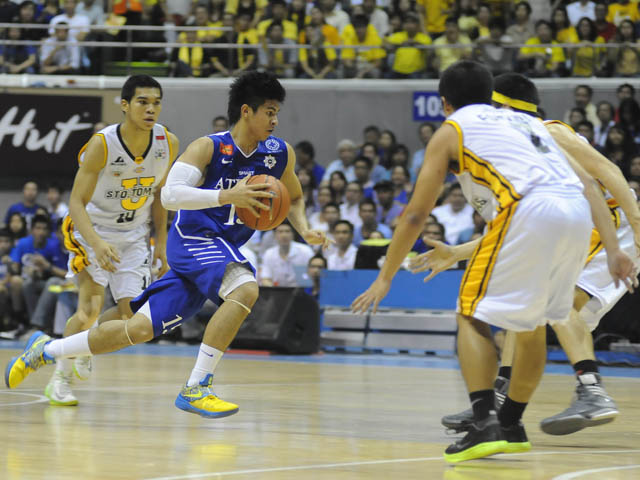
Kiefer Ravena (center) was able to speed by the UST defenders. KC Cruz
UST couldn't contain 'The Phenom' During the Final Four, the DLSU Green Archers were put into a position by Ateneo, wherein the Taft-based squad
had to pick their poison from among the Blue Eagles' many scoring options. The Archers selected Kiefer Ravana, and last season's Rookie of the Year torched them all throughout the fourth quarter, en route to the win. In the Finals, UST did not learn from the Archers' mistake, and allowed Ravena to dominate as well. True, the Growling Tigers defense forced Ravena to miss more than his fair amount of shots, but the sophomore guard did a lot of things, other than put the ball into the basket. He pulled down offensive rebounds, turned the ball over less, and just as importantly, converted free throws at a much higher rate than in the elimination round.
| | Regular Season | Finals |
| Offensive rating | 106.17 | 120.67 |
| Usage percentage | 23.8% | 22.4% |
| Effective field goal percentage | 49.4% | 44.4% |
| Free throw percentage | 77.0% | 91.67% |
| Free throw attempts per game | 5.3 | 6 |
| Offensive rebound percentage | 3.4% | 6.1% |
| Turnover rate | 14.2% | 5.8% |
Again, UST didn't take the ball out of Ravena's hands (His usage percentage took just a slight dip), but they did manage to make him miss more (His effective field goal percentage dipped five points). That said, great players find ways to impact the game in other aspects, and Ravena did just that. In basketball, the effect of one person is more profound than in other sports, because a team can only have five players on the court. Compared to other sports such as football, American football, or hockey, you get a sense of just how valuable a single player can be for a basketball team. When you boil it down, Ateneo had the best player on the court, one that was flanked by a supporting cast that wanted to finish what they started, which was exactly what they did. Next season of course, will be a completely different thing, with key players and their head coach missing from Ateneo, while UST returns virtually intact, save for their starting point guard Jeric Fortuna. Recruits still need to be wooed, and there's an entire offseason to scheme. It goes without saying that one can definitely expect change, come Season 76.
- AMD, GMA News Nico Baguio holds a Masters Degree in Mathematics from the Ateneo de Manila University. He's currently a writer for SBNation's At The Hive and runs a website that focuses on using advanced statistics on the local hoops scene, Humble Bola. You can email him at contact@humblebola.com. You can also follow him on Twitter. 

 GMA Brandtalk
 Tracking
 Archives


