
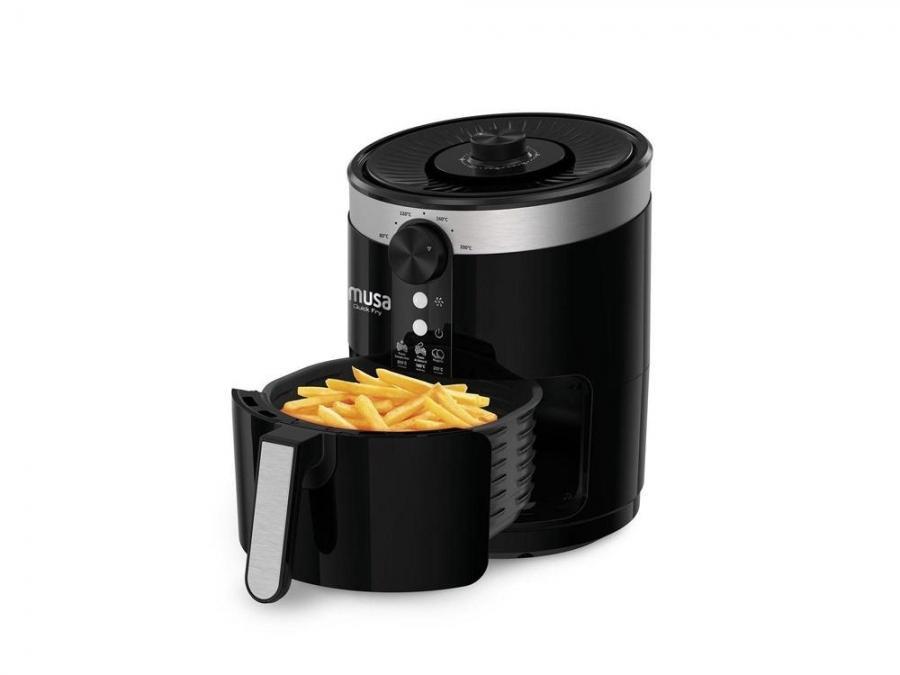
Kitchen wars: Is the Air fryer better than the turbo broiler and convection oven?
Around GMA
Around GMA
Lalaking nakasalubong ng isang pulis, naging mitsa ng gulo | GMA Integrated Newsfeed 'Straight from the Expert: Beauty Queen Boot Camp Part 2' teaser Impeachment complaints batok VPSD, gideklarang ‘sufficient in substance’ | One MindanaoArticle Inside Page
Showbiz News
The air fryer is on everyone's wish list nowadays. But should you really get one?
If you didn't turn into a plantito or plantita during this pandemic, chances are you've become a capable cook with a few specialties under your belt.
Regardless of your skill level, you probably have heard about the air fryer - the toast of the ever-evolving kitchen world in recent years.
The air fryer was unveiled in 2010 by Dutch brand Philips during an electronics fair in Berlin, Germany.
Its technology was revolutionary, to say the least.
A small countertop convection with deep-frying capabilities but without the oil - now, that's new and unimaginable until then.
More importantly, the air fryer tapped into the growing health-conscious consumer market that would only grow from strength to strength in recent years.
In the US alone, it was estimated that nearly 10 million units of air fryers were sold in the country from May 2017 and March 2019.
Then COVID-19 struck and the air fryer found itself becoming even more popular among households.
Thanks to the resulting lockdown, people who didn't give much thought or scoffed at the air fryer started giving it a second glance.
More people were also forced to cook at home and looking for “healthier” options to serve on the table.
To sum it up, the air fryer is the perfect kitchen gadget for its time.
HOW IT WORKS
Air fryers do their job by relying on the circulating hot air to cook food that is commonly submerged in oil to be cooked.
Heat radiating chambers and a fan distributes the hot air - which can rise to 230 °C (445 °F) - to both soften the food while giving it a crunchy exterior.
AIR FRYER AGAINST OLD TIMERS
The arrival of the air fryer undoubtedly revolutionized cooking as we know it.
But as groundbreaking, as it is, its technology draws comparison to reliable kitchen veterans such as the turbo broiler and convection oven.
The comparison makes sense as all three uses circulating hot air to cook or bake food.
A turbo broiler uses infrared/halogen light heat. A convection oven, meanwhile, is equipped with a fan and exhaust system to produce the needed heat.
With all things considered, the air fryer, turbo broiler, and convection oven share the same methods with great results.
The difference is that the air fryer circulates the air faster, significantly cutting down the cooking process - a big plus regardless if you're a casual or expert cook.
An air fryer works best on frozen food and is pretty much a plug and play device.
Air fryers boast of many settings suited for various food types, which is another come on.
Modern technology has a lot to do with this innovation, apparently, and the air fryer found a way to combine all these methods to come up with more efficient results.
On the downside, air fryers are generally smaller than a convection oven so there's only a limit on how much you can put inside of it.
This is where a convection oven and even a turbo broiler come in handy as both have enough space to accommodate whole foods like chicken or fish.
But whatever your preference is (and budget), all three - air fryer, turbo broiler, and convection oven - are sure to make your time in the kitchen more pleasant, and your food tasting good and even healthy to some degree.
Want more lifestyle content like this? Head out to GMA's Lifestyle page.
