
We use cookies to ensure you get the best browsing experience. By continued use, you agree to our privacy policy and accept our use of such cookies. For further information, click FIND OUT MORE.
How foreign powers shape what we see and believe online
Guest: Prof. Rachel Khan, UP Journalism Department
How China is swaying global public opinion — an analyst explains
Guest: Janina Santos, Research Analyst, DoubleThink Lab
How are foreign powers influencing public opinion in the Philippines?
Guest: Giano Libot, Open-Source Intelligence (OSINT) Analyst
Professor Rachel Khan of the University of the Philippines Journalism Department defined FIMI as an external influence or external sources of disinformation operating outside the country.
She said FIMI is a coordinated campaign organized by a group.
“[T]his one is bigger because it's a campaign among either several bloggers outside the country or really institutions that either produce inauthentic, coordinated disinformation or have influencers, individual influencers that want to manipulate the local public sphere,” Khan said.
FIMI grew with the rise of social media, a platform that could influence domestic policies.
It also poses danger since it doesn’t need much capital and people to conduct disinformation.
But unlike local troll farms, where they are more or less authentic paid users, sources of FIMI are harder to detect since they involve another country.
“You know that it's coming from outside, but you don't know whether it's operated or the source is an outside state or a local paying an outside provider,” Khan said.
Meanwhile, Janina Santos, research analyst at DoubleThink Lab, said that in identifying a FIMI, one should not only examine the narrative’s truth and veracity, but also its intention or objective.
“Is it manipulating me into believing in something or to act a certain way?” Santos in a separate interview.
Ep. 1: How foreign powers shape what we see and believe online
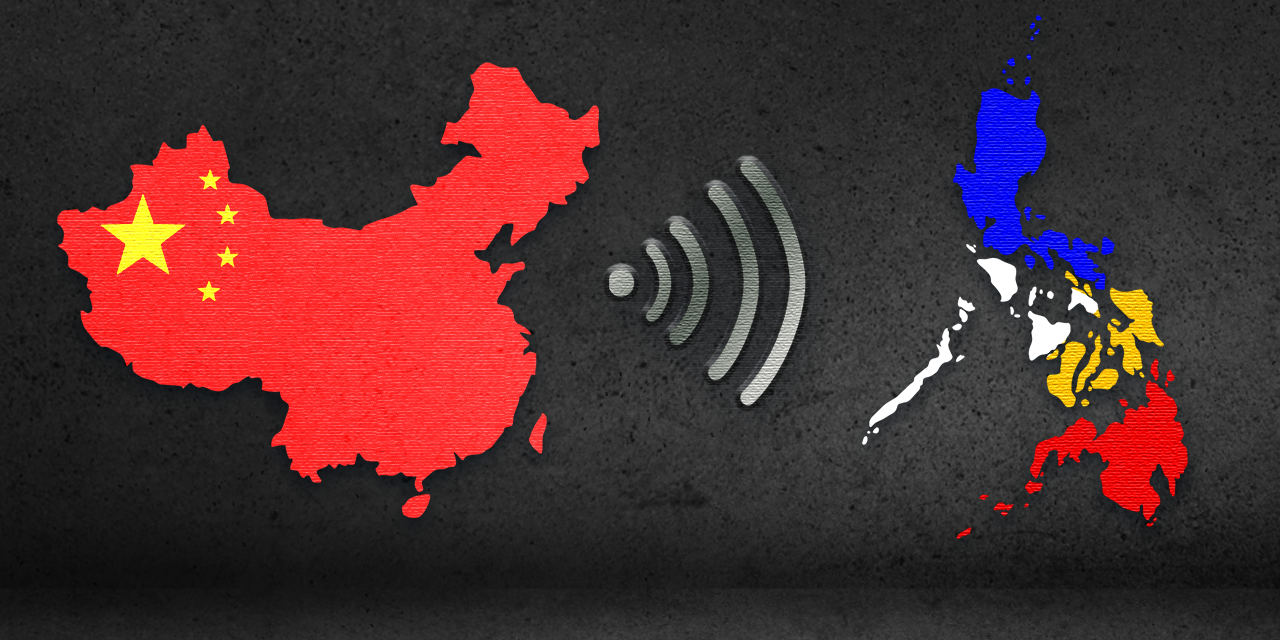
China engages in FIMI by how its news agencies frame issues related to the West Philippine Sea.
“If you just read the news every time there's a conflict in the West Philippine Sea, you would already read that they have a totally different and often fictitious account of what happened,” Khan said.
“Then there's a natural assumption that it's also being done in the unofficial sites or their unofficial influencers,” she added.
Unlike in democratic countries such as the Philippines, propaganda is accepted in China, said Giano Libot, Open-Source Intelligence (OSINT) analyst.
“For the Chinese and the Chinese state, propaganda is actually part of the accepted arsenal of the state to forward its interest and agenda,” Libot said in another interview.
He warned about the lack of accountability for local actors who become complicit in the spread of manipulative narratives.
Libot clarified that while the Chinese Communist Party influences information in the Philippines, accountability should not fall solely on foreign actors, as some Filipinos pander to these operations for personal or political gain.
This can be observed during the 2022 presidential elections, where P1.5 billion was spent on influence operations, Libot said.
“It's an unregulated system. There's no paper trail, there's no contracts,” Libot said.
China has not only influenced the country’s politics but also infiltrated the Philippine media, according to Santos, citing engagement particularly with state-controlled media and foreign trips for journalists.
“There were a lot of exchanges of information, as well as content. Content from the PRC (People’s Republic of China) state media is sometimes published on our state media as well. So may (there’s) content-sharing agreements,” she said in a separate interview.
“They take our journalists to China supposedly to train them and improve their journalistic skills, but then, they are also given tours of several Chinese facilities and even in parts of the country that are supposedly rife with human rights violations,” she added.
Aside from the media, China state-aligned actors also present themselves as think tanks and academics, who publish articles that are more aligned with the Chinese narrative, which also affects the Philippines.
"The purpose of the PRC is to have a local impact within the country, within the policies of the country. But then, because of this high influence, it's starting to have a regional impact,” Santos said.
“It’s very difficult to use the ASEAN as a mechanism for us to advance our interests because China has a lot of influence in those countries,” she added.
However, China’s influence on the Philippines dropped from seventh in the 2022 China Index to 29th in 2024.
This came after the shift between the Duterte administration to the Marcos administration, Santos said.
She added that there are also transparency initiatives in the West Philippine Sea and the formation of strategic partnerships with other countries in terms of defense.
Ep. 2: How China is swaying global public opinion — an analyst explains
Whether it is used to manipulate beliefs or to educate with authentic information, the responsibility for handling social media still lies with the user.
Khan urged the public to engage in pre-bunking, a communication strategy that aims to prevent people from being misled by misinformation before they are exposed to it.
“[I]f you are going to use the same technology to fight disinformation, then it is for the positive, like what we call pre-bunking, like to give out the correct information or to have a rapid response when you are being attacked by disinformation,” she said.
“Basically, that's using the same technology that disinformers use but to a positive and good, in a good way,” she added.
However, fighting FIMI is not only the Philippines’ media’s job because it is targeting the country’s society, information environment, way of life, and security.
“If we shift our lens to pakikipagkapwa instead of looking at each other as adversaries, then maybe we can have a better conversation about things and lessen the gap between people,” Santos said.
“And it's by lessening that gap that we also create more resilience to information manipulation and influence operations,” she added.
Instead of relying on correction, Libot called for a change in mindset in addressing undiscerning people.
“If you have somebody in your household who needs help, don't question their decision first. Ask them, you know, "Why did you come up with that decision?" Trace back. Provide them the necessary ways to be able to interrogate the question on their own,” Libot said.
“If ever they come up with a decision, whether it's the same or not, at least you know that it's coming from an informed place and not something that skewed against certain individuals or a certain politicians favor,” he added. —LDF/NB, GMA Integrated News
Ep. 3: How are foreign powers influencing public opinion in the Philippines?

