

 GMA Brandtalk
 Tracking
 Archives

Teacher seeks TRO vs. DepEd memo removing strands in Senior High School
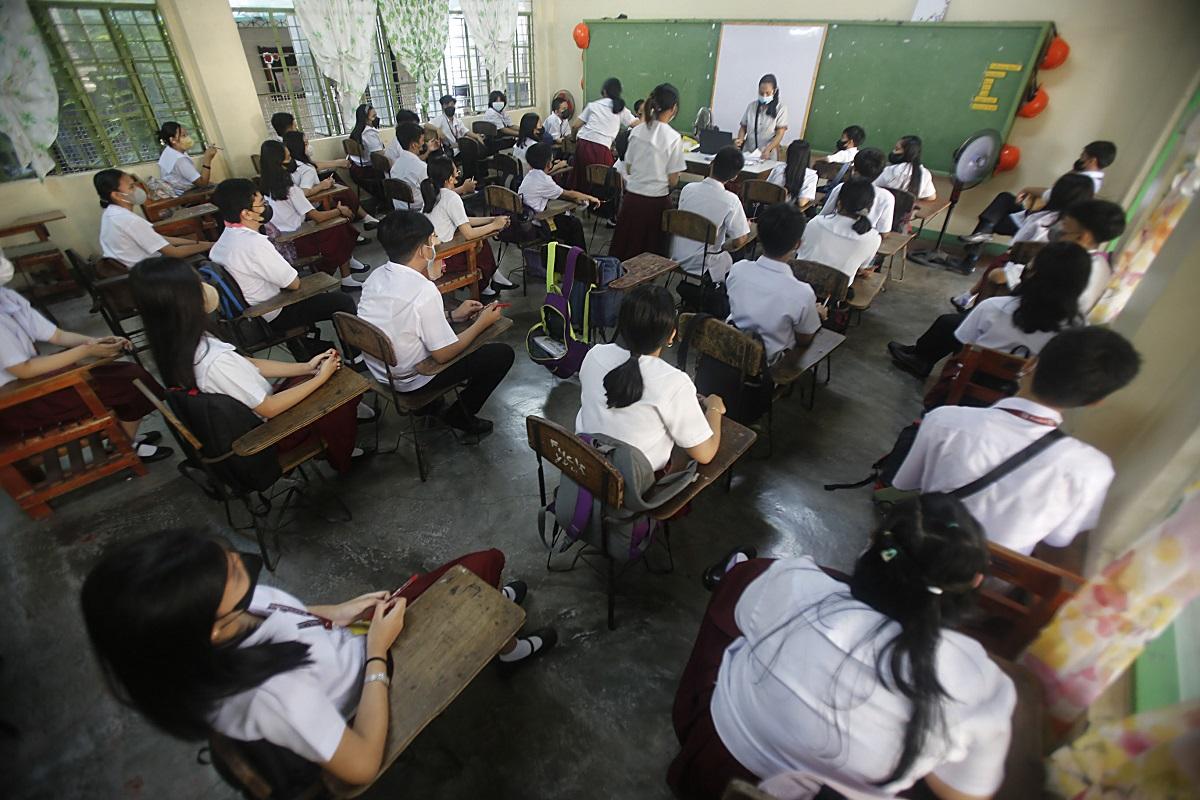
Teacher Barry Tayam on Friday filed a petition asking the Supreme Court (SC) to issue a temporary restraining order (TRO) against the Department of Education's (DepEd) removal of four academic strands.
In a 24-page petition, Tayam asked the SC to issue a TRO and/ or status quo ante order prohibiting the respondents from implementing DepEd Memorandum 012, series of 2026.
The memorandum mandates the dissolution of the Accountancy, Business, and Management (ABM); Science, Technology, Engineering, and Mathematics (STEM); Humanities and Social Sciences (HUMSS); and the General Academic (GA) strands for Grades 11 and 12.
Under the revised curriculum, the system will be streamlined into two main pathways: Academic and Technical-Professional.
"Aside from being electives na lang 'yung mga specialized subject, ako bilang isang ABM teacher, 'yung core subject ay nanganganib. So 'yung core subject, from 15 core subjects magiging lima na lamang po," Tayam said in an ambush interview.
(Aside from the specialized subjects becoming merely electives, as an ABM teacher, the core subjects are in danger. So the core subjects, from 15 core subjects, will become only five.)
"Hindi po siya, tingin ko, naaayon doon sa constitutionality na dapat maganda 'yung quality ng edukasyon na binibigay sa ating mga kabataan. So logically, paano natin masasabi na itong DepEd ay magbibigay ng quality education kung itong core subjects ay babawasan," he added.
(I think it does not conform with the constitutional principle that the quality of education being given to our youth should be good. So logically, how can we say that the DepEd will provide quality education if these core subjects are being reduced?)
Aside from this, Tayam asked the SC to set the case for oral arguments.
He also sought the declaration of the memorandum as unconstitutional and void for having been issued with grave abuse of discretion amounting to lack or excess of jurisdiction.
Tayam asked the High Court to direct the permanent retention and implementation of the Basic Education Curriculum, which he said would preserve 15 core subjects and the traditional SHS strands.
He also requested the SC to render its decision in Tagalog.
GMA News Online has requested comment from the DepEd on the matter, but it has yet to respond as of posting time.
Lack of industries
In a separate forum, a University of the Philippines professor and former College of Science dean said the growing number of Filipino students pursuing education and careers abroad reflects a long-standing problem at home: not a lack of talent, but a lack of industries that can sustain it.
In an interview with GMA News Online, Dr. Giovanni Tapang said the trend is less about ambition to leave and more about necessity.
“Hindi naman siya bago. Marami talagang umaalis,” Tapang said, noting that generations of Filipino graduates have faced the same constraints.
For students in highly specialized fields, those constraints are even more pronounced.
“If I want to be a physicist here in the Philippines, it’s so limited. If I want to be a chemist, it’s also limited, because there are no industries that would need a physicist or a chemist,” he said.
This mismatch pushes many to accept jobs abroad that may not align with their training but offer better pay and stability.
“When these fairs come in, they offer you jobs. It might not be a physicist’s job, but it’s a job nonetheless. And you take it because it pays higher,” he said.
Beyond education reforms
Tapang cautioned against framing the issue as one that can be solved by adjusting school curricula alone, particularly in ongoing debates on general education subjects.
“It’s not really just a GE problem. It’s also a development problem,” he said.
Focusing too heavily on course requirements risks overlooking a more fundamental gap: the absence of a strong domestic labor market that can absorb skilled graduates.
“Unless we address that development problem, where are we bringing our students?” he said.
He also warned that allowing foreign labor demand to shape what is taught in classrooms could distort the purpose of education.
“If the labor market will determine the content of GE, then we might end up teaching George Washington instead of Rizal because it is the U.S. that will employ you,” he said.
“That’s the wrong framing.”
“Maybe we should begin with what skills we need so we can build those industries so people do not have to go out,” he said.
Overseas work, he added, should ideally be temporary and focused on learning.
“If they go abroad, it should be to deepen their skill set. Then they come back and build more here,” he said.
A 'recurring cycle'
Tapang also pointed to what he described as a pattern of reactive education reforms driven by global trends rather than long-term planning.
“The next time it’s not AI, it might be quantum. Then we change our GE again, nonstop,” he said.
For him, the real issue lies in what is often left out of the conversation.
“The debate gets framed around how many GE subjects you have. That’s a false dilemma,” he said. “We are skipping the more important question.”
At the Quezon City education fair on Friday, many senior high school students said they were considering studying abroad for better opportunities and quality education, reflecting a trend that continues to grow.
For Tapang, the takeaway is clear. Until the Philippines builds industries that match the capabilities of its graduates, the outflow of talent will continue.
Earlier today, according to US Embassy Counselor for Public Affairs Jessica Simon, around 3,000 students ten years ago, the figure has risen to about 4,500 in 2025.
She noted that Filipino students continue to pursue a wide range of programs, with STEM courses remaining a key area of interest.—VDV, GMA News

