






Manny Pacquiao has candidly acknowledged using drugs during his youth — long before he rose to become a boxing legend and a senator. Like other rebellious adolescents, he experimented with harmful substances.
In numerous cases, drug use represents a fleeting period that is overcome through maturity, rehabilitation, or sheer willpower. Even those who go on to achieve high office reflect openly on their past mistakes. Barack Obama, for one, has spoken frankly about his wayward youth.
“I made some bad decisions,” he told students during his first presidential campaign. “I experimented with drugs… It wasn’t until I got out of high school and went to college that I started realizing, ‘Man, I wasted a lot of time.’”
Former President Rodrigo Duterte has talked about abusing fentanyl, but would later claim he was joking.
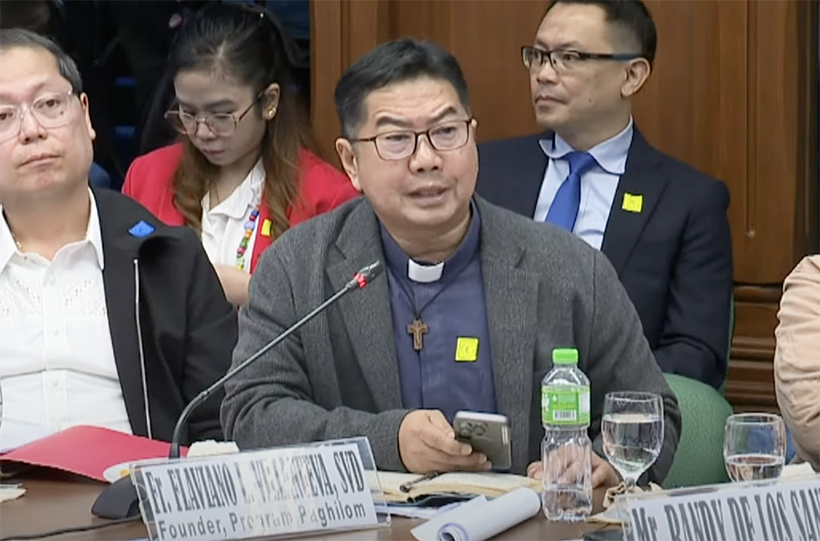
Then there’s Fr. Flaviano “Flavie” Villanueva, this year’s Filipino recipient of the Ramon Magsaysay Award, given to Asians embodying the “greatness of spirit” of the well-loved Philippine president who died in a plane crash in 1957 while still in office.
Father Flavie is a self-confessed drug user who recovered from addiction. But as a young substance abuser who turned his life around, he represents the possibility of redemption.
Now a devout priest, Father Flavie has dedicated his life to serving society’s most marginalized. But global headlines highlighted a single fact in his career. The international Catholic news site Crux was typical: “Filipino priest who defied Duterte to receive Nobel Prize of Asia.”
During former President Duterte’s war on drugs — a campaign applauded by many — Father Flavie was among the most vocal critics. But he did more than condemn the extrajudicial killings of thousands. He bravely ministered to victims and their families. His activism led to sedition charges, later dropped in 2023, though death threats continued. His courage inspired others to speak up, form coalitions, and resist what he has called a “pandemic of apathy.”
I first encountered Father Flavie up close in 2018, during the height of the drug war. He delivered the homily at the Mass marking the first death anniversary of Kian delos Santos, the 17-year-old Grade 11 student who was captured on CCTV being dragged away by police before his death. Kian became one of the most poignant symbols of that bloody era.
At the time, I was doing an I-Witness documentary focused on the mothers of victims in Caloocan, an epicenter of the killings. Kian had lived in Caloocan, helping run his family’s sari-sari store while attending high school.
The chapel in Caloocan was small, and not even full. In those days, many sympathizers stayed away, wary of public association with a drug war victim. Among the few government representatives present at the Mass was the late Chito Gascon, then chair of the Commission on Human Rights and a frequent target of President Duterte’s ire. Journalists who dared report on the drug war likewise faced intense scrutiny, and often harassment.
Many veteran journalists still held the belief that exposing wrongdoing would stop it. Yet in 2016–2017, the opposite happened — the killings intensified even as coverage continued. The populace was being conditioned to accept that those killed on mere suspicion somehow “deserved” summary execution. Reporters were labeled as biased and liars, even when documenting real atrocities. Yet they persisted.
After writing an acclaimed book on the drug war, trauma journalist Patricia Evangelista observed that she didn’t walk into the drug war believing that her writing would change minds or policy. Rather, her goal was to preserve memory:
“My only expectation is to keep a record. A good one. I hope a useful one for the future if it’s necessary… My faith is in journalism. Not that it will change the world, but it keeps a record of it, so we don’t forget.”
She and other colleagues clung to the hope that the record they were keeping would be useful for a reckoning someday.
Father Flavie, despite threats and legal entanglements, persevered too. He empowered victims’ families to bear witness — to give testimony, to become part of the record. His Program Paghilom assisted with exhumations, legal aid, counseling, even education support. In 2024, he inaugurated the Dambana ng Paghilom memorial at La Loma Cemetery, a symbolic and hopeful structure that now serves as an emblem of resistance and remembrance for drug war victims.
If he was a drug-using youth in a later time, he could have been a victim, too. Father Flavie is undeniably deserving of this award, but it’s also clear how fortunate he is. He was given a chance at redemption, denied to many whose memory he champions.
The Ramon Magsaysay Award Foundation could have selected a safer, less controversial figure. Instead, by choosing Father Flavie, it chose courage made manifest.