






There’s a coffee shop in Batanes called Honesty. But unlike other establishments and brands named after ideals — Serenity, Goodwill, Heaven, and so on, which feel aspirational — the Honesty Coffee Shop is not something it strives to become. It is simply what it already is.
This small seaside enterprise operates entirely on trust. There is no cashier, no guard, no staff overseeing transactions. Customers walk in, take what they want, and leave payment in boxes and other receptacles scattered around the shop. Today, you can even pay by GCash or bank transfer.
I’ve been coming to Honesty for more than twenty years. Back then, it served little more than coffee and snacks for boat passengers newly arrived from nearby Sabtang Island. As visitors gradually discovered it, the shop expanded. It now sells souvenir magnets and T-shirts, as well as Arius Wine, made from the berries of the native, pine-like arius tree. I took a bottle from the shelf and paid by GCash. It was delicately sweet.
Over those two decades, while many other places have been transformed beyond recognition, not much has changed in Batanes.
“Honesty” still runs on the same system — a quiet affirmation that not everything in the world has been compromised.
There are still no malls, foreign-owned hotels or resorts, fast-food chains, or even stoplights anywhere in the province, the smallest in the Philippines (pop. est. 19,000). This is not for lack of appeal: the islands are among the most scenic places I’ve visited anywhere.
Rather, residents have deliberately resisted large-scale commercial entry, using progressive national laws to protect both their surroundings and their way of life.
Most inhabitants are Ivatan, an indigenous people and the only ones legally allowed to own land here. In 1994, the entire province was declared a protected area, making it the only one in the country where the whole territory falls under conservation law.
Spend a few days here and you realize there is far more at stake than land and sea.
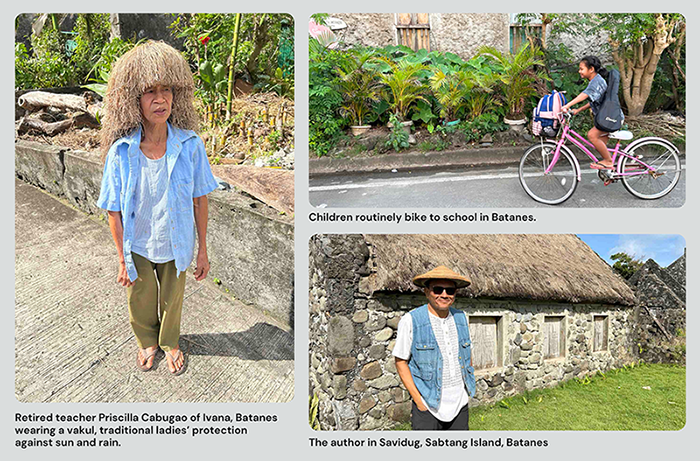
Grandmothers and small children bike safely along well-maintained national roads, where four-wheeled vehicles are rare. Motorists yield to cyclists and pedestrians, and horns are used only when rounding blind mountain curves.
I spoke with two policemen — young, trim, and assigned to the town of Ivana (population 1,400), home of the Honesty Coffee Shop. They told me there have been zero crimes reported this year, as there were last year.
Arriving early for my ferry crossing in Sabtang Island, I was told I could leave my luggage unattended at the port while I looked for merienda across the street. When I returned to a now-crowded terminal, my bag was exactly where I had left it.
Modesty is a province-wide virtue. Prestige here is tied not merely to land ownership, a friend explained, but to the effort one invests in the land — being able to grow staple crops like kamote and sharing the harvest with neighbors. Showbiz celebrities who visit draw curious glances, but are not mobbed the way they would be in Manila malls.
Local executives move about like ordinary members of the community. I encountered the mayor of Uyugan, former school principal James Richard Cabugao, on his way to a wedding with his young daughters. He was driving the family vehicle: a tricycle with a wooden sidecar. On Sabtang Island, I saw a barangay captain standing atop his own tricycle, repairing a street lamp.
I first came here in 2004 to produce a documentary on the mataw, the annual hunt for dorado, a prized fish dried and stored for the lean, windy months — an Ivatan system of food security. Dried dorado is so valuable it can serve as currency, traded for other necessities.
What makes the mataw remarkable is the social obligation associated with it: fishermen with more abundant catches are expected to share with those less fortunate, ensuring no one goes hungry. Life here is anchored in cooperation and mutual care — a value system that has enabled the Ivatan to survive centuries of powerful storms in isolation.
It is a system based on sapat, or “having enough,” rather than the endless accumulation many outsiders take for granted. “Typhoons are our teacher,” one fisherman told me. “They taught us how to survive.”
In a place where time seems to stand still, my team and I came recently to document change.
For more than two centuries, people here have lived in stone houses — solid structures designed to withstand even super typhoons. A distinctive emblem of Ivatan endurance and ingenuity, these dwellings now face the risk of disappearing.
In 2019, the ground itself turned against them. A series of strong earthquakes shook the province, heavily damaging or destroying more than 200 homes, mostly on the northernmost island of Itbayat. Tested repeatedly by storms, the stone houses proved vulnerable to this different force of nature.
Even before the earthquakes, these structures were already being abandoned. Homeowners cited the growing difficulty of sourcing local materials for repair — kamagong and other native hardwoods chief among them. When the province was declared a protected area in 1994, the intention was to safeguard an exceptional environment, but the law also restricted the cutting of trees, and the gathering of coral and other traditional building materials.
Generally law-abiding, residents did not turn to illegal logging or underground markets. Instead, cement, steel, and other modern materials gradually replaced traditional ones. New houses began to look as though they could exist anywhere. The 2019 earthquake destroyed many of the old stone homes in an instant, accelerating this quiet drift toward the generic.
In response, engineers and architects from Cagayan State University designed a “modern” Ivatan house: traditional in appearance, with stone walls and a cogon roof, but reinforced with steel. Wood was shipped from outside the province so no local trees would be cut.
Drawing on indigenous knowledge, mainland engineers worked alongside local builders for a year to create what they hope is a more sustainable version of the centuries-old design.
My team and I were there to document the turnover of the finished structure, set on a sea-swept edge of Uyugan. The local government plans to present it as both a tourist attraction and a model for future construction.
A seasoned builder in the audience confided his doubts that non-Batanes wood could withstand native termites. Only time in this unforgiving environment will tell.
But as traditional structures disappear, there is little choice but to innovate — or lose them altogether.
The Ivatan house is more than shelter. It is a physical expression of a culture shaped by constant negotiation with wind, sea, and scarcity.
“Resilience” is an overused word, but here it feels complete. It is not merely the capacity to endure hardship, but the discipline of succeeding by living in harmony with nature and with one another.
Cooperation and sharing are not just ideals; they are prerequisites for survival, but also for the kind of social progress possible when greed is restrained. There is no display of extravagant wealth, but neither is there grinding poverty. As we say: sakto lang — and sanaol.
In Uyugan, I met an articulate kamote farmer repairing his cogon roof. When I asked about his family, he mentioned, without fanfare, that one of his daughters is a law student at UP Diliman.
I arrived in Batanes wondering how its people resist the worst influences of the modern world.
I left wishing that we might all learn to be a little more like Batanes.
(The author recently went to Batanes with his team to shoot the story “Stone by stone: Saving the Heritage Houses of Batanes,” for the podcast, “Howie Severino Presents.”)