






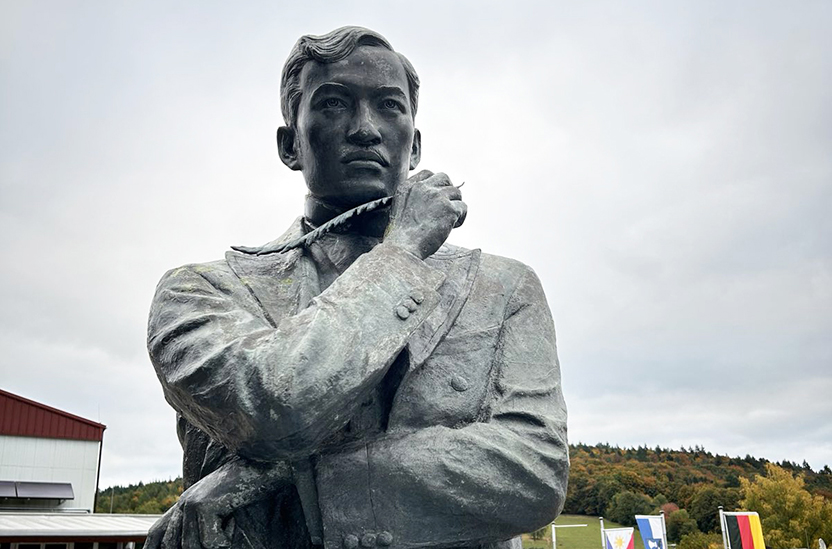
History remembers José Rizal as many things: novelist, physician, patriot, martyr. What is rarely mentioned is that he was also a lottery winner. We do not engrave “Lucky Bettor” on his monuments, yet those winnings quietly financed one of his deepest devotions — nature itself: the mountains, seas, rivers, forests, and animals of his homeland.
By living in, preserving, and studying a significant expanse of wilderness during his final four years, Rizal arguably became the first Filipino naturalist.
Perhaps “naturalist” is what should be added to the monuments. (A naturalist is an enthusiast who observes and studies nature in the field, as opposed to a natural scientist who conducts lab experiments with access to specialized equipment like microscopes.)
Throughout his life — in his novels and poetry, his letters, and even in a storied theological debate with a Jesuit thinker over the origins of creation — Rizal evoked the natural world as his primary inspiration. In views that exasperated his Ateneo mentor, Fr. Pablo Pastells, Rizal argued that the best evidence of God was not in the Bible, but in nature.
"In the middle of these grand forests, under the shadow of these ancient trees, one feels the presence of a superior being,” Rizal wrote in a lengthy correspondence with Pastells.
In his second novel El Filibusterismo, the character Isagani pines for a natural environment that seems to anticipate Rizal’s own future:
"O, in the solitude of those mountains I feel free, free as the air, like a light blasting unharnessed through space! A thousand cities, a thousand palaces I would give just for a corner of the Philippines where far away from man I could feel truly free!"
For much of his life, Rizal’s engagement with nature could be described as romantic and observational rather than scientific. He was a wanderer who took hikes and reveled in the scenery. He famously wrote "To the Flowers of Heidelberg" after steeping himself in the fragrance of the German countryside. Nature moved him deeply, but he was still detached from it.
A stroke of extraordinary fortune would change that, granting him stewardship of land even as he was stripped of his freedom.
Soon after his exile to Dapitan in Mindanao, Rizal and his chief guard jointly purchased a lottery ticket in Manila — and won. In 1892, when letters were his only link to the outside world, news of the prize arrived by mail boat, festooned with celebratory ribbons.
After sending money to his family and settling his debts, Rizal still had enough to purchase sixteen hectares of land: hilly forest with a narrow strip of shoreline facing Dapitan Bay. Located about a twenty-minute hike from town, the property was considered undesirable — thickly wooded, and of little commercial value. His Spanish guard supposedly scoffed at the purchase.
Rizal could have spent his winnings on comfort, luxury, or even bribery in pursuit of freedom. Instead, he chose forest and sea — land alive with plants and animals he could observe, document, and use to educate the students who would live with him.
The property was called Talisay, named after a native tree species. Rizal briefly considered renaming it Baluno, another tree more prominent on the land, but wisely retained the more lyrical name.
Because of his exemplary conduct, Spanish authorities allowed him to live on his Talisay estate. There, he began to realize a vision of the nation he imagined: restrained development, a protected and studied forest environment, and a community that took only what it needed from nature.
He built a modest home for himself and, later, for his common-law wife Josephine Bracken. (The Church refused to marry them unless Rizal retracted his writings against the friars, something he would not do.) He also established a clinic, a school, a dormitory for boarding students, and quarters for visiting family members, all situated near the shore with commanding views of the sea.
Behind these structures rose a dense forest: gurgling streams, small waterfalls, and a slice of the nation’s rich biodiversity. When I visited Dapitan in 2022 and walked those same woods, I marveled at the towering dao and other hardwood trees still standing.
In a profound irony, the survival of Rizal’s forest is a direct consequence of his death sentence. Following his execution by firing squad on December 30, 1896, the Spanish government expropriated his property. This began a chain of state ownership, passing from Spanish to American hands, and finally to the Philippine government in 1946. Had Talisay remained private, it likely would have succumbed to residential development or resort construction; instead, it remains a protected sanctuary, a living memento of his final years.
While the Talisay estate now serves as a shrine and museum, housing his writing desk and personal effects, the true heart of his legacy lies just beyond the exhibits. Most visitors come to pay their respects at the museum, yet few venture into the forest up the hill. This wilderness was more than a scenic backdrop; it was Rizal’s open-air laboratory and an extension of his classroom, providing a retreat where he could reflect on a life that was nearing its consequential end.
During his exile, Rizal transformed his students into budding naturalists. The dozen or so adolescent boys who boarded with him did much more than book learning; they accompanied him into the wild to catch butterflies and gather seashells for preservation and study.
To deepen their understanding, Rizal shipped numerous preserved specimens to renowned German scientists. This was a sophisticated intellectual barter: in return, the scientists sent the books Rizal craved, including Russian novels and Greek classics (translated into German, which Rizal read fluently).
These transactions led to several "eureka" moments when European experts identified at least four of Rizal’s specimens as species entirely new to science. His legacy remains etched in the biological record through names like Apogonia rizali, a small beetle that honors its discoverer.
Today, a significant portion of the collection Rizal shipped to Germany remains tucked away in museum archives — a preserved portrait of Mindanao’s biodiversity in the 1890s. This untapped archive poses a haunting question: What could a modern, thorough study of these specimens reveal about the Philippines' original natural heritage, and just as importantly, what have we lost in the century since?