






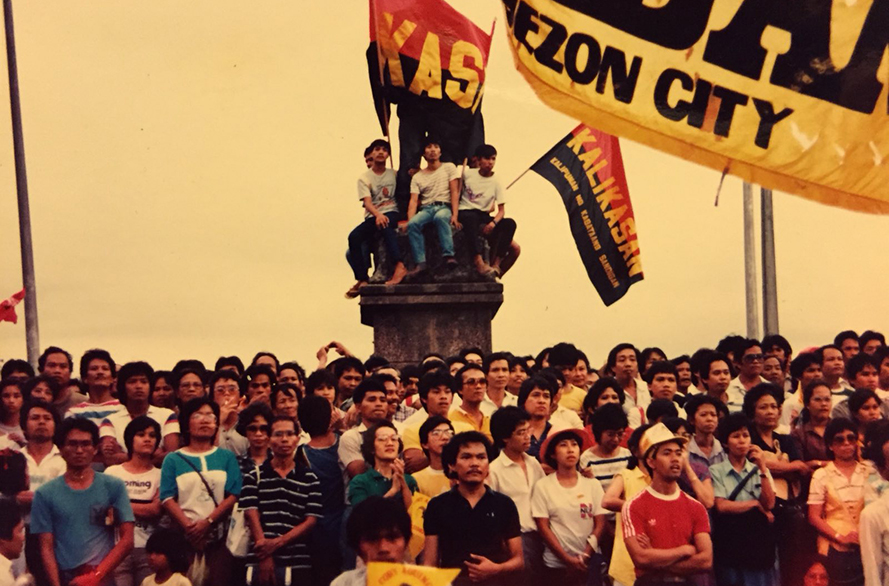
I used to ride an old school bus that rattled through the intersection of Bonny Serrano and Katipunan Avenues in Quezon City. About a decade later, I found myself at that same junction shaking in my shoes, fully expecting to witness a massacre — or to become one of its victims.
It was the last week of February 1986, nearly forty years ago. I was a novice high school teacher with no classes that day because a revolution was raging in the streets.
I was one of millions out there too — on EDSA, on its side streets, and in public spaces across major Philippine cities — calling on the longtime dictator Ferdinand Marcos Sr. to resign.
That familiar intersection in Quezon City contained only a sprinkling of the massive crowds. The festive throng was on EDSA itself. Those on the side streets seemed to be the hard core, the ones prepared to face the bayonets rumored to be just around the corner.
People had blockaded that intersection and other strategic points near EDSA to protect a small group of officials and military officers who had defected from the Marcos regime and were holed up inside Camp Aguinaldo, probably shaking in their shoes as well. Among them was the late political chameleon Juan Ponce Enrile.
Soldiers loyal to Marcos, commanded by General Fabian Ver, were reported to be preparing an assault on Camp Aguinaldo from multiple directions.
Then, at that intersection, I witnessed a sight I will never forget: a group of young priests and seminarians, clad in flowing white sutanas, walking — or rather, defiantly marching — up a steep, curving road. They took their places in the middle of the street, prepared to block tanks and infantry with their bodies.
I watched from inside a blue pickup truck borrowed from my landlady. My fellow teacher Yeyey Alfonso and I had loaded the truck with large drums of drinking water (this was before ubiquitous disposable bottles) and we crawled through the crowds, refilling the containers of thirsty protesters.
One of the sutana-clad priests spotted me and ordered me to drive the pickup into the intersection to add to the barricade against the assault everyone feared was coming. Trembling, I offered no resistance to sacrificing my landlady’s truck.
A phalanx of loyalist soldiers eventually appeared. They took in the grim faces sitting on the street around my borrowed pickup, and then they turned back. It was just one of many small confrontations where people power overcame armed might.
A day later, with Malacañang in danger of being overrun by fervent crowds, Marcos, his family, and close associates fled, whisked away by U.S. helicopters to Clark Air Base and ultimately into exile in Hawaii.
There are good reasons, mostly unsentimental ones, to recount these events now.
Foremost in some minds is the recent dramatic capture by U.S. special forces of Venezuelan President Nicolás Maduro and his wife, extracted from inside their own quarters.
Both Marcos and Maduro were despised dictators, and both were removed with the help of U.S. military helicopters. But the parallels end there.
Some have tried to conflate the two episodes as proof of U.S. imperial overreach and naked regime change. Yet in 1986, the United States was a Marcos ally until the very end, and intervened largely to save him from annihilation. It was intervention, yes, but almost humanitarian, aimed at preventing a bloodbath in Malacañang.
As Cardinal Ambo David has written:
“What is still lacking is the Venezuelan equivalent of EDSA People Power — a sovereign, nonviolent civic movement that clears the way for a legitimate democratic transition, one that resists not only authoritarian continuity but also a U.S.-run transition. Venezuela is missing that middle step.”
That was what we witnessed in February 1986: a fraudulent election, followed by a military revolt, sustained and protected by a massive surge of civilian activism. His forces unable to breach civilian crowds and barricades to attack rebel soldiers, President Marcos had little choice but to step down and board a U.S. chopper into exile.
We need to tell these stories again because memory fades over four decades, and in its place arise tall tales that denigrate a sovereign, nonviolent triumph that once captivated the world. This chapter of our history is barely taught in schools, leaving a void where civic pride and democratic memory should be.
I will admit that I myself did not sit in that intersection prepared to meet bayonets and my Maker. But I like to think I was amply represented by that blue pickup truck.
When I sheepishly confessed to my landlady Len where her truck had been when I finally returned it, she smiled and gave me a thumbs-up. Even far from danger, she too had been represented.