






I share my home with bats. I rarely see them, but each morning our veranda is littered with guano (that elegant-sounding word for bat poop). The day begins with sweeping it up, an annoying ritual that competes directly with the more ennobling task of making coffee.
Only recently have I learned that bats, at least in my place, serve a far more sublime purpose than leaving nutrient-rich droppings behind.
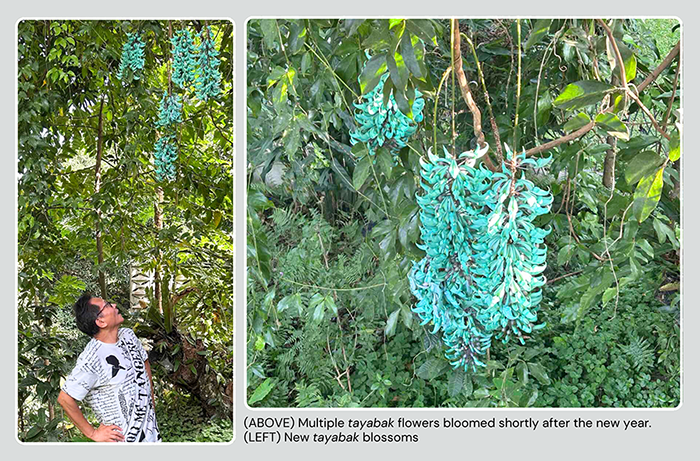
Hanging now from a lush vine in my backyard are what look like living chandeliers, flowers so strange they’re often described as “otherworldly.” They belong to the endemic jade vine, whose beak-shaped petals glow with a luminous turquoise — or, if you prefer a more precise word, teal. (Coincidentally, teal has been named by global trend authorities the “Color of the Year” for 2026!)
A dozen or so of these spectacular blossoms have just begun to open behind my house, a source of endless delight at the start of the new year. We’ve invited guests over solely to gawk at them.
Rarely encountered in the Philippine wild anymore, the jade vine is more easily found in the world’s leading botanical gardens, displayed as a prized curiosity. We planted ours in our garden two years ago. It grew riotously, nearly smothering our massive mango tree. Last year a single flower appeared, then another — never more than one at a time, as if the vine were rationing its secret beauty.
But as 2026 dawned, multiple jade vine flowers — known in Tagalog as tayabak — began to bloom at the same time. I posted a photo on Facebook to announce their arrival and was surprised by the excitement it sparked. Some commenters said they had never seen this native flower before; others lamented that although they had successfully propagated the vine, they had never been able to coax it to bloom.
One tayabak admirer reminded me that the silhouette of its distinctive cluster of flowers — the “chandelier”— appears on every new five-peso coin, elevating the vine to national icon. On the coin, however, the tayabak is stripped of its soul, rendered in cold metal and deprived of its haunting blue-green radiance.
After I shared my photo, I was deluged with requests for advice on how to propagate the vine and, especially, how to make it flower.
That was when I learned about the bats.
According to various sources I looked up, bats are the jade vine’s natural pollinators. As they hang upside down beneath the flowers to drink the nectar, pollen falls onto their bodies and is carried to other blooms as they move along the vine.
Fruit bats already roam the woods behind my home, but it turns out they also hang around my house, quite literally, drawn by the flower’s sweet nectar and its luminous color, a beacon for the bats in low light.
That’s why the jade vine rarely flowers outside the wild. In the absence of bats, seasoned gardeners hand-pollinate this Philippine endemic. It takes a special dedication to do that. The lucky (and lazier) ones — like me — who live near woody habitats can let bats do the work that comes naturally.
They do leave a mess on my veranda. But it’s just a minor annoyance when I can sit back, sip freshly brewed coffee, and take in the teal-colored spectacle unfolding around me.