





Essay by Kristyn Maslog-Levis, Sydney, Australia
I did not set out to learn nor listen to SB19. Living in Sydney, Australia for over two decades meant I knew little about new artists in the Philippines, so I did not know they even existed.
During my visit to the Philippines in 2024, I watched The Voice Kids and immediately recognised Billy Crawford, as I grew up watching him on TV. I knew who Julie Anne San Jose was because I watched Maria Clara at Ibarra during my visit in 2022. But I did not know who the two other coaches were — this Pablo guy and Stell guy who were members of a group called SB something something.
No matter. I was more interested in learning more about the kids than the judges, anyway, so I forgot about them.
After going back to Sydney, I continued to watch Filipino TV shows, including the popular noontime show, It’s Showtime. One day in March 2025, I put on the live telecast of the show on my phone as I drove to pick up my son from school. A song came on that caught my attention, and because I was only listening and not watching (responsible driver here), I only heard them introduce the group as SB something something and their song called something something.
I listened and drove, enjoying the background noise and not really paying attention to it. But two minutes into the song and I found myself putting my car speakers on full blast. The song was pulling something primal inside of me I could not ignore. As I couldn’t check my phone to watch the show, I made a mental note to check YouTube later on.
Then I picked up my son and totally forgot about it.
April 2025, the same thing happened. Driving for school pick-up, It’s Showtime introduced SB something something and their song Dungka. I remembered the title because I was confused. Was the word even Filipino? I remembered hearing the screams of the fans and wondered, who are these people and why are audience members screaming like this?
Then the song came on, and that primal call inside of me reemerged, reminding me I was supposed to check out the previous episode to watch the segment that I had missed. I did not hesitate to put my car speakers on full volume as I drove to my son’s school.
The song was over by the time I picked up my son. But it lingered in head, so much so that I had to have a lengthy discussion about my reaction with my sixteen-year-old, very cerebral son.
“I found Filipino pop songs I like and I don’t know why I like them,” I said.
“That’s okay. It happens,” my son said. “What’s the song?”
“I can’t remember,” I said.
“Is it in English or Tagalog?” he asked.
“Both? Maybe?”
The conversation went on and on about music and why some of it hit differently.
When I got home, work took over and, again and I forgot to search for the songs I heard.
Weeks later, on the bus to the city, I randomly listened to an OPM playlist on Apple Music, and I heard another song that made me pause. The song had Bisaya rapping in this deep voice — so deep it vibrated inside my head. I could not believe I was listening to a contemporary song with Bisaya words included in an OPM playlist.
You see, when I was a kid growing up in Cagayan de Oro, a city down south in Mindanao in the Philippines, we were not allowed to speak in Bisaya in the classroom. You either speak in Tagalog or English, otherwise you got fined. It made me feel like speaking Bisaya was inferior to speaking Tagalog and English. That being Bisaya was perceived to be less — uneducated and provincial.
Hearing that Bisaya rapping shooketh me to my core. This time I managed to look at the artist’s name and saw that it was SB19 and the song was called Kalakal.
Thus began the digging into the SB19 rabbit hole.
I don’t know when I decided I loved them. I don’t know when I decided that Pablo and Stell are my biases. I don’t remember when I decided I needed to see them live. All I knew was that I had to listen to their songs over and over and over again. So much so that I racked up over 7,000 minutes listening to them in less than six months (excluding their solos and YouTube videos and their social media posts and the reaction videos and the fan cam — you get the gist).
But I couldn’t stop there. I had to figure out why I was so obsessed with this group. I am a logical human being. The last time I had something similar to this experience was with Ricky Martin in the early 2000s, and even that was only a fraction of my obsession with SB19.
Why is this happening to me?
Of course, I am not the first fan to go Stan. Even grandparents around the world have had their moment of Stanning their idols in their lives. Just look at what happened during Frank Sinatra’s concerts, where audience members would just relieve themselves on their seats so they do not miss a single moment of his performance. There was literally urine on the seats and floor. At least now, fandoms have adult diapers to help them.
But I digress.
Months into the rabbit hole descent, I realised that my obsession started after I heard them — way before I saw them perform. It was the beat. The lyrical poetry. The words in Bisaya. The surprise of hearing OPM presented this way. The connection to their message (because who among us has never had the experience of wanting to scream ‘Tumabi ka dyan’? Or contemplated about the cruelty of time?). I could choose what song I needed depending on what type of day I’ve had.
You see, my work forces me to be updated about the many ways our world has gone downhill. I consume one bad news story after another, with very little reprieve, because it’s part of my job. I needed something to keep me sane while also entertaining me at the same time. SB19 was that oasis. When something made me angry, Dam and Crimzone hyped me up. When I needed calm, I start with I Want You and Mapa. When I want a moment of delulu, I go to Stell’s Room and listen to Di Ko Masabi.
While my personal experience of obsession may differ from others, it’s not surprising to know how many of us A’Tins are out there. Fandom participation has been proven to improve psychological well-being. It provides a way to temporarily retreat from life’s realities and enjoy the company of like-minded people who also connect with SB19’s music. And in this day and age, everyone definitely needs at least one coping mechanism to survive the pressures of life.
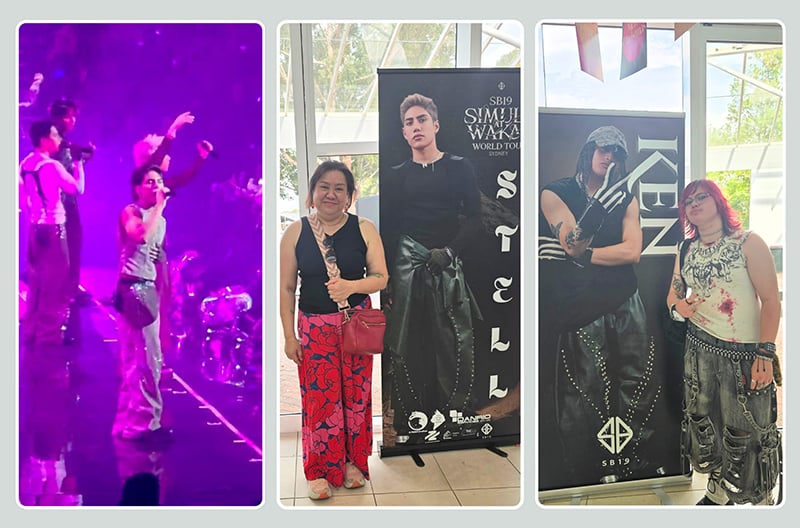
Still, I was lucky that my discovery of SB19 aligned with their Simula at Wakas World Tour down under. My son and I were able to get tickets to their Sydney concert at the Norwest Convention Centre in December 2025. They’re the only Filipino group I watched with my Australian-born son who does not speak Filipino but memorised their lyrics anyway. I wish I had the knees to withstand the hours of standing in the mosh pit, but the seated experience was still phenomenal. My son and I lost our voices that night from screaming at the top of our lungs.
Maybe it’s because they’re Filipino. Maybe it’s because they’re self-made. Maybe it’s because of their humble beginnings. Maybe it’s because of their talent and their genius. Maybe it’s because they’re hilarious and are not afraid to be so. Maybe it’s all of the above. I don't really care anymore. I am comfortable digging further down the rabbit hole.
Happy for you to join me.
P.S. If 1Z Entertainment ever commissions an official biography for SB19, I’m putting my hand up for the job. Don’t tell my boss.
Dr. Kristyn Maslog-Levis is an academic, former journalist, and marketing and communications lead. She earned her Master of Communication from Nanyang Technological University, Singapore, as an ASEAN scholar, and holds a PhD in creative writing from the University of Technology Sydney (UTS) via an Australian government scholarship. Her doctoral research explores cultural diversity within Australian children’s and young adult (YA) literature. An accomplished author, Kristyn penned the bestselling YA Engkantasia series and the picture book We Have It All. A recipient of the 2020 ASA Award Mentorship Program for Writers and Illustrators and shortlisted for the Voices from the Intersection Mentorship Program in 2022 in Australia, she continues to advocate for inclusive storytelling through both her scholarly and creative practice.
Instagram: @k.m.levis