






My wife Ipat and I had a DIY wedding. We were young, idealistic professionals who decided to pool our savings and decline any monetary assistance from our parents. It was 1994 — before prenup pictorials, same-day edits, and wedding coordinators wearing headsets.
We relied on friends. I didn’t know any wedding photographers. But I knew photojournalists. So I asked my friend Alex Baluyut if he could shoot our wedding. He said yes without hesitation. I had no expectations except that there would be visual proof we got married.
I had recently worked with Alex on a story about illegal logging. He spent days in the forest, staking out sites where it might happen. The year before our wedding, he embedded himself in a police station to produce photo essays on police culture — documenting everyday cruelty alongside the hardened cops’ absurdities, like getting pedicures during their downtime.
An editor looked at the photos and declared them too soft. “Tapangan mo pa.” Make it braver.
So Alex went back. He stayed long enough to witness a police jail hostage crisis, putting himself in harm’s way and capturing the bloody end of one of the year’s most dramatic stories. Those photographs would later appear in his book “Brother Hood.”
Years earlier, he had traveled for four months with the NPA in Mindanao at the peak of its power. He documented firefights, a rebel wedding in the mountains, and the execution of a comrade. They would be published in a controversial book, “Kasama.” Just before the book’s launch, someone bought out nearly the entire first print run to suppress its circulation.
In the 1980s, Alex had what many considered an enviable job as a well-paid Associated Press photographer, covering the predictable churn of daily news. He walked away from that security to pursue long-form journalism projects — including the book on the NPA.
Alex did not take easy paths. By the time we were planning our wedding, he was already something of a legend. Asking him to shoot it felt almost absurd.
Yet he photographed our wedding with the same seriousness he brought to a hostage crisis or guerrilla training in a mountain camp.
The photos are all in black and white. None are posed. No one looks at the camera. Nothing feels staged — because nothing was. It was reportage, not a wedding album.
Afterward, some relatives searched for the expected group shots — the assembly-line portraits of abays, the ninongs and ninangs flanking the bride and groom. But that wasn’t Alex. Heaven forbid he direct people to turn this way or strike a wacky pose. That’s not what photojournalists do.
In the last decade of his life, Alex found a second calling.
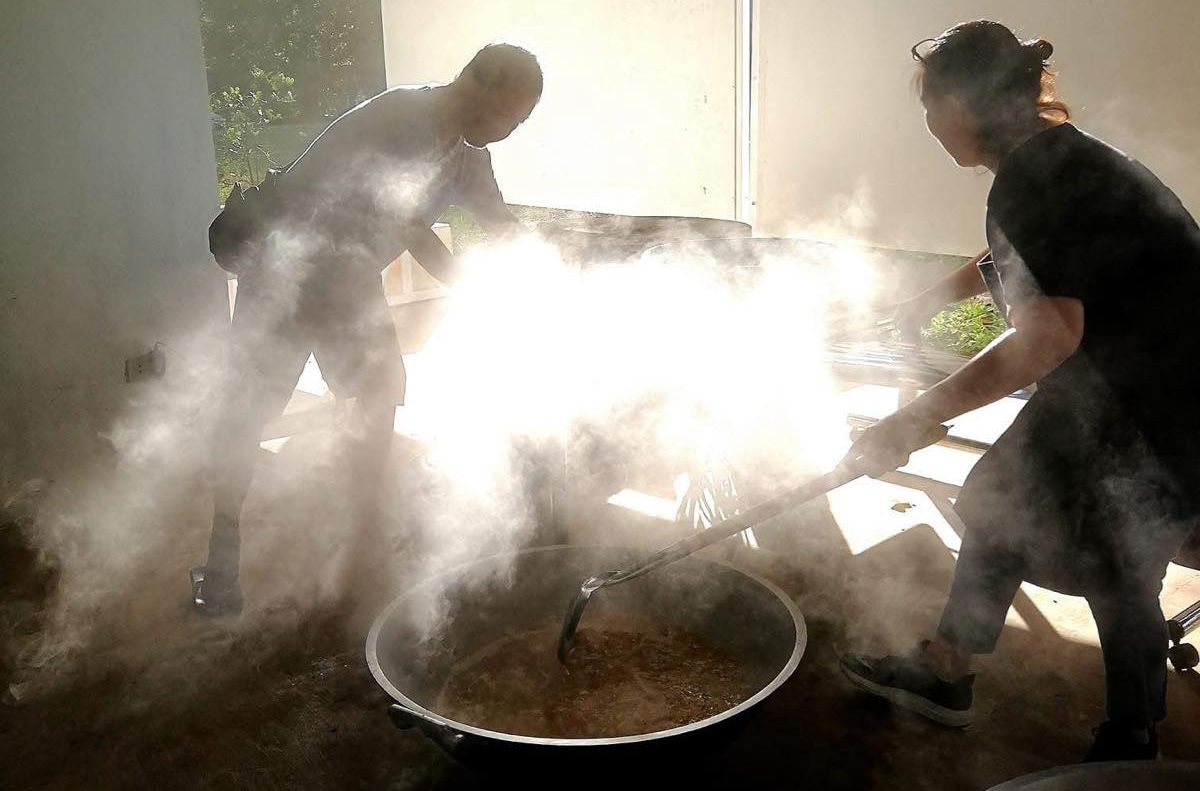
After Super Typhoon Yolanda in 2013, moved by the hunger and bleak conditions of evacuees, Alex and his partner Precious Leaño established a deployable soup kitchen. They called it the Art Relief Mobile Kitchen, or ARM-K, and it became a movement.
Instead of handing out packaged rations, they cooked hot meals — healthy food, prepared fresh — for hundreds, sometimes thousands. Volunteers, including evacuees themselves, chopped vegetables, stirred vats, and served neighbors. It wasn’t just about fending off hunger. It was about dignity. About restoring a rhythm of normal life in the midst of ruin.
I saw them in action in Batangas after the Taal eruption in 2020. The same intensity Alex once trained on firefights, he now focused on simmering broth and managing volunteers. The same urgency, now directed at hunger.
Alex passed away on February 27.
When grieving friends began posting screenshots of their final exchanges with him, I scrolled through our own chat history. One of our last conversations was a minor “tampuhan” over the use of a photograph — my fault, which I admitted. “Paano ako makakabawi?” I asked. How do I make it up to you?
He forgave me. Of course he did. Our friendship was larger than that misunderstanding.
Then came the Oroquieta floods of December 2022. Alex and Precious mobilized their equipment, supplies, and volunteers, and set up in a barangay hall. My son Alon, then 20 and home for Christmas from college, flew down to help.
It became one of the formative experiences of his young life — chopping vegetables for hours, serving food, sleeping on the floor of the barangay hall, taking instructions from Alex and Precious. He told me later that despite the bleakness — the loss of life, the mud, the exhaustion — Alex kept the vibe light. He cracked jokes. He made it fun. All the while under enormous pressure to feed the multitudes. It was a master class.
Yesterday morning, I broke the news to Alon that his Tito Alex had died.
“How do you know?” he asked.
“I saw his photographer friends posting about it.”
“He was a photographer?”
“One of the great ones. A legend.”
“He was a legend?”
“Yes,” I said. “He was.”
And in that small exchange, I realized something. My son knew him not as the fearless chronicler of wars and rebels and hostage crises — but as the man who taught him how to chop vegetables fast enough to keep up, how to work until the last evacuee was fed, how to keep things light when everything seemed bleak.
Both were true. That was Alex.