





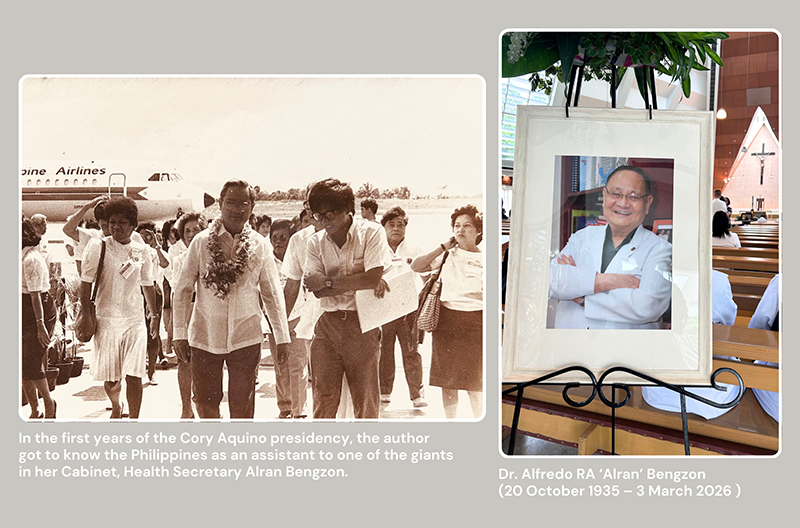
Forty years ago this month, I went to see Dr. Alfredo “Alran” Bengzon in his house in Pasig and asked for a job.
He had just been appointed Secretary of Health by the new president, Cory Aquino. I was 24 years old and excited to help the new revolutionary government. We had just spent the previous two years together in the streets.
My late father Rod “Sepoy” Severino and Tito Alran were best friends in college at the Ateneo, where they both edited the Heights literary magazine, sang in Father James Reuter’s glee club, and performed in many theater plays. If my father did not name me after their beloved teacher Horacio de la Costa, he might have named me Alfredo. Tito Alran was my baptismal ninong, and my only one.
My family and I were living in the US when Ninoy Aquino was assassinated upon arrival in Manila in 1983. When I decided to go home, binilin ako ng dad ko kay Tito Alran.
I don’t think my dad, a Philippine diplomat, expected his esteemed classmate to turn me into an activist, but that’s exactly what happened. Soon after I returned, Tito Alran invited me to join Manindigan, the pro-democracy group he helped organize. I attended many mass actions and meetings, including long discussions in Tito Alran’s house. In 1985, I got arrested at a rally and spent a week in solitary confinement in Fort Bonifacio before I was released into the custody of my father, who then allowed me to rejoin Tito Alran in the streets.
So after the Marcoses fled in 1986 and Tito Alran became part of the Cabinet, I went to his house and told him I was willing to do anything to help him and the new government. Secretary Bengzon made me his first executive assistant. I traveled with him on his first visits to regions, where he would give inspirational talks about the promise of a new era, inspect hospitals, and learn firsthand the health situation in the provinces. Having traveled little around the country before, I too first got acquainted with my country that way.
In his inspections, I would walk beside him and write down his observations for his later review. I remember at one time he told me to note down that hospitals had a “hotel” dimension — like beddings, meals, and janitorial services — that needed management skills that many hospital chiefs then, who were all doctors, had not trained for. Perhaps that’s partly why today the Ateneo medical school that he led gives both a medical degree and an MBA. The scope of learning covers both the minutiae of human anatomy and the strategic vision to run an immunization campaign.
While touring the regions as the new health secretary, he set out to reform the health sector. He reached out to NGOs, academics, and community-based groups, saying that the work of government was too important to leave to government alone. He and his team scrutinized procurement records and had long talks (some likened them to interrogations) with nearly everyone of consequence in the department. They then weeded out the most corrupt, gave many others a second chance, and promoted those with the cleanest records.
He clashed with entire industries, reforming relationships that corrupted the health sector. He alienated fellow doctors who had grown comfortable in these arrangements. The Milk Code — one of his first initiatives — banned infant formula in hospitals and promoted breast feeding. The Generics Act empowered patients and made doctors less beholden to pharmaceutical companies. He worked hard to make family planning services available even with a strong conservative lobby in the government. The spread of AIDS in areas around the US military bases gave him another reason to advocate for their removal. I was a witness to all this.
At the same time that he took strong positions, Secretary Bengzon took care of his own relationships in the government, especially with President Aquino. I would be in his office when he took calls from the President who would ask him for advice even on non-health matters. Perhaps that’s why he became the country’s first peace commissioner and a negotiator facing the US over the military bases.
With innate political and diplomatic skills, he survived the turbulence in the Cabinet, even as many of his colleagues resigned or were removed or sidelined. Secretary Bengzon was one of only two Cabinet members to serve the entirety of the Aquino presidency.
I was usually the youngest — and quietest — person in the room when his brain trust would meet late into the night. So, every day was a master class. Secretary Bengzon ran a meritocracy, elevating even non-doctors to positions of leadership in the DOH, especially his two young and brilliant protégés, Mario Taguiwalo and Rhais Gamboa, who were just in their mid-30s but entrusted with enormous responsibilities as his undersecretaries. Even though I was his best friend’s son, I never felt like a nepo baby.
Many colleagues know that he was very demanding and not always easy to work with. Ang matira matibay, ika nga.
He would assign me to write his speeches, which hardly ever met his standards. I would rewrite and rewrite, sometimes sleeping in his house to finish a speech. I knew he could probably write them himself, because he wrote elegantly for Heights and I would see him writing in his journal when he was already alone in his office late at night. I realized later that all that work I did was his way of mentoring.
At one time, he told me I would one day be his Ted Sorensen. I had to look up who Ted Sorensen was, and realized he was President John F. Kennedy’s speechwriter.
When I left his fold in 1988 to fulfill my ambition to be a journalist, I felt I had just gotten the best preparation possible. It was an extended boot camp for learning about the country, the government, and my own capabilities and limitations.
Even today, decades later, I feel his influence in my bones. He taught those around him to have a healthy discontent, so you would strive to improve every day. He gave me a critical but also sympathetic attitude towards people in government. He showed by example that if you expect others around you to work hard, you need to work harder than everyone else. Most of all, if you want our country to be better, you need to be the change you want to see.

We use cookies to ensure you get the best browsing experience. By continued use, you agree to our privacy policy and accept our use of such cookies. For further information, click FIND OUT MORE.