





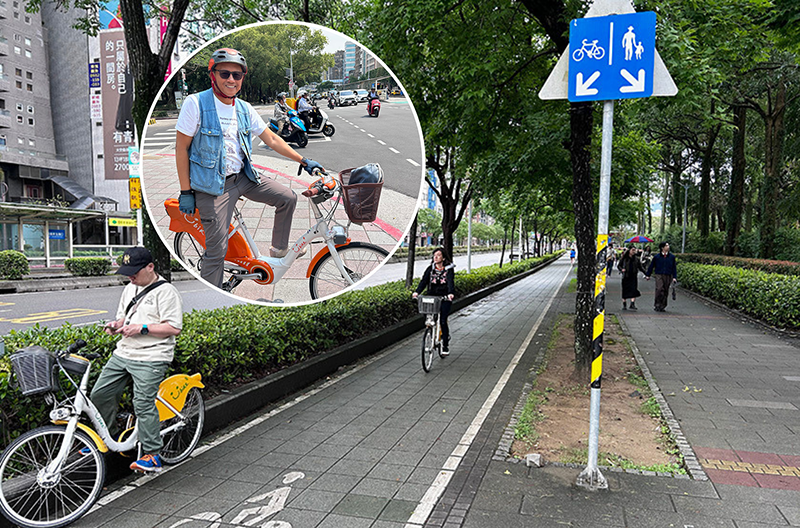
I wear a helmet whenever I bike. It has saved my head a couple of times, enough to make it non-negotiable. In the Philippines, helmets are a common sight. If I post a biking photo without one, I’ll surely be bashed for setting a bad example.
So when I came to Taiwan this Holy Week, planning to bike every day, I packed my usual helmet without a second thought.
What I didn’t expect was feeling weird about it.
Apart from my wife, who is as dutiful about helmets as I am, I saw almost no one wearing one while biking in Taipei, the capital. And this in a place where cycling is not a niche activity but a primary mode of transport, used by people of all ages and classes.
The Taiwanese are not reckless, far from it. Biking here has been so normalized, so seamlessly woven into the transport system, that it feels almost as safe as walking. If pedestrians don’t wear helmets, why should cyclists in such a place?
Lest this sound like the start of yet another rant about Philippine deficiencies, I’m not going there. We know them well enough. Instead, I ask myself: what might be possible back home, now or in the future?
In Taipei, and perhaps the rest of Taiwan, safety is not just a matter of individual behavior but collective design. First of all, bike lanes are integrated into sidewalks, not the roadways. The sidewalks are wide enough to accommodate both cyclists and pedestrians, with little obstruction — no rows of vendors competing for space.
The logic of sidewalk bike lanes is simple: pedestrians are far less at risk from cyclists than cyclists are from cars. Where pedestrian and bike lanes converge, there is a choreography of yielding that feels learned rather than enforced. In my 10 days of city cycling in Taiwan, I didn’t see a single cop needing to direct traffic. I noted no tempers flaring or raised voices. Just the calmness of expected courtesies.
That only works, of course, when space is allocated for everyone, and cars aren’t treated like royalty.
Then there is the reliable efficiency of YouBike, the omnipresent public bike-share system where you can unlock a bike — either analog or battery-powered pedal-assist — with the same beep card you use for the train and bus. The bike stations are on nearly every city block, and roving mechanics make sure each bike is usable.
Small details matter. Curbs at intersections and crossings dissolve into wide ramps. Transitions are smooth, so movement is continuous. I recall riding on Aurora Boulevard in Quezon City some years ago when my pedal hit a high curb, causing me to swerve into the way of a tail-gating jeepney, sending me to the hospital.
Here, I found myself watching elderly riders move at an unhurried pace on sidewalks, without needing to avoid curbs. When they cross streets, cars give way. Walkers and bikers wait for their green light, even when there’s no oncoming traffic.
Embedded in Taiwanese urban culture is a deep respect for shared space. The most vulnerable, like a senior cyclist or a parent with a child, usually get priority. When you can cross the street or ride a bike without fearing a road bully, the city becomes less stressful. There is peace of mind, and with it, better health, mental and physical. It’s probably no coincidence that I hardly saw anyone obese, despite their carb-rich diet.
With an epic energy crisis upon us, the lessons of places like Taipei acquire a fresh urgency. The question is not whether we can replicate them exactly, but whether we can begin to imagine streets where choosing to bike does not feel like an act of courage.
Metro Manila, vast and chaotic, would benefit immensely from safe pedestrian and cycling infrastructure. But friendlier curbs alone are not enough. Urban culture must evolve so that bike commuting is seen as simply practical and not a reflection of income class.
Smaller cities may offer a more realistic starting point: Iloilo, Dumaguete, Naga, even fast-growing destinations like Siargao and La Union. These places can still choose a different path, before car dependence hardens into habit.
Even if it feels weird here, I still wear my helmet. It reminds me where I come from. But as bare-headed cyclists pass me by, I’m also reminded that safety can be designed and learned so that it’s not a matter of luck but a way of life.

We use cookies to ensure you get the best browsing experience. By continued use, you agree to our privacy policy and accept our use of such cookies. For further information, click FIND OUT MORE.