






On free TV, my colleagues and I always have to think about "Aling Barang."
She's the imaginary viewer who represents the audience demographics that broadcast professionals must win over if we want to remain broadcast professionals.
She's a mature woman of modest means who wants to be entertained as much as she needs to be informed, watching television na nakadaster at nagpapaypay, as one colleague describes her — wearing a house dress and fanning herself.
She'll watch a public affairs program if it's interesting and important. But above all, it must be relatable and in a language she can easily understand. For the majority of free-TV viewers (or those watching over analog television without cable or the internet), that language is usually Filipino.
Those of us who have survived more than a few years in this competitive industry know the drill: Bebenta ba 'yan kay Aling Barang? Mage-gets ba niya?
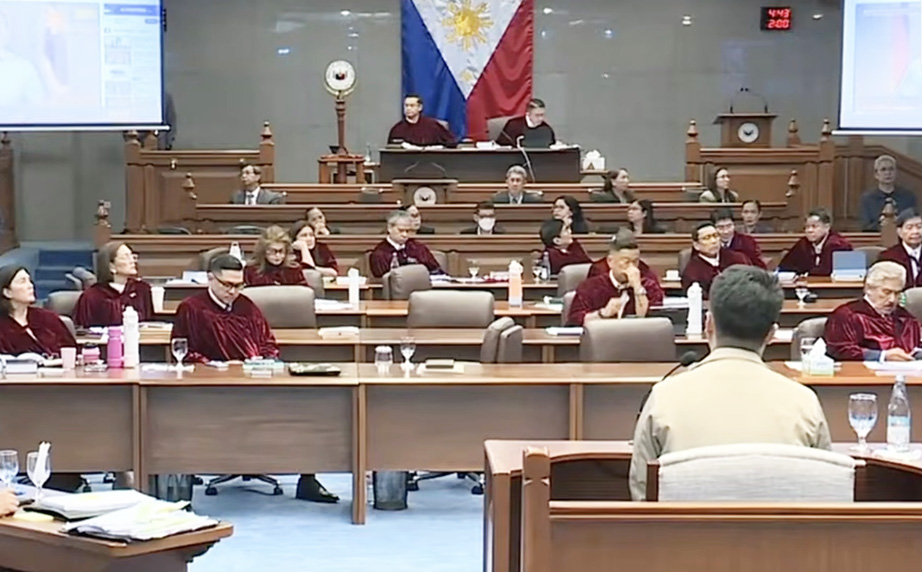
As this reality TV show called the Senate impeachment trial enters its second week, you have to wonder who the audience is supposed to be.
It's probably not Aling Barang.
No one calls me Mang Howie yet, but I had no idea what "suppletory application" meant. I wasn't even sure how to spell "suppletory." Yet there were lawyers and senator-judges debating it as if everyone watching knew what they were talking about.
Apparently, it's the legal principle that allows the Senate to borrow provisions from the Rules of Court whenever the impeachment rules leave a gap.
Then there’s the Latin.
Prosecution lawyers kept reminding everyone that the impeachment trial is sui generis, as though that's something people casually say over breakfast. Ad cautelam. Ab initio. Quantum of evidence. Latin ad nauseam.
At one point, the NBI agent on the witness stand was asked by the defense whether he knew what motu proprio meant, as though it were school recitation. To his credit, the witness knew the answer. Bonus points for him.
You can excuse legal jargon. Lawyers spend years mastering it as the medium of their realm.
But what about the "hegemonic dominance of greed"? That came from the defense's highbrow opening statement.
I rather like that the word "hegemonic” shares a couple of syllables with "demonic." But how many viewers would understand that the speaker was essentially accusing the other side of having a monopoly on greed?
More than a few observers have noted that the lawyers often sound as though they're performing — actors in a theater where the costumes happen to be robes. On the few occasions when anyone, senators included, slipped into Filipino, they suddenly sounded like ordinary human beings instead of avatars.
This is less a critique of this particular impeachment trial than of the legal profession itself.
Some years ago, I covered a baby-trafficking court case. On the witness stand was an impoverished mother who had "sold" her baby to a foreign trafficker.
The judge, the prosecutor and the defense lawyer all spoke in their flowery, exclusive language. Every few sentences, however, they had to stop so an interpreter could explain everything in Filipino to the bewildered mother. She could have been Aling Barang.
It struck me that everyone in the courtroom was Filipino. Yet someone still had to translate the proceedings so that the person whose life was most directly affected could understand what was happening. Without the interpreter, she would have remained in the dark about a discussion that could determine someone else's fate, perhaps even her own.
Our Constitution places great emphasis on social justice. Yet the language in which it is most often quoted, and the language in which our laws are overwhelmingly written, can itself become a barrier to justice. Justice cannot be fully accessible if the people in whose name it is administered need someone else in the courtroom to explain what is being said.
In the case of the impeachment trial, that explainer role belongs to journalists and their lawyer resource persons, some of the latter wielding an impressive grasp of the Filipino language, proving that lawyers can communicate proficiently to ordinary people.
This Senate actually has fewer lawyers than any other Senate under the 1987 Constitution. So perhaps the non-lawyers in the room can remind their colleagues that this proceeding is sui generis, or a uniquely political process not bound by the usual byzantine legal procedures and rules.
I had the pleasure of interviewing UP Law Associate Dean Paolo Tamase about the history of impeachment trials in the Philippines. As an example of accessible and effective language in this context, Dean Tamase pointed me to Senator Lito Lapid’s explanation of his vote in the trial of Chief Justice Renato Corona in 2012. I quote excerpts here:
“Nagpiprisinta po ako dito hindi bilang abogado, hindi po ako pwedeng magsalita ng Republic Act dahil hindi maniniwala ang tao sa akin. Hindi po ako nagmamarunong marunong dito. Ang ginagamit ko lang po konsensya, representante ng masa na hindi nakapag-aral, hindi marunong mag-Ingles, ni walang alam sa batas.
“Kaya noon pong nagsasalita si Chief Justice Corona, nagsusumbong sa taumbayan, awang-awa po ako sa kanya. Akala ko totoo ang sinasabi niya. Hindi pala.
“… Naaawa po ako sa kanya dahil naiintindihan ko po kung anong damdamin niya at sa kanyang pamilya, naranasan ko rin po yan. At sana sa pagkakataong ito, pasasalamatan ko siya dahil nung pangalawa kong panalo bilang senador, sa kanya ako nanumpa bilang senador.
“Pasensiya na po. Pasensiya na po. Pasensya na po. Ang hatol ko sa inyo, guilty.”
My caveat: While honesty about one’s ignorance can be seen as a virtue, non-lawyer senators do have an obligation to study the law. They’re lawmakers, after all. Good intentions alone can be disastrous. Yet more plainspokenness can still make this historic moment a greater learning experience for all of us.
In the 2026 trial of Vice President Sara Duterte, also a lawyer, the most accessible and best understood words, so far, may have been uttered by the respondent herself, in the video that everyone by now has seen, which was played again as part of the evidence. The words were as clear as day. No translation needed for Aling Barang.