






No bees, no food.
Bees are abuzz with a lifetime of productivity. These marvelous creatures provide the world honey, beeswax, royal jelly, and propolis with substantial uses all their life. Their role in the ecosystem is crucial, as pollinators are essential in the reproduction of crops, fruits, nuts, berries, and a long list of plants that we rely on for food.
Cebu-based beekeeper Bernice Romualdez Ocampo finds bees as the most fascinating creatures in the “whole wild world.” While there are other pollinators like birds, bats, and even some rodents and insects, Bernice considers bees to be the most important due to their “abundance, efficiency, and widespread impact on both agricultural and natural ecosystems.”
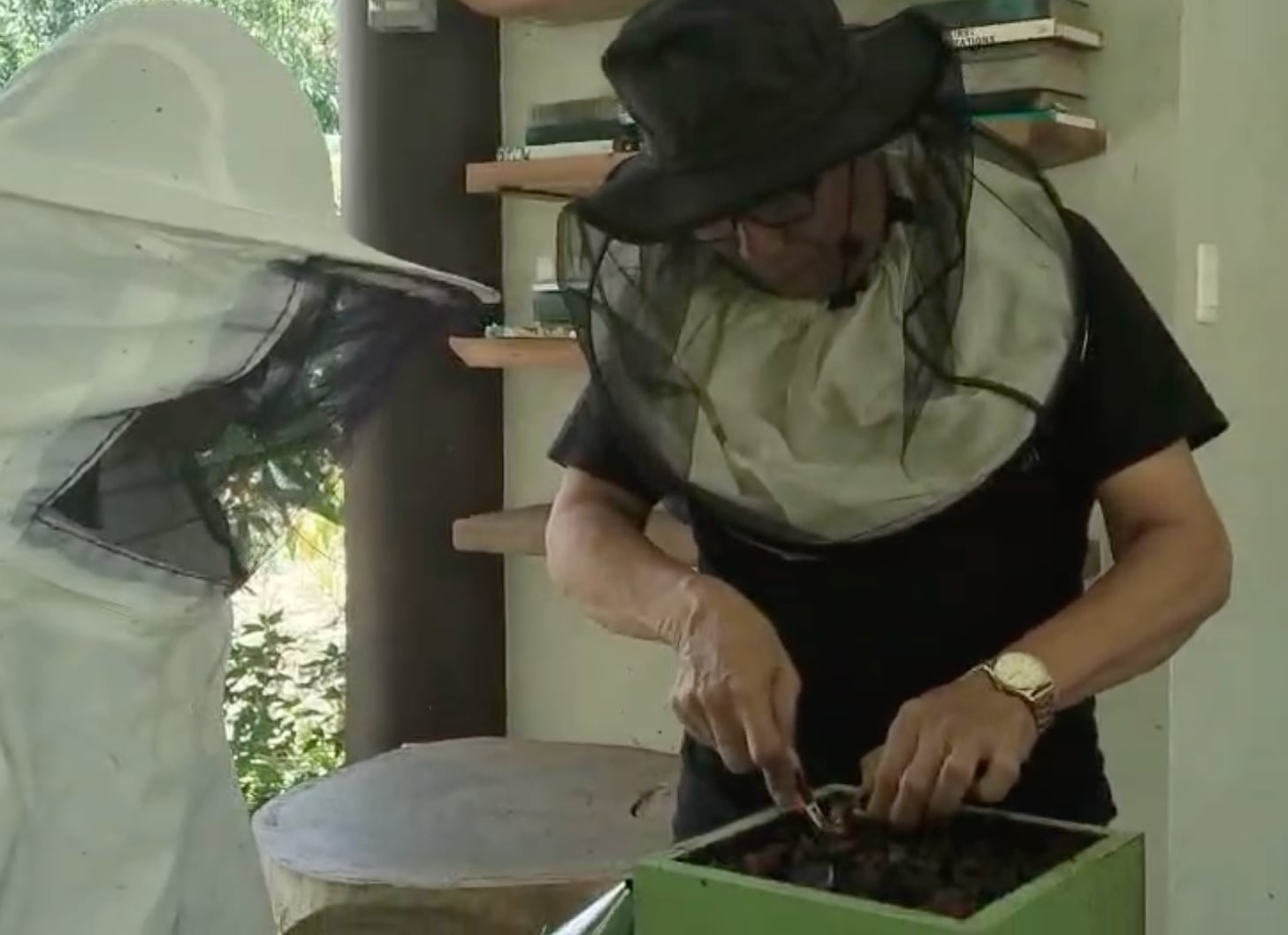
Bernice nurtures a bee farm in Barangay Bato, Toledo City, in the midwest section of Cebu Province, and learns constantly from their behavior, intricate social structures, remarkable communication patterns, and their crucial role in pollination.
Bernice considers herself a newbie yet in beekeeping, but she has sealed a precious relationship with bees. In a farm tour on July 26, 2025, Bernice showed, for a start-up, about ten wooden boxes where colonies of honeybees (Apis) thrive, and other improvised tubes made of bamboo for the hives of the endemic stingless bees referred to locally as “kiyot" (Tetragonula biroi).
“If only people have understood thoroughly the complex societies of bees, and live by way of bees, where individuals get to be the best in their tasks similar to bees, the Philippines would have been better; bees are such captivating creatures,” Bernice exclaims.
Bernice underscores her admiration for the industriousness of bees. She said that if only everyone in society works like bees, food security is guaranteed. And if everyone cares for everybody by performing their duties, there would have been abundance to benefit all, not just a few.
In other words, adopting a lifestyle inspired by the work ethic of bees, and their highly functional social structure, means high regard for collective effort, or communal work.
Bernice will be among a swarm of beekeepers, or apiarists, set to converge on August 21-23, 2025 for the 29th BeeNet Visayas Conference and its 30th Founding Anniversary.
Bernice said that it is important for a gathering of academicians, researchers, enthusiasts, experts, hobbyists, and information specialists to discuss concerns on bees, challenges, solutions, and spread of valuable information. She pointed out that people’s apparent lack of information about bees stems from challenges in information dissemination, education, and communication.
BEES IN CRISIS
No matter how crucial bees are to food security, challenges in conservation continue to mount. These challenges are exacerbated by human activities on top of environmental and climate factors.
Certain individuals and organizations will proceed with their detrimental activities - in the guise of development - because land conversions and spraying of pesticides, for example, or similar human activities with the proclivity to cut corners, rake in profits easy-peasy.
Whereas beekeeping and queen bee nurturing takes time – or forever - to make money. In fact, according to Alberto Bartolata, or simply “Bart,” an agriculturist and seasoned apiarist, it remains a struggle, especially with the use of organic methods that take a considerable period before cash rolls in.
Thus, the need to converge with academicians, researchers, specialists, and other beekeeping enthusiasts for continued learning on apiary, or the art and science of beekeeping. The convergence is a venue for extensive sharing of valuable information, best practices, insights, and available technology.
One of the least explored industry, Bart pointed out, is involving bees in forest conservation.
BEES BUZZ, FORESTS HUM
“Why do you think most reforestation programs plod, or do not take off at all?” Bart poses this question during the tour.
Bart elucidates how bees are essential insects, crucial for pollination and biodiversity: "Bees support the growth of flowers, and other plants, including trees."
But once the topic about beekeeping in the vicinity of woodlands to support reforestation is raised, none is taken seriously locally, as far as Bart knows.
“Cite any program of the government that considers bees in reforestation programs, and you will find none. This is still an area waiting to be explored,” Bart emphasizes.
In a brief discussion, it was inferred that because the sting of bees first comes to mind, people shun from them; bees are associated with the stigma --- or “sting-ma.”
Bart points out that through the conference, more individuals are expected to care about the trouble that bees go through. These are people who have a buzz of curiosity and appreciation for bees. If one cares about food, one must care for the bees first. No bees. No food.
In addition, Bart says that one of rich sources of food is the forest – a granary of a wide variety of fruits, tubers, mushrooms, roots, nuts, leaves, seeds, honey. And, by the way, honey does not spoil, as proven by centuries of studies, due to its unique properties that inhibit microbial growth. It makes bees extremely impressive.
Once bee farms thrive near forests, Bart adds, pollination activities of bees contribute immensely to forest regeneration and expansion. Further, forests guarantee bees of nesting habitats and vast foraging spaces, as bees work no end to provide food to humankind.
Bart underscores that once food security becomes the least concern of governments, the local government unit can start incentivizing people’s participation to long-term conservation of forests. The beekeeper can further earn this way.
These possibilities will be discussed thoroughly by a roster of speakers from Thailand, Australia, and Malaysia in the 29th BeeNet Conference and Technofora, and the 30th Founding Anniversary of the organization, at the Cebu Technological University (CTU) Hotel from August 21-23, 2025.
The speakers have decades of experience in apiary, and melittology (the scientific study of bees), that would further enrich knowledge and provide long-term solutions to growing concerns in the beekeeping industry.
So, make a beeline to the confab, according to Bernice and Bart, because if we care about food, we make it a duty to care about bees.