






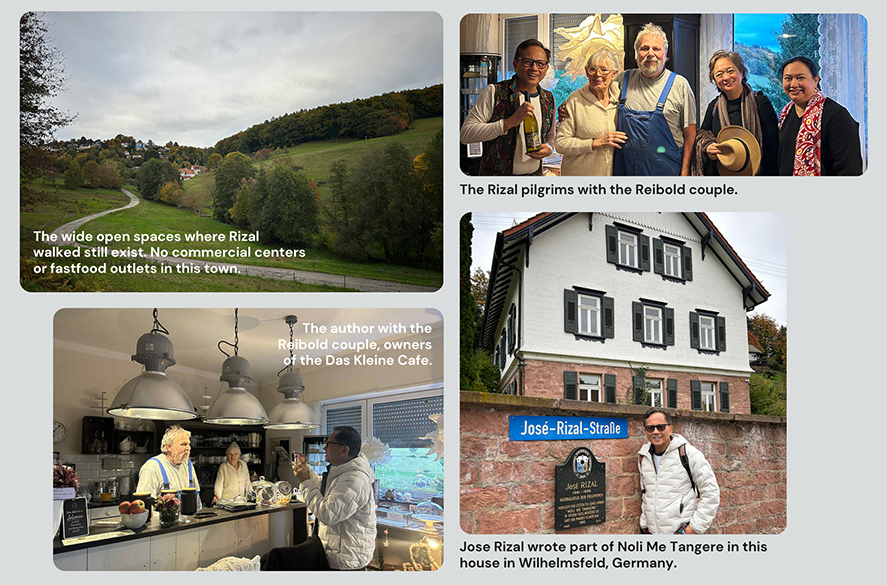
Our small, hardy band of Filipino pilgrims had been trudging through a quaint German town when we suddenly faced a universal traveler’s predicament: we needed to find a restroom.
There were no public facilities in sight on that chilly weekday, nor a soul around to ask for directions. The secluded, wooded trails nearby were beginning to look dangerously tempting.
We were in Wilhelmsfeld, the object of our pilgrimage and the mountain community where Jose Rizal had spent a formative two months in 1886 finishing Noli Me Tangere.
Just as significant, perhaps, was that Rizal boarded with Pastor Karl Ullmer, a Protestant minister, and his warm, young family. The Filipino doctor was not only learning the German language but also imbibing a kind of intellectual openness — a German sensibility that allowed people of different faiths to debate, disagree, and yet remain good friends. It was, in various ways, a living model for the diverse and cohesive nation Rizal would imagine for the Philippines.
That was of course just three decades before the first world war that tore apart Europe. But the Germany of Rizal’s time was a haven for the Filipino. It inspired him to write some of his best poetry, translate classic German literature into Tagalog, and pursue advanced ophthalmological training with some of the best eye doctors in the world. The gentle landscape was where he took long walks, perhaps mentally finetuning the dialog in Noli that would echo across generations.
He drew a comic strip for the Ullmer children featuring a suitor bowing before his love interest, only to release a powerful fart with visible fumes, causing the room to shake. The drawing, still preserved today, is proof that the martyred hero also possessed a wacky sense of humor.
If you want to find the Ullmer-Rizal house in Wilhelmsfeld, you’re told to look for the modest church, with its steeple rising into view as you walk down a steep, winding road. The house is across the church, which makes sense because the pastor’s house belongs to the church. Over the next century, it would shelter a succession of pastors and their families, until the church recently put it up for sale. Senator Loren Legarda announced last May that she was personally purchasing the house. The plan is to open a portion of it to the public as a “Sentro Rizal,” a hub of cultural learning and exchange.
When I first saw the house, even as a lonely, uninhabited shell, I felt transported to the long-ago summer when Rizal lived there, his temporary three-story home standing above a meadow now glowing with the orange and yellow leaves of autumn.
Then just 24, Rizal may have been living the best part of his life. Nearly everyone he met was charmed by his amiable personality, proficiency in languages, and encyclopedic knowledge. It was still a year before the Noli would be published, which would lead to his family’s persecution, and eventually his execution. His beloved, Leonor Rivera, was still waiting faithfully in the Philippines, not yet the heartbreak when she married another man.
In Wilhelmsfeld, Rizal was deeply cherished. The Ullmer family kept nearly everything he touched, even his doodles on scraps of paper, many of which were later donated to the Philippines. Reaching this destination felt like a milestone in my own extended Rizal pilgrimage, which began with a trip to Calamba in my youth and continued, much later, to Rizal’s residences in Paris, Madrid, Brussels, Ghent, Dapitan, and finally, this German town without a stoplight.
Drinking in the same air that enveloped our hero 139 years ago, we took the obligatory photos in front of the house and later gazed at the Rizal statue in its own little plaza.
Our hearts full, we were almost ready to head back, by taking the bus to Heidelberg, then the train to Frankfurt. But before that, there was one more task: finding a restroom. It had been more than four hours since our last point of relief.
My three fellow pilgrims — university professor Nikki, Filipino-German student Samuel, and my wife, Ipat — and I were not about to tough it out all the way to Heidelberg.
We walked on until we found a small café — alas, it was closed. But the owners, a smiling, white-haired couple, took one look at our desperate faces and kindly waved us in.
When they learned that we were Filipinos on a Rizal quest, their hospitality overflowed. They brewed us fresh coffee, served a luscious strawberry cheesecake, and even handed us a bottle of white wine, which the gentleman said was Rizal’s favorite. We tried to pay, but he only smiled and said, “Just remember us well.”
Then came the best part — a Rizal story I had never heard before. The cafe owner's great-grandfather, then the young son of the village shoemaker, had once fetched Rizal’s shoes from the Ullmer house and brought them back promptly after his father mended a small tear. As an old man, the shoemaker’s son would still tell this story about the famous Filipino.
“He was the last person in Wilhelmsfeld who knew Rizal,” said Rüdiger Reibold, our host. I noticed from the cafe’s interior that he was also a master metal artisan. “When my great grandfather died in 1965, people from the Philippines came.”
In 1886, horse-drawn transport to and from Wilhelmsfeld was scarce. I could imagine Rizal walking the 15 kilometers from Heidelberg, wearing out his shoes and needing the services of Mr. Reibold’s ancestor.
In 2025, we didn’t have to walk. In our bus to Heidelberg, we carried the warmth of the Reibold couple, strangers who became friends, connected to us across time by Jose Rizal.