






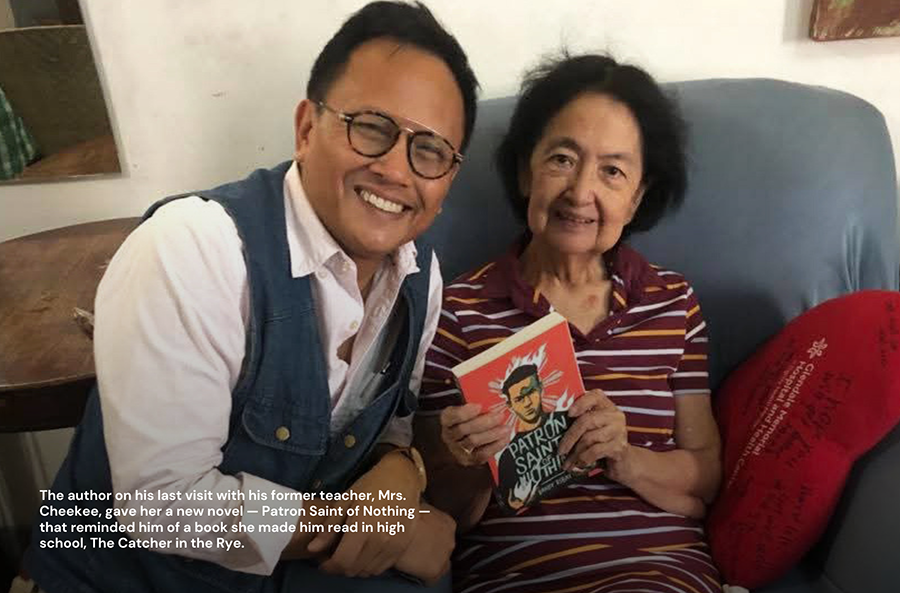
There are teachers you remember fondly. Then there are teachers you liked so much they made you want to be a teacher too.
Mrs. Ching Chee Kee was an English teacher at Ateneo High School for 41 years. My class of restless, irreverent teenagers was in fourth year when she taught us. She was in her first decade of teaching.
Whenever we got overly rambunctious (a word I learned then), I don’t recall her ever getting angry; she’d just roll her eyes and mutter, “Crazy guys…” That was one of her favorite words, crazy. And she had many occasions to use it.
More than anything else, she taught us that a love for reading and writing was one of the greatest blessings you could carry around in life.
She made us read all sorts of literature, from tough classics to stories that spoke directly to our pimply angst.
Right after college, I was still so grateful that I went back to the same school to teach for two years, in the same English department where I became her co-teacher and seatmate in the faculty room. Trying to manage, let alone teach, rooms full of rowdy boys was one of my first real responsibilities in life, and looking back now, one of the best decisions I ever made.
One of the novels we read in her class was The Catcher in the Rye by J.D. Salinger, which amazed us. Narrated by Holden Caulfield, a troubled teen around our age, the tone was conversational, confessional, and brutally honest — like the “bull sessions” we’d have about how we felt about things, usually slights caused by one classmate or another. Holden was basically having a bull session with himself.
Mrs. Chee Kee then gave us a writing assignment we’ll never forget.
She left us last week.
Made me channel my inner Holden, for her:
Let’s just say literature and I didn’t like each other in high school. At least not right away. I tried to like it, I really did. But it was all this fancy, flowery stuff that made you feel stupid if you didn’t get it.
Florante at Laura used words no dude would ever say in real life; Rizal’s novels were so complicated I just pretended I understood them; and Shakespeare — don’t even get me started — made English sound like an alien language.
It all seemed phony as hell, you know? Like those dead writers were trying to impress people who said things like juxtapose and existential.
We were just jaded teenagers who spoke in Taglish and just wanted to pass. (Well, much later, I did end up using words like juxtapose and existential.)
Then came fourth year, and this teacher, Mrs. Chee Kee. I swear, that woman had energy like she drank a thermos of coffee before every class. She’d get so excited she’d toss chalk in the air and miss when she tried to catch it. She wrote so fast on the blackboard we could barely read her scribbling. Her laugh was more of a cackle; and she always cackled at her own corny jokes. She was cheeky, pun intended. I had to look up “cheeky” when I first heard it. It’s been one of my favorite words ever since, to remind me of Mrs. Chee Kee.
Anyway, she made us read this book — The Catcher in the Rye. And man, was it different. It didn’t sound like some ancient guy talking from a pedestal. It was like someone our age who got it. This Holden Caulfield kid wasn’t trying to be deep or poetic. He just trash-talked to himself about other people, like we would. Except maybe he was a little more messed up.
We were Filipinos, not Americans, but boys our age had similar issues anywhere. Pimples the size of volcanoes. Crushes that didn’t like you back. The worry that you had stopped growing taller. The fear of showing your parents your grades. Holden would’ve understood. Then he’d declare the whole high school scene phony anyway, just to make himself feel better.
What I liked most was how the book didn’t try to tell you what you should be. It just showed you what you already were: confused, trying hard, sometimes sad, other times giddy — the whole roller-coaster teen thing. Holden could also be a real jerk, sure, but he also wanted the world to be better. Not richer or cooler. Just more honest. That hit us hard. Maybe that could be our wish too, even if we were pretentious fools ourselves in wanting to wear the same pricey, branded clothes our wealthiest classmates wore.
Mrs. Chee Kee didn’t just make us read Catcher, though. She made us write like it. Not copy it, but find our hidden Holden, by plumbing our own tangled experiences and emotions. She said, “Don’t need to be perfect. Just sound true.” So we tried. On paper, not on some computer (those weren’t a thing yet). I remember staring at my size-one pad, trying to write something real for once. It felt weird, like undressing in public.
Yet I also felt free. We didn’t have to sound like Shakespeare or Rizal or any of those guys with big vocabularies. We could just be us. We didn’t even have to show it to anyone except Mrs. Chee Kee, who didn’t bother to grade or judge it; she simply acknowledged the effort with a word or two of encouragement.
As we matured, we built on that and I realized what authenticity really is: it’s more about sincerity and not pretending, digging deep without having to sound deep, even if it comes out messy and full of slang and rambling sentences, like this one.
No one else has to see it. Just know that writing true can somehow make you a better person.
Mrs. Chee Kee, crazy as she was, taught us that.