






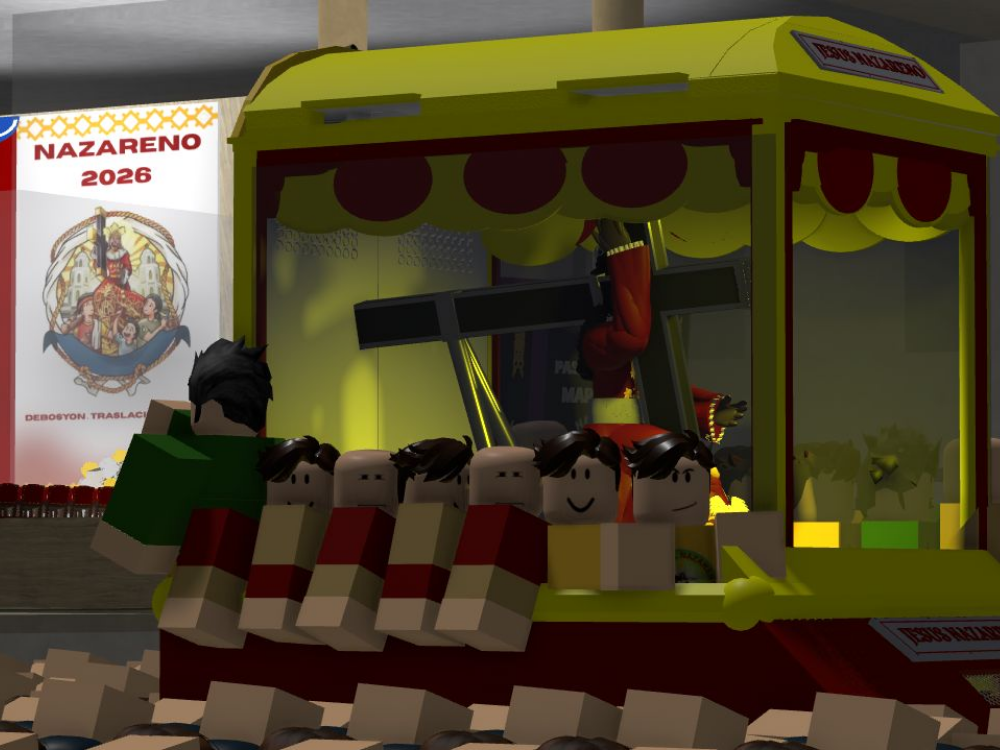
For years, religious rites have found a comfortable modern nook within the virtual realm– not via livestream– but on Roblox and other online open-world gaming platforms where users can experience virtual happenings in real time.
A 2024 report by Jiselle Casucian of GMA Integrated News suggested that the global shutdown caused by the COVID-19 pandemic (2020-2022) prompted a new creative wave of praise and worship.
This kind of devotional practice is not confined to physical interactions, one that goes beyond the affordances and limitations onsite gatherings could offer. It requires only– on top of the online faithful who inject life into these services – an online server, and digital world builders.
PREPARATION
One of these simulation builders is the Catholic Roblox Community (CRC), an active youth-oriented Catholic organization engaged in recreating worlds on Roblox.
Their primary focus is to mimic religious events like the Feast of Jesus Nazareno and allow the faithful in the digital realm to partake in the activities.
Just like in real life events, organizing a live gathering on Roblox requires rigorous planning and heavy groundwork.
“Bago po namin simulan ang mga virtual events, we have meetings, mga plano para sa mga events na gagawin sa bawat pista. Pinaghahandaan po namin ‘to months before piyesta,” said 18-year-old CRC president Jelo Amor, himself a Jesus Nazareno devotee and a native of Biñan, Laguna.
According to Jelo, CRC’s Nazareno 2026 preparations commenced in as early as October 2025, “nagkakaroon na po kami ng mga pag-uusap sa kung anu ang mga dapat gawin.”
CRC has 64 official members as of publishing– half of which are the group’s active planners and gamers who contribute in the development of the world-building mechanisms on Roblox Studio– the video game’s building tool where, quite literally, imagination is the limit.
“Sa computer po sya (ginagawa)... dun kami gumagawa ng iba’t-ibang klase ng models, systems na ginagamit sa mga event,” Jelo told GMA Regional TV News.
For Nazareno 2026, CRC put up a week-long virtual celebration highlighted by sub-events that were all patterned after the actual Feast schedule.
As per the group’s initial list of activities announced on December 28, 2025, the virtual Nazareno 2026 was to hold versions of the ‘Walk of Faith’ or the Thanksgiving Procession, Replica Procession, and Pahalik, with a virtual traslación as its main activity.
The virtual event – designed modestly to recreate the physical elements crucial to the Feast – featured a fully depicted image of Jesus Nazareno and its andas (carrier), and elaborately built locations relevant to the procession such as the Quirino Grandstand and the Ayala Bridge.
“Minsan po kaunti lang kaming nag-aayos ng mga (Quirino) Grand Stand, simbahan – madali na lang sa amin mag ayos nun kasi naglalagay lang naman kami ng mga dekorasyon,” he explained, adding that their event prep involved anticipating the ‘safety’ of the virtual andas so it would not flip, or change position.
HICCUPS
Like any other organized occasion, Roblox-hosted feasts are not immune to hiccups that are more inherent than isolated.
In what appeared to be an ‘art imitating life’ moment, CRC’s digital traslación– just like the real life 2026 procession that went down as the most arduous in history– encountered major challenges that not only slowed down the parade, but postponed pre-scheduled festivities.
Because of server errors, CRC had to move its virtual traslación from January 10 to January 11.
According to Jelo, two reasons caused the game to crash: the overwhelming number of live players entering the server, and the players’ inability to hold an organized line.
“Nung January 10, hanggang Quirino Grandstand lang kami, yung iba kasi ayaw pa humawak ng lubid kaya nahihirapan pa kami, yung lubid kasi yung mismong hahatak sa andas… so kung hindi sila lumubid napakahirap paandarin ng andas parang in real life lang,” he spelled out.
Jelo and his team could not control the number of digital devotees urging to join the in-game traslación, which, according to the 18-year-old Biñan native, could have been mitigated given that the activities were being livestreamed anyway on Facebook.
“Ang limit ng isang Roblox game ay 200, dumami nang dumami, umabot po kami sa limit tapos nagla-lag na yung game kahit wala masyadong model. Ang ending po, nai-abante naman namin yung Andas hanggang Padre Burgos lang pero hindi na umabot ng Ayala so kinansel na namin yung live,” he explained.
On top of this, there were virtual players who insisted on climbing the carriage, “may mga kabataang pilit sumasakay sa andas so pinapayagan naman namin minsan pero pag sumobra sila ng sampa, nafi-fling o lumilipad ang andas. Pero hindi naman namin sila mapipigilan sumampa dahil devotion na po yan.”
In the end, CRC was only able to hold a virtual traslación without playable in-game characters on January 11– a day after its initial schedule.
To compensate, Jelo and his team posted on Facebook photos of the fully designed traslación and the parade’s movement.
“Pero humingi kami ng sorry sa mga supporters namin na hindi natuloy, naintindihan naman po nila, at sabi namin babawi na lang kami sa ibang events ng Nazareno.”
This reflects an important realistic element in the ebbs and flows of event management. Hiccups can and will be inevitable, as these intimate faith-based executions – albeit highly modern and virtual – will still be rightfully subject to human errors.
PURPOSE
Asked why they engage in such devotional activities, Jelo said it's all about expressing their faith while taking advantage of the virtual world’s ever-expanding landscape.
“Kaya ginawa po namin ito ay para sa mga kabataan natin na hindi nakaka-attend ng mga physical mass, or mga physical events lalo na mga bata pa yung iba. Kaya hinihikayat namin sila na dito na dumalo kasi we have mga virtual mass and events,” explained Jelo.
“Bilang devotion, ginagawa po namin siya. Roblox creator po talaga ako, so gumagawa talaga ako ng mga modelo ng santo, ng kung anu-ano, dahil sa pamamanata.”
Jelo and his community of open-world gamers started as a fellowship of Catholic devotees on Minecraft, a game similar to Roblox.
The Catholic Roblox Community began working as a group with less than 10 members in August 2023.
“We had five to ten persons sa group chat po nung simula, ngayon around 60 plus na pero yung iba hindi active.”
Jelo Amor is a Jesus Nazareno devotee and attended his first ever in-person traslación during the 2026 edition of the Feast of Jesus Nazareno.
At the intersection of his Catholic devotional practice and his identity as a Roblox gamer is transcendence, or applying what he’s experienced in real life to the virtual worlds he builds on the gaming platform.
“Nago-observe kami in real life, tapos icoconduct namin yung gawain in real life sa mismong virtual game.”
Roblox gamers who wished to practice their Roman Catholicism outside traditional means have made significant strides in bringing devotionals into the digital universe.
This younger generation of Catholics– born and raised as Internet natives equipped with intuitive cyberskills– show that while methods change, there exists an enduring and persistent faith.
“Goal ko dito is tuloy-tuloy ang pamamanata, at hindi lang naman ang Nazareno ang devotion namin, marami pang ibang devotion. Gusto ko lang iparating na tuloy-tuloy lang ang devotion natin kasi lahat naman yan ay dinidinig ng Panginoon.”
Faith-based gatherings are gaining more accessibility than ever before due to technological augmentation.
It started as livestreamed masses, or Zoom fellowships and other virtual services, but in-game churches are here to stay, too.