






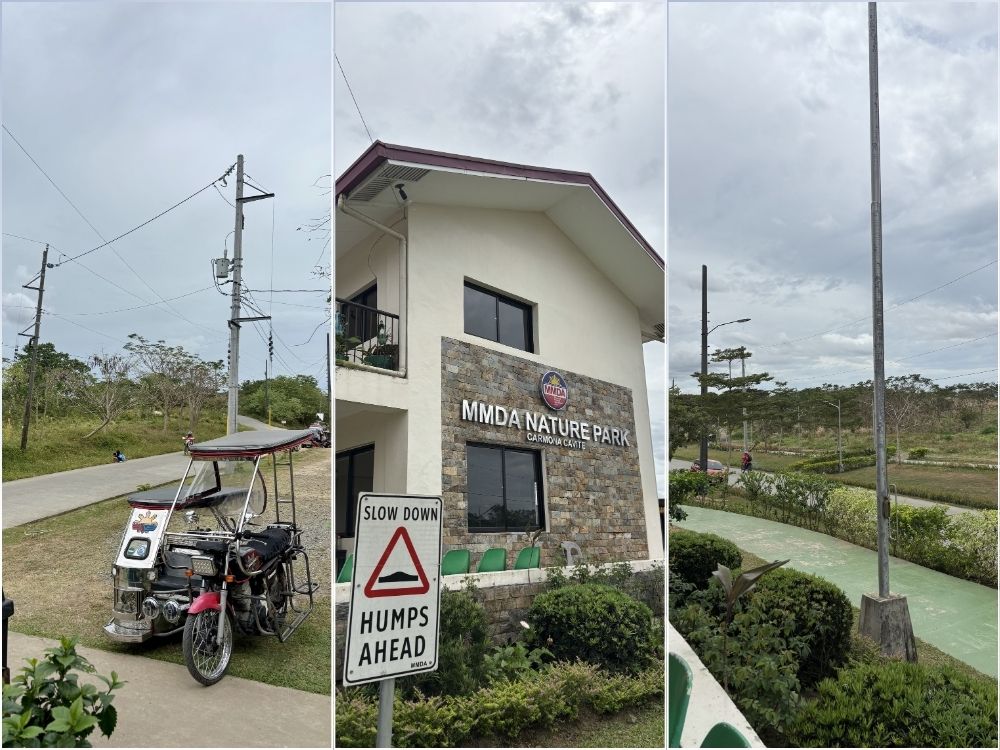
Situated in the hilly parts of Carmona, Cavite is a thriving eco park which in its past life was a sanitary landfill, or dumpster.
It is called the MMDA Nature Park– opened to the public only a few years ago– a converted ecotourism destination where visitors can walk down a trail and set up picnics while in the presence of greenery.
The park is straightforward in form: small and medium-sized trees that offer shade, a variety of thick and flowery bushes, green grass covering a huge swath of land, and a bamboo-roofed pavilion featuring an overlooking all-nature view.
There are flat grassy areas suitable for traditional outdoor-style lounging, and a dedicated walk trail. A suitably small MMDA office rests on one of the hills in the middle of the 65-acre property, where property managers and security personnel are camped.
CARMONA SANITARY LANDFILL
Before its conversion to the ecotourism destination that it is right now, the MMDA Nature Park used to be a massive MMDA-run landfill that served as a dumping site for waste coming from Metro Manila.
It operated as a landfill sometime between 1990 and 1993, but had to reportedly cease operations due to severe environmental concerns.
Local residents and other surrounding communities complained about surface and water contamination, unpleasant odor, and the inevitable persistence of garbage trucks travelling to and from the garbage site– raising the alarm on possible health hazards and diseases.
Since the closure, it was reportedly abandoned and left unused for many years.
A journal article by independent researcher Richard Dein Altarez in 2019 studied the existing land use of the former dumpster, and examined the amount of lead present in the grazing food chain.
According to the paper, the Carmona sanitary landfill was in operation between April 30, 1993 and March 31, 1998, and described the abandoned property as, at that time, "devoted to grass and shrub growth" with nearby communicities using its "abundant vegitation as a grazing area" for cattle, goat, and chicken.
It also found that the Carmona Sanitary Landfill– in a five-year-span or so– received 23 million cubic meters of wastes, including but not limited to “unsorted refuses such as household products, electronic equipment, paints, chemicals, and others” that might have most likely contaminated the land and water stream with heavy metals like lead (Pb).
Its soil, plants, insects, and chickens were tested for possible lead contamination, as the paper revealed that during the time of the study, the abandoned landfill exhibited traits suitable for conversion to a recreational park or playground, but not for grazing and planting edible crops.
Some years after the study, the Carmona Sanitary Landfill was indeed refurbished and reopened to the public as the MMDA Nature Park– an ecotourism destination in the city’s elevated portion that boasts a green space with cool winds.