






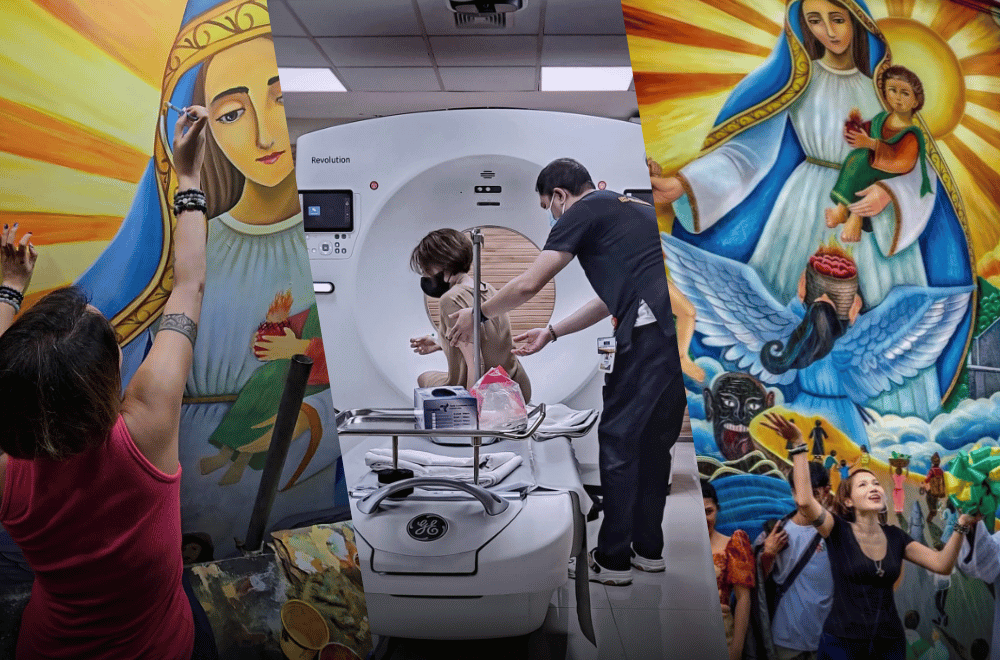
Miracles come in many forms and can come for those who believe.
For months, artist and cancer survivor Dee Jai painted a mural for Nuestra Señora de Salvacion, referred to by devotees as Iná, as she prayed that her sickness would not return. She had promised to offer her work as she asked for total healing for her and her partner. They had both battled cancer.
She imagined painting on canvas at first but decided, eventually, to work on a mural at the Nuestra Señora de Salvacion Parish in Joroan, Tiwi, Albay, where she grew up in.
While she was fulfilling her panata, Dee found herself facing another frightening possibility: that her cancer had returned.
PANATA ON PAINTING
Dee said she was inspired to make the offering because she felt she had little else to give.
“Hindi naman ako mayaman. I cannot offer anything,” she told GMA Regional TV News.
Some devotees fulfill their panata by attending Mass on a specific day for a period of time or traveling to Joroan from faraway places, she said.
For Dee, what she could offer was her art.
When a priest showed her a large white wall outside the newly renovated church, she found the perfect canvas to express her art, and her devotion.
Only later did she realize that the mural had become the very offering she had promised Iná.
“Habang tumatagal, nare-realize ko, oh, ito na pala yung panata [ko kay Iná],” Dee said.
The mural was outlined in late February 2026 and Dee started painting a month later, completing her work in May.
The mural was scheduled to be blessed and unveiled to the public on August 7, 2026.
PAINTING THROUGH FEAR
The mural was not the only thing Dee was working on during those months.
After reaching complete remission for about a year, she began bleeding again.
The symptom was frightening for someone who had already gone through the battle against cervical cancer.
In the last week of April, doctors saw something concerning during an examination. There was inflammation and what appeared to be abnormal blood vessels, and the findings were described as “suspicious.”
Dee immediately underwent a biopsy.
The result showed “atypical squamous cells,” a finding that concerned her doctors because it indicated that something abnormal was present. But the sample was not sufficient to determine fully what was happening, so doctors recommended another biopsy.
For months, Dee lived with the possibility that her cancer had returned.
She went back and forth between medical appointments and Joroan, continuing to work on the mural while waiting for answers.
The fear was so strong that she had already begun preparing herself for the possibility of another cancer diagnosis.
Still, she kept painting. She believed she had to finish the mural. After all, it was the promise she had made to Iná.
“Sabi ko tatapusin ko talaga yung mural,” she said.
LITTLE MIRACLES
August 7 came and the mural was unveiled and blessed, finally.
Just five days earlier, on August 2, Dee had undergone a loop electrosurgical excision procedure (LEEP), in which doctors removed tissue from her cervix for laboratory examination.
Typically, results would take one to three weeks to come, meaning Dee expected to spend more time waiting worrying about whether her cancer had returned.
But on the morning of the mural’s blessing, something unexpected happened.
Dee has long associated water with signs from Iná. Whenever she prayed for a sign, she said, it would sometimes come as a sprinkle or unexpected rain.
When the ribbon was cut during the mural’s unveiling, a drizzle fell from the sky. Dee took it as a sign of affirmation.
At the time, however, she did not know that another surprise was coming.
Her LEEP result was not expected to arrive for several weeks but while Dee was on her way home from the unveiling, her doctor called her with unexpected news: the result had arrived early.
It was not malignant.
Dee said her doctor told her the result was clean and that she should be healed within six weeks.
She began crying and told her doctor about the mural that had just been unveiled and how meaningful the timing was for her as a devotee of Ina.
That was when her doctor shared another unexpected detail. At that time, the doctor was in Manila, in a car. On the vehicle’s dashboard was a small image of Nuestra Señora de Salvacion. The doctor took a photo and sent it to Dee.
For Dee, the timing was overwhelming.
Since after the mural's unveiling, her bleeding had stopped.
HEAVEN IS NOT LOUD
Dee said she used to think miracles had to be spectacular, something extraordinary or impossible that would make the whole universe stop and look.
“I learned that miracles can sometimes unfold softly or gently that they're almost unnoticed,” she said.
“Sometimes, a miracle is already happening right in front of you, but you don't recognize it until you choose to believe,” she added.
Dee said faith has taught her that heaven does not always answer with something loud.
“Sometimes she whispers through rain, through people, through signs, through unexpected little moments that somehow feel too perfectly timed to be a coincidence,” she said.
250 YEARS DEVOTION
Dee's story comes as devotees mark the 250th year of devotion to Nuestra Señora de Salvacion, the patroness of Albay.
Father Joseph Salando, rector and pastor of the Diocesan Shrine and Parish of Our Lady of Salvation in Joroan, said the title refers to one of the many titles of the Blessed Virgin Mary, who is regarded by Christians as the mother of Jesus and, by extension, their mother.
“Our Lady of Salvation was declared patroness of Albay by Bishop Teotimo Pacis, the second bishop of Legazpi, on December 8, 1975,” Fr. Joseph said.
The shrine's Pilgrimage Season opens every July 1 and runs through the annual pilgrimages held until October.
But August is its highlight, with the feast of Our Lady of Salvation celebrated on the third Saturday.
The devotion continues to draw thousands of pilgrims.
Fr. Joseph said around 5,000 people were expected to come from Camarines Norte for one of the August pilgrimages, with some walking about 11 kilometers for four hours at night to reach Joroan.
Young people are also part of the tradition.
Father Joseph said about 3,500 young people attended the annual youth pilgrimage the previous year, with this year's pilgrimage scheduled for October 3.
For Dee, keeping that devotion alive among young people is important.
She remembers Joroan being much more crowded when she was young, with vehicles parked far from the church and devotees walking long distances to reach the shrine.
She now hopes art can help younger generations encounter Iná in a way that feels meaningful to them.
WHAT IS A PANATA?
For Fr. Joseph, a panata is more than a promise. It is a sacred vow made to Mary, a saint, or Jesus Christ, and one that entails sacrifice.
“An expression of love, of faith, and an expression of true love, of true faith, entails sacrifice,” he said.
That sacrifice can take different forms. For artists like Dee, it can mean offering the talents they believe God has given them. Painters spend days and weeks working, often under difficult conditions, Fr. Joseph said.
That is what makes Dee's mural an alay: not simply the finished artwork but also the time, effort, and sacrifice she gave to create it.
Fr. Joseph said miracles are, first and foremost, statements of faith, although physical healing can also be examined through science and medicine.
He said miracles can take many forms, not only healing of the body, but also healing of the soul, relationships, and personal transformation.
In Dee's case, he said, her faith, courage, family, community, science and medical care could all be part of her healing journey.
“God moves through science, doctors, medicine,” Fr. Joseph said.
He added that there are many things people cannot easily explain, but which they experience as part of the mystery of life and faith.
A MESSAGE TO THE YOUTH
Dee does not want young people to feel that faith has to be imposed on them.
She said she understands those who question, search, and look for tangible proof because she once felt the same way.
“I won't ask you to believe blindly. I only ask you to keep your heart open enough to wonder,” she said.
She hopes young people will learn to find the extraordinary in ordinary experiences, and to ask not only “Why is this happening to me?” when faced with adversity, but also “What can this teach me? What can I create from this? Who can I become because of this?”
She also wants them to develop whatever gifts they have — whether in art, intelligence, humor, writing or other talents — and use them to help others.
Dee has conducted art workshops and free art interventions for people with disabilities, Indigenous communities and communities affected by disasters.
She calls it “art with a purpose.”
For her, that is another lesson from her devotion to Iná: a gift becomes more meaningful when it becomes a blessing to someone else.
And after everything she has survived, Dee said she no longer looks for miracles only in the extraordinary.
Sometimes, she said, they arrive as rain, a medical result, a tiny image of Iná.
And perhaps, she said, faith is learning to recognize them when they do.
“If you choose to walk with Iná, don't just look for miracles... become someone who helps make miracles possible for others,” Dee said.