






Tacloban City and the rest of Eastern Visayas saw the worst in 2013.
Maximum sustained winds of 350 kilometers per hour, never experienced before in the Philippines, blew across Eastern Visayas and created a 20-foot-high storm surge.
Super Typhoon Yolanda was yet the worst storm ever to have hit the nation, but the determination to rebuild despite the unimaginable led to Tacloban City’s renaissance; proof that the human spirit is always stronger than any tempest.
Ten years went by, the memory is indelible to many. Some survivors may have chosen to leave and thrive somewhere else to escape the memory of the harrowing experience, but some survivors have stayed at home battling it out through the spirit of resilience.
The impetus to recover is potent despite the ebb and flow of memories every time survivors pass by Anibong District, the worst hit by the storm surge where thousands perished and some continue to be unaccounted for.
But while over 6,000 died and three million families suffered, they have also seen the outpouring of love from all over the country and the world. As President Ferdinand Marcos, Jr. had put it: people who helped were “moving without prompting and without hindrance and without ceasing.”
The collective strength and determination of responsive groups and individuals helped Eastern Visayas and parts of Central Visayas back on their feet.
Help continues to come through “Handa Pilipinas,” unwittingly.
If there was one thing most notable during the 10th ST Yolanda commemoration on November 8, 2023, it was the exposition of groundbreaking technologies that provide solutions while managing disaster risk reduction.
A disaster of such magnitude might take a repeat, God forbid. But contraptions and innovation are here already.
The “Handa Pilipinas” exposition by the Department of Science and Technology showcased solutions for efficient warning systems, command centers, geo-risk technology-driven software application to strengthen disaster resiliency and management, response plans, emergency response teams, and evacuation procedures; and other devices to make evacuation and other management systems more effective and efficient.
A do-it-yourself bamboo shelter, for example, measuring 24 square meters (6m x 4m), is developed to help address the need for emergency shelters during disasters.
The bamboo shelter can be assembled and disassembled within 3-4 days by four medium built workers.
It is a modular, DIY shelter that can fit in a six-wheeler truck when packed; a semi-permanent shelter for calamity-stricken areas. It is electricity and water supply ready, and that 90 percent of its materials comes from renewable sources.
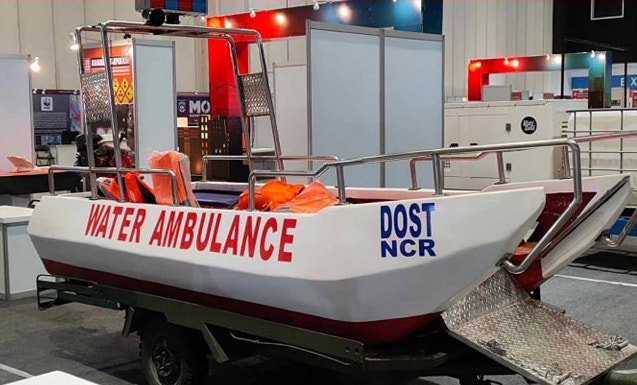
Another interesting contraption is the unsinkable water ambulance deemed beyond price, especially for rescue operations.
The water ambulance comes with the promise of high reliability with good speed and exceptional handling that even beginners in boating will find it easy to use.
There are other interesting innovation such as a collapsible toilet box, and a water purifier.
The answers to pad the further impact of erratic weather patterns upon our vulnerable communities may be far from being complete and perfect, but these are already handed over to us waiting for acceptance en masse.