






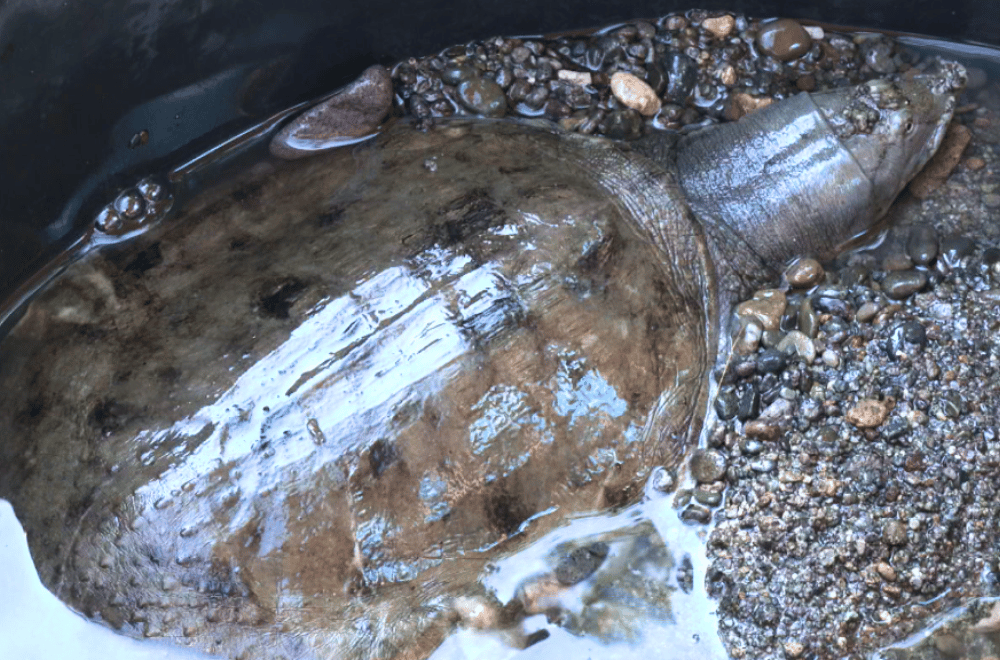
Fishermen in San Juan, La Union face dwindling fish populations reportedly because of the growing population of an invasive species of turtles, the Chinese softshell turtles also referred to as ‘ahas-pagong’.
Mario Bautista, a fisherman from Barangay Nagsabaran, said there was a time when there were plenty of fish at the Baroro River. The numbers reportedly went down because the turtles allegedly ate the fish.
“Posibleng nanganak sila, may malalaki [at] may maliliit na nakukuha… dati wala ang mga ‘yan,” Bautista said.
Four Chinese softshells, one of which was caught by Bautista, were turned over to the Coastal Underwater Resource Management Actions (CURMA), an environmental conservation Non-Government Organization (NGO).
“Ito kasi ay invasive species, hindi taga-rito sa atin. Ang nangyayari, very destructive sila; for one, wala silang predator and aggressive sila… pinapatay nila ‘yung local species, plant, and wildlife species,” Carlos Tamayo, Director of CURMA, said.
Unlike local turtles, the Chinese softshell turtle has a softer shell, a neck as long as its shell, and a long snout.
They are found commonly in rice fields, rivers, streams, and other freshwater areas, and they bite.
Tamayo said the turtles were imported into the country for food but somehow got loose and spread.
“Sa world [or global] industry, tinatawag din nila itong turtle soup, kung narinig niyo na. These turtles ay na-import sa ating bansa for food, [and] somehow nakalaya sila and kumalat,” he said.
“Napakalaking problem ito even in other parts of the country, like in Pampanga. This is a big problem now, kasi ‘yung fish industry naapektuhan nila, kasi kinakain [nila] lahat,” he added.
Besides conserving the Chinese softshell turtles, CURMA is also exploring ways to control their population.