






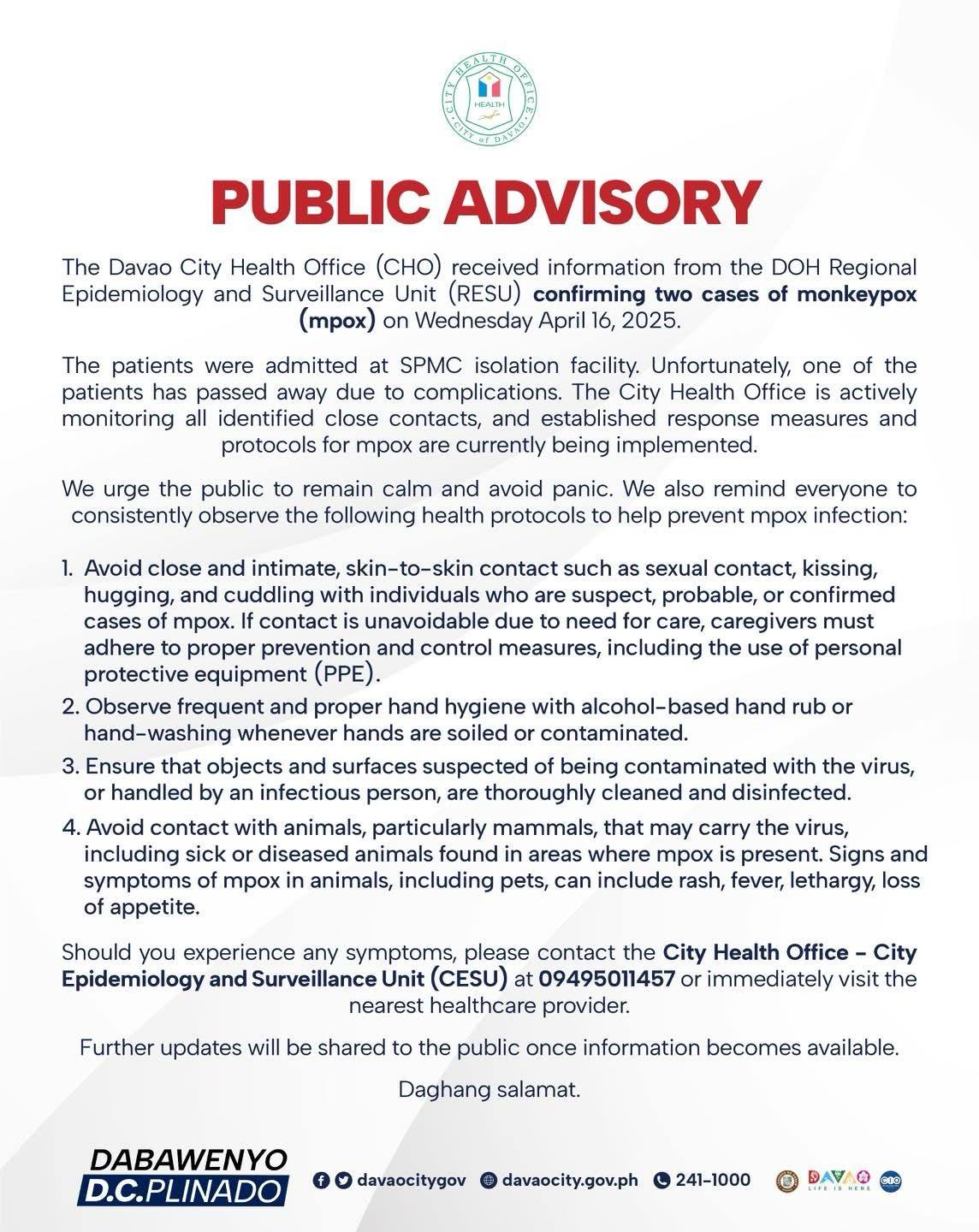
Davao City has recorded two cases of monkeypox (mpox) Clade II variant, the city government confirmed in a statement on Friday, April 18, 2025.
One of the patients passed away but the Department of Health (DOH) said the patient may have died from non-mpox complications.
In a public advisory, the local government said the City Health Office received the confirmation from the DOH Regional Epidemiology and Surveillance Unit (RESU) on Wednesday, April 16, 2025.
The advisory said the two patients were placed in the isolation facility of the Southern Philippines Medical Center (SPMC) where one of them passed away.
In a story by GMA News Online, DOH said the patient who passed away may have died "likely ....of non-mpox complications.”
DOH Assistant Secretary Albert Domingo clarified that the patient who passed away "did not succumb to mpox itself." He said the patient was in a "severely immunocompromised state and is likely to have died of non-mpox complications."
Health authorities are monitoring the patients’ close contacts and have implemented response measures and protocols.
“We urge the public to remain calm and avoid panic,” the advisory said.
The local government also reminded the public to observe the following health protocols to prevent being infected with the disease:
- avoid close and intimate, skin-to-skin contact such as sexual contact, kissing, hugging, and cuddling with individuals who are suspect, probable, or confirmed cases of mpox. If contact is unavoidable due to need for care, caregivers must adhere to proper prevention and control measures, including the use of personal protective equipment (PPE).
- observe frequent and proper hand hygiene with alcohol-based hand rub or hand-washing whenever hands are soiled or contaminated
- ensure that objects and surfaces suspected of being contaminated with the virus, or handled by an infectious person, are thoroughly cleaned and disinfected
- avoid contact with animals, particularly mammals, that may carry the virus, including sick or diseased animals found in areas where mpox is present. Signs and symptoms of mpox in animals, including pets, can include rash, fever, lethargy, loss of appetite.
The Centers for Disease Control and Prevention (CDC) said that this disease can be acquired through direct contact with body fluids or skin-to-skin contact, including touching the rash or hives of a person who has it.
They added that both clades can spread through "direct contact with infected animals," "close contact such as intimate or sexual contact with a person with Mpox," and by touching contaminated materials.
According to the World Health Organization (WHO), symptoms of mpox include skin rash or mucosal lesions, accompanied by fever, headache, muscle aches, back pain, low energy, and swollen lymph nodes.
(With reports from GMA News Online)