






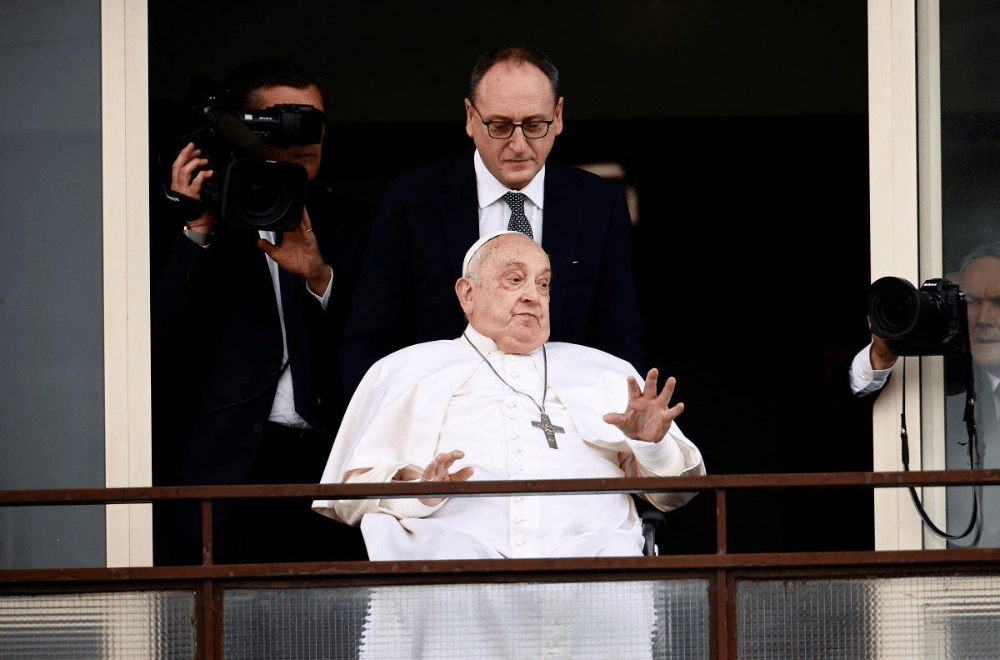
Pope Francis, the first Latin American leader of the Roman Catholic Church, has died, the Vatican said in a video statement on Monday, ending an often turbulent reign marked by division and tension as he sought to overhaul the hidebound institution.
He was 88, and had suffered various ailments in his 12 year papacy.
"Dear brothers and sisters, it is with profound sadness I must announce the death of our Holy Father Francis," Cardinal Kevin Farrell announced on the Vatican's TV channel.
"At 7:35 this morning the Bishop of Rome, Francis, returned to the house of the Father."
His death follows a series of hospitalizations and medical complications related to respiratory illnesses.
According to a report by GMA News Online, the pontiff was most recently hospitalized at Rome’s Gemelli Hospital in February 2025 for bronchitis, which later developed into double pneumonia.
His condition deteriorated rapidly in late February, with the Vatican reporting he was in critical condition after a prolonged respiratory crisis resembling severe asthma.
Doctors also noted the onset of kidney insufficiency and the need for high-flow oxygen therapy.
Despite initial signs of stabilization, his health remained fragile through March.
He suffered repeated episodes of acute respiratory insufficiency, required non-invasive ventilation, and underwent multiple bronchoscopies to relieve airway obstructions.
Though he showed gradual signs of improvement and was discharged in late March, the Vatican had warned that his clinical condition remained complex and his prognosis "guarded."
HEALTH ISSUES IN RECENT YEARS
The Pope had faced a succession of health issues in recent years.
These included chronic sciatica, recurring colon inflammation (diverticulitis), knee and ligament injuries, and a hernia surgery in 2023.
He also battled pneumonia in late 2023 and suffered a fall in early 2025 that injured his forearm, as documented in multiple reports by GMA News Online.
Despite these setbacks, Pope Francis remained spiritually active until his final weeks.
He continued to issue public messages from his hospital bed, expressing solidarity with fellow patients and gratitude for prayers offered worldwide.
One of his final messages, sent days before his discharge from Gemelli Hospital, reflected on illness as a shared human experience: “Our bodies are weak but, even like this, nothing can prevent us from loving, praying, giving ourselves, being for each other, in faith, shining signs of hope,” the Pope wrote.
HISTORY
Jorge Mario Bergoglio was elected pope on March 13, 2013, surprising many Church watchers who had seen the Argentine cleric, known for his concern for the poor, as an outsider.
He sought to project simplicity into the grand role and never took possession of the ornate papal apartments in the Apostolic Palace used by his predecessors, saying he preferred to live in a community setting for his "psychological health," according to a report by GMA News Online.
He inherited a Church that was under attack over a child sex abuse scandal and torn by infighting in the Vatican bureaucracy, and was elected with a clear mandate to restore order.
But as his papacy progressed, he faced fierce criticism from conservatives, who accused him of trashing cherished traditions. He also drew the ire of progressives, who felt he should have done much more to reshape the 2,000-year-old Church.
While he struggled with internal dissent, Francis became a global superstar, drawing huge crowds on his many foreign travels as he tirelessly promoted interfaith dialogue and peace, taking the side of the marginalized, such as migrants.
Unique in modern times, there were two men wearing white in the Vatican for much of Francis' rule, with his predecessor Benedict opting to continue to live in the Holy See after his shock resignation in 2013 had opened the way for a new pontiff.
Benedict, a hero of the conservative cause, died in December 2022, finally leaving Francis alone on the papal stage.
Francis appointed nearly 80% of the cardinal electors who will choose the next pope correct as of February 2025, increasing the possibility that his successor will continue his progressive policies, despite the strong pushback from traditionalists.