






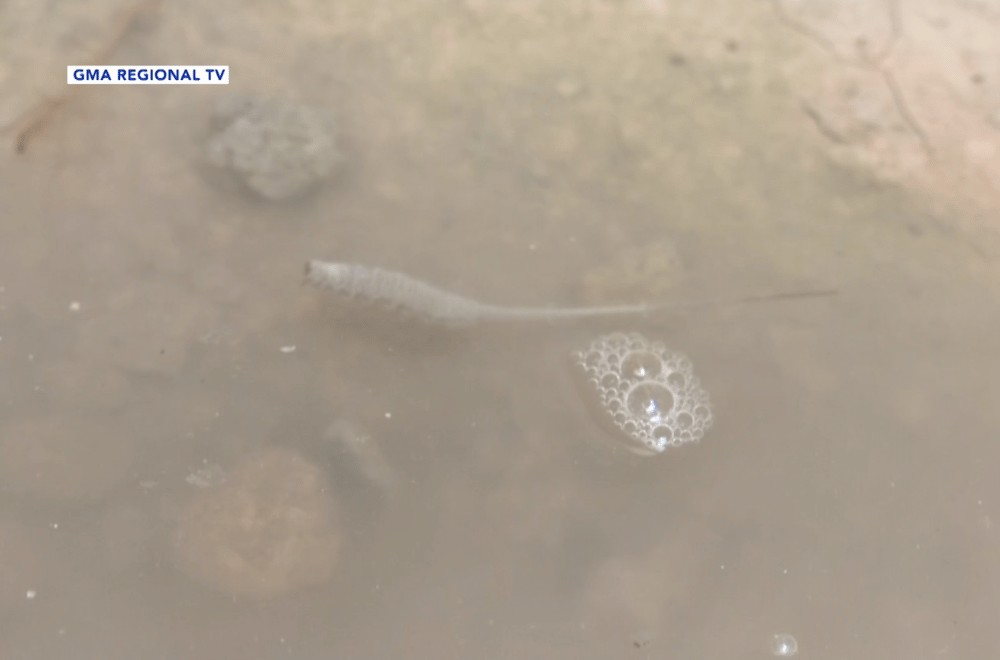
What was supposed to be a regular day of doing laundry turned unsettling for a woman in San Fernando City, La Union after spotting dozens of strange, squirming worms in the water, with tails sticking out above the surface.
Esperanza Albaytar, a resident of Barangay San Fernando, said she first saw the strange creatures near their water pump while washing clothes.
Shocked by the movement, she took a closer look.
“Naglalaba po ako nung time na ‘yon. May nakita po akong may gumagalaw doon sa may mga naipong tubig,” she said.
“Last night chi-neck ko ulit, mas madami sila. Napansin ko din ‘yung buntot nila, nasa labas ng tubig, nakaangat siya. Siguro doon sila nagbi-breed o doon na lang humihinga sa buntot na ‘yon,” she added.
She posted a video of the worms in a Facebook group, where people reacted with both curiosity and fear.
Experts later identified the creatures as rat-tailed maggots, the larval form of the Eristalis tenax or drone fly, which resembles a honeybee when fully grown.
“Tinawag na drone fly kasi kahawig siya ng honeybee. Hindi siya peste. Mako-consider nga natin siyang beneficial organism kasi pollinator siya,” April Marinay, an entomologist, said.
The maggots get their name from their long “tails,” which are actually breathing tubes that let them take in air while submerged.
“Ito ay tube na ginagamit nila para makahinga sila sa tubig. It can extend up to 10 times the length of the body para makarating sa air,” Marinay added.
While the maggots themselves are not harmful to humans, experts warned that they often live in dirty, stagnant water, which could carry bacteria that contaminates food or drinking water.
“Posibleng present na rin doon ang mga lamok, ang mga langaw. And eventually i-invite niyan ang mga daga, ang mga ipis,” Marinay said.
“Ang makakapag-correct nito ay sufficient na sanitation. Hindi man siya peste, but again, this is an indicator that we have a problem in our water,” she added.