






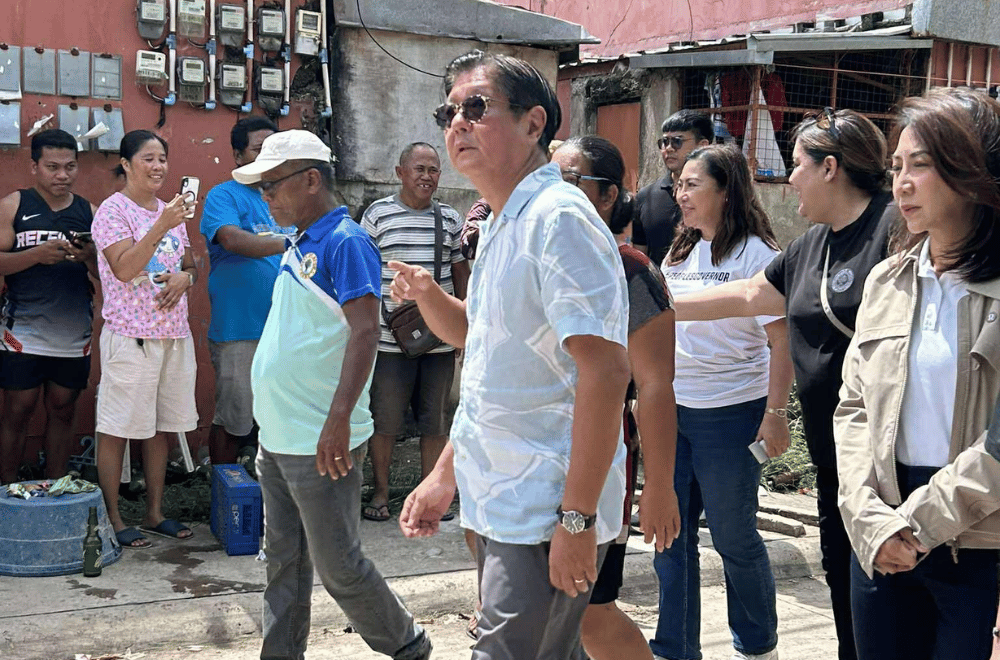
President Ferdinand Marcos, Jr. arrived in Bogo City, Cebu on Thursday, October 2, 2025, to check on communities affected by the magnitude 6.9 earthquake that struck northern Cebu on Tuesday, September 30, 2025.
Governor Pamela Baricuatro led Cebu officials in accompanying the President during his site visit, which included the Yolanda Housing Village in Barangay Polambato, a relocation site for survivors of Super Typhoon Yolanda.
The village was badly damaged by the tremor, and reports said at least eight bodies have been recovered from collapsed houses in the area.
The President was joined by Cabinet members, including Public Works Secretary Vince Dizon, Tourism Secretary Christina Frasco, and Social Welfare Secretary Rex Gatchalian.
Marcos said the Office of the President will donate P50 million to Cebu Province and P20 million each specifically to Bogo City, Sogod, and San Remigio - three of the local government units affected severely by the earthquake.
At least P10 million each will be given to Bantayan, Daanbantayan, Madridejos, and Medellin.
Earlier, Defense Secretary Gilberto Teodoro, along with other key officials, had already been dispatched to the Command Center in Bogo City to lead the government’s response following the President’s directive.
Vice President Sara Duterte also visited northern Cebu evening on Wednesday, October 1, where she met with Medellin Mayor Edwin Salimbangon and distributed relief goods in neighboring San Remigio town.
RESPONSE
Government agencies have begun distributing food, water, medicine, and emergency supplies to affected areas.
The Department of Social Welfare and Development has so far allocated P264.96 million worth of assistance, while health teams and medical supplies from the Department of Health have been deployed.
The Department of Public Works and Highways (DPWH), the Metropolitan Manila Development Authority (MMDA), the Department of Energy (DOE), and the Department of Information and Communications Technology (DICT) are working on road clearing, restoring electricity, and reconnecting communications.
DEATH TOLL REACHES 72
According to the National Disaster Risk Reduction and Management Council (NDRRMC), the death toll from the quake has risen to 72, with nearly 300 people injured. More than 47,000 families, or around 170,000 individuals, have been affected, with at least 20,000 displaced from their homes.
Search, rescue, and relief operations continue under the Bureau of Fire Protection (BFP) and Philippine National Police (PNP), as of press time.
Meanwhile, the Philippine Institute of Volcanology and Seismology (PHIVOLCS) reported that aftershocks have reached 2,461 as of Thursday morning.
The strongest, a magnitude 5, occurred at 10:46 p.m. Wednesday. PHIVOLCS warned that aftershocks may continue for several days to weeks but are expected to weaken gradually.
The earthquake, which struck offshore near Bogo City on September 30, is the strongest ever recorded in northern Cebu. It produced Intensity VII shaking in Bogo City, Daanbantayan, Medellin, San Remigio, and Tabuelan.
(With reports from John Kim Bote, dySS Super Radyo Cebu)