






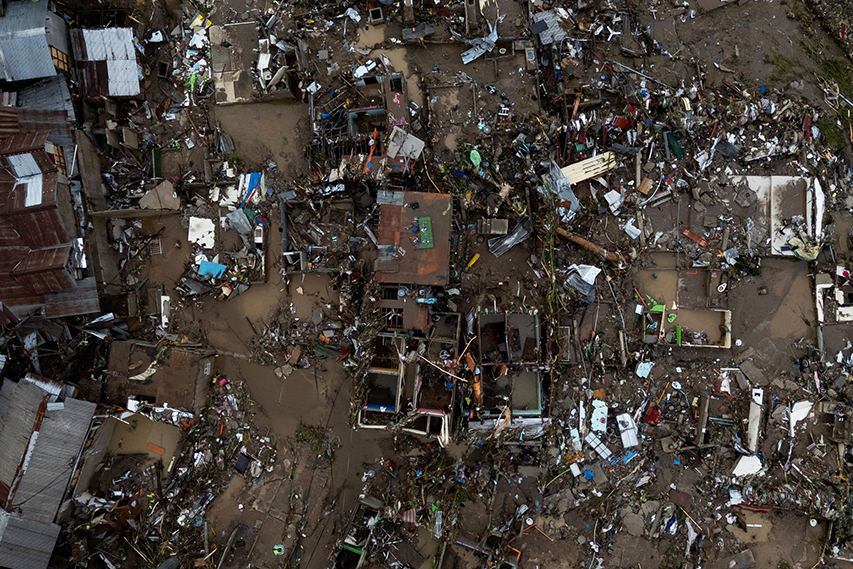
More than 24 hours since Typhoon Tino unleashed its wrath on Cebu, the island logged at least 111 deaths in different towns and cities.
Data released by the Cebu Provincial Government and mayors of different local government units on November 5, 2025 showed Liloan topping the list with 35 deaths.
- Liloan – 35
- Compostela – 25
- Cebu City – 12
- Mandaue City – 12
- Danao City – 9
- Talisay City – 7
- Balamban – 6
- Asturias – 2
- Consolacion – 1
- Bantayan – 1
- Tabogon – 1
Governor Pamela Baricuatro said the province has sought reinforcement from the national government because local responders have been maxed out, considering they, themselves, are victims of the typhoon.
“Nangayo ta’g reinforcement sa national kay maxed out gyud kaayo ang atong mga responders because, of course, ang Cebu City sad, nanginahanglan sad sila’g tabang. So we’ve already talked to Malacañang yesterday regarding sa reinforcement sa mga responders… so we also talked to Secretary Teodoro, DILG, so that’s why nagpadala sad sila’g responders from Coast Guard, AFP, PNP, Philippine Navy,” Baricuatro said.
President Ferdinand Marcos, Jr. is reportedly set to check the situation in Cebu personally.
The governor also convened representatives from the energy sector, communication and telco, and water to find ways to restore supply of basic services.
“We want to restore power and water as soon as possible, so mao na atong priority karon, aside sa ongoing rescue operations,” Baricuatro said.
In line with the province’s relief and recovery efforts, the Provincial Board has supported the executive order Baricuatro issued placing the province under a state of calamity. The governor said the declaration is necessary to enable the province to access calamity funds quickly, control prices of goods, and expedite relief and rehabilitation efforts, pursuant to the Philippine Disaster Risk Reduction and Management Act of 2010.
Tino made landfall in the northern town of Borbon at 5:10 a.m. on Tuesday, November 4, 2025, and brought with it heavy rains and dangerous winds.
Torrential rains dumped on Cebu caused massive flooding in many parts of the province, including in Liloan where a video footage showed residents of Barangay Jubay going up the roof of their houses to avoid getting carried away by floodwaters.
Those who died in another barangay, Cotcot, drowned in raging floodwaters at the height of Tino’s presence in Cebu between 4 a.m. to 7 a.m. on November 4.
A resident, Amy Bobo, shared how her family struggled to survive the flood. Unfortunately, her five-year-old child was carried away by floodwaters.
In Mandaue City, a video taken by a resident of a residential compound in Barangay Umapad showed vehicles getting submerged in floodwaters. An establishment in the city had to siphon floodwater out of its basement where cars have been trapped and submerged.
In Talisay City, hundreds of houses in a community along the Mananga River were destroyed when the river overflowed. At least 1,088 individuals from 262 households were displaced.
In Cebu City, floodwaters reaching 12 feet in Villa del Rio 1 carried vehicles away. According to residents, the torrential rain caused the creek nearby to overflow and triggered the flooding.
PAGASA ANALYSIS
Data released by PAGASA on November 5 showed that Tino produced a significant amount of rainfall in the Visayas region.
“The rainfall amount exceeded 20-year return period in many areas of the Visayas,” PAGASA said, adding, that widespread flooding was imminent in low-lying areas in Central Visayas on November 4.
“A 20-year return period means that in any given year, there is a 5% (or 1/20) chance this extreme rainfall event (or worse) could occur,” PAGASA said.
In Cebu island, however, areas with recorded water level exceeding critical level based on PAGASA’s automatic rain gauge (ARG) do not include those with recorded deaths. These include Bagakay, Toledo with 428 mm; Ilihan, Toledo with 300mm; Danao City with 183 mm; and the Mactan Synoptic Station in Mactan Island with 183 mm.
The significant flooding triggered by extreme rain, PAGASA said, resulted in loss and damage to property and livestock, and even loss of lives.