






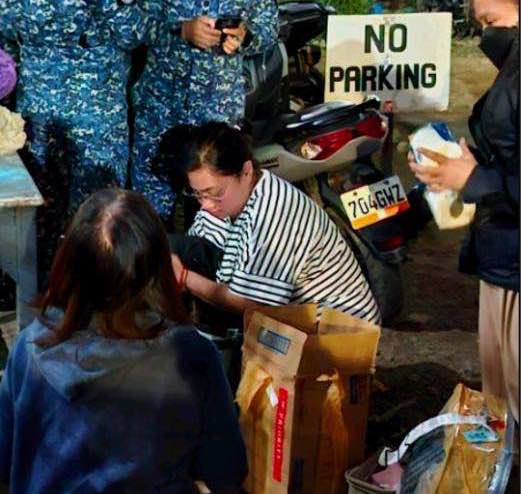
Controversial contractor Sarah Discaya was committed to the Lapu-Lapu City Jail along with eight officials of the Department of Public Works and Highways (DPWH) Davao Occidental dawn on Saturday, December 20, 2025.
Discaya and her co-accused arrived separately at the Mactan Cebu International Airport (MCIA) on December 19, after warrants of arrest were issued to them by the Regional Trial Court (RTC) Branch 27 for their involvement in anomalous flood control projects in Davao Occidental.
Two of eight DPWH engineers arrived at around 3 p.m. on December 19. They were taken immediately to the RTC Branch 27 at the Lapu-Lapu City Hall of Justice.
Discaya arrived past 6 p.m. who was also immediately ushered into the RTC Branch 27.
Security was tightened at the Hall of Justice upon her arrival.
Four DPWH officials arrived at the said court past 7 p.m.
The accused from Davao Occidental would have been cooped in one flight. However, an airline policy directed that the accused should board the flight in pairs at a time, which led to their rescheduled flights.
The remaining pair arrived later and proceeded to the court for the return of warrants.
In a statement of the legal counsels of seven of the eight DPWH officials, the concrete revetment project in Barangay Culaman, Jose Abad Santos town is no “ghost,” citing that the project is operational.
The counsels described their clients to be “collateral damage" in the flood control project controversy in the country.
GMA Regional TV Balitang Bisdak, in an interview with the lawyers, said that their clients are affected in the transfer of the case to Cebu. Four of their clients are senior citizens.
“We believe that since the alleged crime is committed in Malita, Davao Occidental, we think the proper venue should be in Malita, Davao Occidental…since there is a graft court in Davao City we believe that it should be tried there,” said Atty. Paul Tristan Sato.
“As to the detention, we are exploring the best place to detain them to emphasize and maximize their safety and security,” according to Atty. Frank Dinsay, the other counsel of the 4 DPWH officials.
Meanwhile, prior to Discaya’s detention, her children were given the opportunity to be with their mother. Her children visited her at the Hall of Justice while the commitment order was processed.
The accused left the Hall of Justice by midnight for their medical examination after the processing of their commitment order. They were taken to the Lapu-Lapu City Hospital for their check-up. The medical procedure took about two hours inside the Emergency Room (ER).
They boarded the National Bureau of Detention (NBI) prison van at about 2 a.m. toward the Lapu-Lapu City Jail in Sitio Soong, Barangay Mactan.
At past 2 a.m., the van reached the jail facility and entered the compound.
Members of the media were prohibited entry inside the facility. However, in a video and photograph released by NBI 7, Discaya was seen preparing her personal belongings for entry in the facility.
Personnel of the Bureau of Jail Management and Penology (BJMP) 7 facilitated a standard inspection of the belongings.
“Ang three females including Mrs. Discaya sa female dormitory, while the six male accused sa male dormitory. [Reporter: Unsa ni RD sagol sila sa uban?] Yes, kasama sila walang special room for them kasama ng lahat ng detainees ng Lapu-Lapu, yun ang pag-uusap namin sa head ng BJMP 7 walang special treatment, yun ang utos ng Secretary of Justice natin - Sec. Frederick Vida, walang special treatment,” according to Atty. Rennan Augustus Oliva, NBI 7 director.
Oliva said that the RTC Branch 27 is the first court that acquired jurisdiction of the accused. Should there be other courts that would order the arrest of the involved, for example of Discaya, certain arrangements will be made.
“The first court who acquired jurisdiction is Branch 27 because they are the first court that issued warrant of arrest against Mrs. Discaya as well as eight DPWH Davao engineers. [Reporter: So kung may ibang court na mag- atubang sila’g kaso, video call lang appearance?) Video, unless extremely needed by the court but normally video conferencing,” Oliva pointed out.