






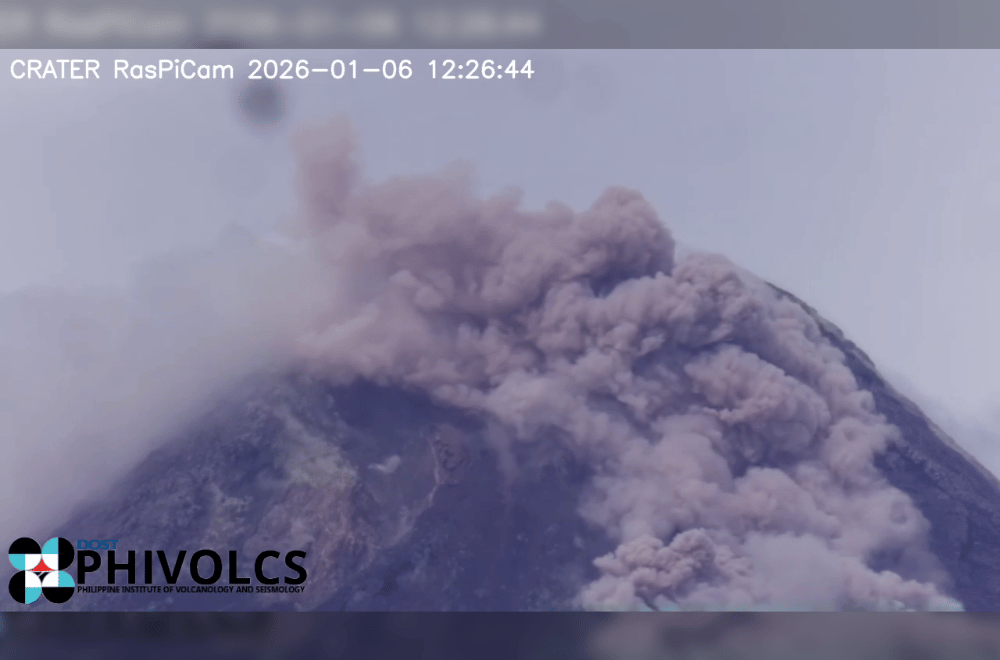
State volcanologists raised Mayon Volcano’s alert status to Alert Level 3 on Tuesday, January 6, 2026, after the collapse of a growing lava dome triggered dangerous pyroclastic density currents, or “uson,” on the volcano’s slopes.
In a bulletin issued at 1:20 p.m. on January 6, the Philippine Institute of Volcanology and Seismology (PHIVOLCS) said Mayon’s alert level was raised from Alert Level 2 due to an increased tendency toward a hazardous eruption.
PHIVOLCS said repeated collapse of the unstable summit dome has produced an increasing number of rockfall events since the alert level was raised to Level 2 on January 1. A total of 346 rockfall events and four volcanic earthquakes were recorded from January 1 to 6, compared to 599 rockfall events logged from November to December 2025.
The agency said the volume of rockfall debris increased on Monday, with nighttime incandescence observed, signaling faster dome growth and the extrusion of new lava at the summit crater.
At 12:26 p.m. on Tuesday, pyroclastic density currents were generated along the Bonga Gully on the southeast side of the volcano following the collapse of newly extruded lava. PHIVOLCS said the PDCs lasted at least three minutes and traveled up to two kilometers from the summit crater.
Sulfur dioxide emissions remained at background levels, but ground deformation data showed continued inflation of Mayon’s eastern and southeastern slopes, indicating ongoing magma movement. PHIVOLCS said these parameters point to a slow but increasing effusive magmatic eruption.
With Alert Level 3 in effect, PHIVOLCS warned of higher chances of lava flows, rockfalls, and hazardous pyroclastic density currents affecting the upper to middle slopes of the volcano, as well as possible explosive activity within days or weeks.
Authorities recommended the evacuation of the six-kilometer Permanent Danger Zone due to the risk of PDCs, lava flows, and other volcanic hazards. Increased vigilance against lahars and sediment-laden streamflows was also advised, especially during heavy rain.
PHIVOLCS said ashfall may likely affect areas on the south side of the volcano based on prevailing wind conditions. The agency also advised civil aviation authorities to ensure that aircraft avoid flying close to Mayon’s summit, as ash from sudden eruptions could pose a danger to flights.
Earlier, authorities had already imposed flight restrictions around Mayon and reviewed evacuation plans in Albay as the volcano showed signs similar to those observed before its 2023 eruption.
PHIVOLCS said it continues to closely monitor Mayon Volcano and will release updates as new developments occur.